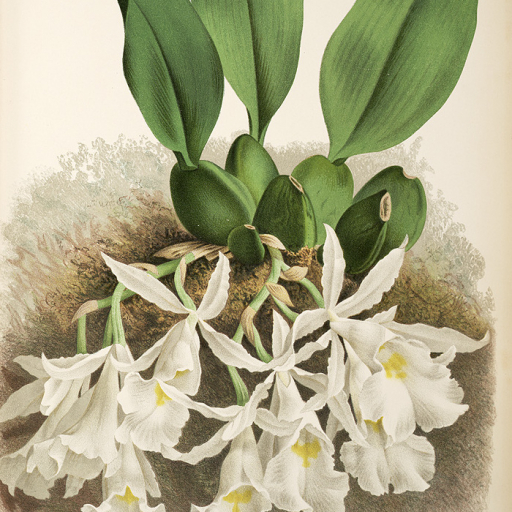
Plant Overview
Known as the "Sweet Trichopilia," this orchid is a true sensory masterpiece for any indoor garden. Hailing from the misty cloud forests of Central America, it is legendary for its intoxicating fragrance—a spicy, sweet perfume that can easily fill an entire room. It is often a favorite among collectors who enjoy the "snowy" appearance of its frilled, spotted blooms.
🔍 How to Identify
- 🌸 The Bloom: Features large, pendulous flowers that are creamy white and heavily freckled with raspberry-pink or ruby-red spots. The "lip" of the flower is notably large and ruffled.
- 🍃 The Foliage: A single, broad, and leathery leaf grows from the top of each pseudobulb, providing a deep green backdrop to the pale flowers.
- 🥔 The Pseudobulbs: These are uniquely flattened, oval-shaped structures at the base of the leaves that act as water reservoirs for the plant.
🏡 In Your Garden
- ☁️ Humidity is Key: Because it originates in high-altitude forests, this orchid craves high humidity and excellent air circulation. If the air is too dry, the new leaves may grow with "accordion" crinkles.
- 🪴 Breathable Roots: It has a "fine-root" system that hates stale or soggy conditions. It thrives best in a very airy bark mix or mounted on cork, as long as it is watered frequently enough to stay slightly damp.
⚠️ Safety & Toxicity
- 🐾 Pet Friendly: Trichopilia suavis is generally considered non-toxic to cats, dogs, and horses, making it a safe choice for pet-filled households.
- 🛡️ Sensitive Skin: While not poisonous, some people with sensitive skin may experience mild irritation if they handle the roots or sap frequently. It’s always best to wash your hands after pruning.
✨ Fun Fact
The scent of Trichopilia suavis is so complex that scientists have compared it to a mixture of spicy cloves and Lily of the Valley. In its native Costa Rica, it is often celebrated as one of the most fragrant wild flowers in the country!

Detailed Care Instructions

Some plants require more regular watering than others, which should be done every few days. It's critical to maintain the soil moist all of the time. The water requirements of the same plant placed in pots with varying sizes will differ. Because the water in the smaller pot evaporates faster than the water in the larger pot, it will require more watering. Regardless of pot size, the surface should constantly be maintained moist.








