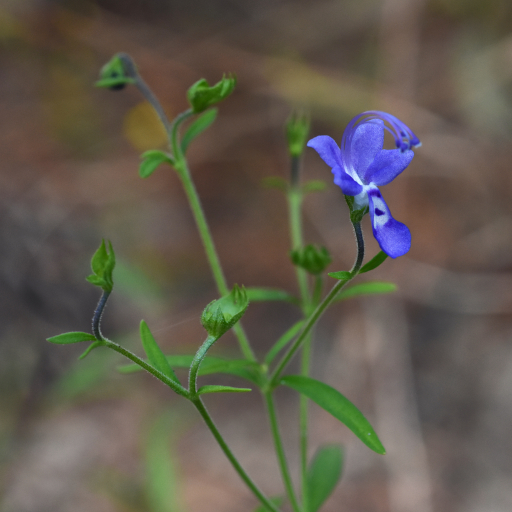
Plant Overview
Often called the Narrowleaf Bluecurls, this delicate annual is a hidden gem of the sandy pine barrens and open woodlands of the Eastern United States. Its most striking feature is its tiny, violet-blue flowers that look like they’ve been accessorized with long, elegant eyelashes. While small and spindly, it creates a misty blue haze in the late summer landscape, serving as a vital late-season nectar source for native bees.
🔍 How to Identify
- 🌸 The "Curls": The plant is named for its four long, violet stamens that arch dramatically out of the flower in a graceful curve.
- 🌿 Needle-like Foliage: Unlike its broader-leaved cousins, T. setaceum features very narrow, linear leaves that are almost needle-like and grow opposite one another along the stem.
- 🟩 Square Stems: True to its membership in the Mint family, the stems are distinctly four-sided and covered in tiny, sticky glandular hairs that release a faint, herbal aroma when touched.
🏡 In Your Garden
- ☀️ Sun and Sand: This plant thrives in "difficult" spots where other flowers might wilt. It demands fast-draining, sandy or gravelly soil and full sun to mimic its native scrubland habitat.
- 🐝 Pollinator Engineering: The unique curve of the stamens is a specialized evolutionary trick; when a bee lands on the lower lip of the flower, the stamens "spring" down to precisely dapple pollen onto the bee's back.
- 🌱 Disturbance Sensitive: It has a delicate root system and generally resents being moved once established. It is best grown from seed directly in its permanent home, where it will happily self-sow for the following year.
⚠️ Safety & Toxicity
- ✅ Non-Toxic: Trichostema setaceum is generally considered safe and is not listed as a toxic plant for humans, cats, or dogs.
- 👃 Strong Aromatics: The plant contains potent essential oils typical of the Mint family. While not harmful, the pungent scent and sticky residue can be overwhelming to some, so it’s best enjoyed as a visual treat rather than a culinary one.
✨ Fun Fact
The genus name Trichostema is derived from the Greek words thrix (hair) and stema (stamen), a literal description of those incredibly fine, hair-like purple curls that make the flower so distinctive.

Detailed Care Instructions
To grow Trichostema setaceum, also known as the blue curls or slender vervain, you can follow these steps:
- Climate and location: Trichostema setaceum is native to California and requires a Mediterranean or dry climate. Ensure that your location has similar conditions with mild winters and dry, hot summers.
- Soil preparation: The plant prefers well-draining soil with average fertility. Sandy or loamy soil works best. Amend the soil with compost or well-rotted manure to improve the drainage and nutrient content.
- Choose a sunny spot: Trichostema setaceum thrives in full sun. Select a location in your garden or yard that receives at least six hours of direct sunlight each day.
- Sow seeds or purchase seedlings: Trichostema setaceum can be grown from seeds or purchased as seedlings. If starting from seeds, sow them directly into the prepared soil after the last frost date or start them indoors 6-8 weeks before the last frost. Make sure to press the seeds lightly into the soil without covering them completely.
- Watering: After planting the seeds or seedlings, water them thoroughly. Once established, Trichostema setaceum is drought-tolerant and requires minimal watering. Water deeply but infrequently, allowing the soil to dry out between watering sessions.
- Mulching: Apply a layer of organic mulch around the base of the plant to help retain soil moisture and suppress weed growth.
- Pruning: As the plant grows, you can prune it lightly to encourage bushier growth and prevent it from becoming leggy. Trim the plant after the blooming season to tidy it up.
- Fertilizer: Trichostema setaceum generally does not require additional fertilization if you have prepared the soil adequately. However, if your soil is lacking nutrients, you can apply a balanced, slow-release fertilizer during the growing season, following the package instructions.
- Pests and diseases: Blue curls are generally resistant to pests and diseases. Monitor the plant for any signs of pest infestation or disease and take appropriate measures if necessary.
- Enjoy the blooms: Trichostema setaceum produces vibrant blue flowers that attract pollinators such as bees and butterflies. Enjoy the beautiful blooms and make sure to allow some flowers to go to seed, as Trichostema setaceum readily self-seeds and will produce new plants in subsequent years.
Following these steps should help you successfully grow Trichostema setaceum in your garden or yard.
The watering requirements for this plant vary based on the stage of growth and the surrounding temperature and humidity. As a general rule, the soil should be kept moist but not waterlogged.
During the initial stages of growth, the plant will require frequent watering, as the young roots are not yet able to reach deep into the soil. Water should be applied evenly across the soil surface to ensure that all parts of the root system receive moisture.
Once the plant is established, watering can be reduced, but should still occur regularly to provide the necessary moisture for healthy growth. The frequency of watering can be reduced during periods of cool, damp weather, but should be increased during hot, dry periods.
When watering, it is important to avoid getting water on the foliage or flowers, as this can lead to damage and disease. Watering should be done at the base of the plant, with a gentle stream directed towards the soil.
To determine when the plant requires watering, it is helpful to perform a soil moisture test by inserting a finger into the soil up to the second knuckle. If the soil feels dry at this depth, watering is necessary.
Overall, the key to successful watering is to ensure that the plant receives consistent, even moisture throughout the growing season.
To fertilize the plant, use a balanced fertilizer with a ratio of 10-10-10 or 20-20-20, applied according to the package instructions. Fertilize once a month during the growing season. Be careful not to over-fertilize, as this can damage the plant. Water the plant thoroughly before and after fertilization to help distribute the fertilizer evenly. Avoid fertilizing during the plant's dormant period.
The optimal soil for the Trichostema Setaceum plant should have good drainage and be slightly acidic. It is recommended to use a sandy or loamy soil mixture that is well-draining and not too heavy. The plant prefers a soil that is slightly moist but not constantly wet. It is also important to make sure the soil is rich in nutrients, as this will help the plant thrive. Adding organic matter such as compost or peat moss can help improve the soil quality. When planting the Trichostema Setaceum, it is important to make sure the soil is loosened and the roots are able to spread out and grow.
Trichostema Setaceum plant can be propagated through the use of seeds or cuttings. To propagate through seeds, collect mature seed pods from the plant and let them dry out completely. Gently break open the pods and collect the seeds. Sow the seeds in trays filled with a well-draining soil mix and cover lightly with soil. Keep the soil moist but avoid overwatering, and place the trays in a warm, sunny spot. The seeds should germinate within a few weeks.
Alternatively, Trichostema Setaceum can be propagated through stem cuttings. Take a cutting from a healthy plant, making sure the cutting is at least 6 inches long and includes several leaves. Remove the lower leaves from the cutting and dip the cut end in rooting hormone. Plant the cutting in a pot filled with moist, well-draining soil and place in a warm, bright spot, but out of direct sunlight. Water regularly but avoid overwatering, and keep the soil moist but not wet. The cutting should root within a few weeks, and can then be transferred to a larger pot or into the garden.








