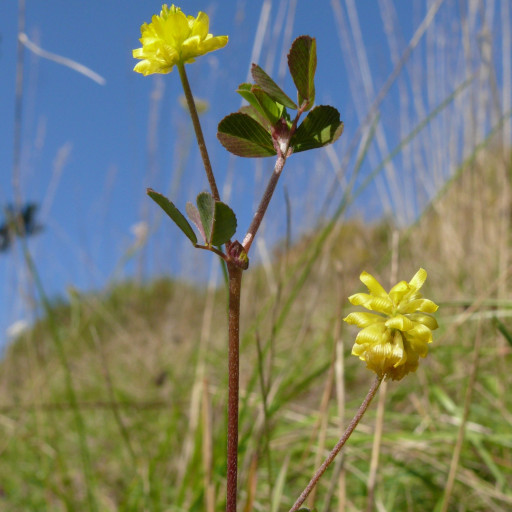
Plant Overview
Often called the "Hop Trefoil," Trifolium campestre is the cheerful wanderer of the clover family. It is best known for its bright yellow flower heads that resemble tiny, golden raspberries or miniature hops as they age. While often dismissed as a common roadside weed, this resilient annual plays a vital role in meadow ecosystems by enriching the earth beneath it.
🔍 How to Identify
- 🌼 The "Hop" Bloom: Look for small, rounded clusters of 20–40 bright yellow flowers. As the flowers fade, they turn a papery light brown and fold downward, mimicking the look of a dried hop fruit.
- 🍃 The Stalked Leaflet: Like all clovers, it has three leaflets (trifoliate). A key giveaway for this species is that the central leaflet has a short stalk, while the two side leaflets sit directly on the main stem.
- 🌱 Growth Habit: This plant stays relatively low to the ground, usually topping out at 10–30 centimeters. The stems are often slightly hairy and can take on a reddish hue in bright sunlight.
🏡 In Your Garden
- ☘️ The Natural Fertilizer: Hop Trefoil is a nitrogen-fixer. It hosts special bacteria in its roots that convert atmospheric nitrogen into a form plants can use, essentially acting as a free, organic fertilizing service for your soil.
- ☀️ Drought Warrior: You will often find this plant in "disturbed" areas—sandy paths, rocky outcrops, or dry lawns. It thrives in poor soil where more delicate plants wither, making it an excellent indicator of dry, low-nutrient conditions.
⚠️ Safety & Toxicity
- ✅ Generally Safe: Trifolium campestre is considered non-toxic to humans, cats, and dogs. It is not known to cause skin irritation upon contact.
- 🐾 Livestock Caution: While safe for common household pets, large-scale grazing by livestock (like cattle or horses) on clover-heavy pastures can occasionally cause "bloat," though Hop Trefoil is much less likely to cause this than its larger cousins, Red and White Clover.
✨ Fun Fact
The "Hop" in its name isn't just for show—the flower heads look so much like the hops used in brewing beer that early botanists used the Latin word campestre (meaning "of the fields") to describe its favorite place to grow these "mock hops."

Detailed Care Instructions
| Humidity | Normal |
| Lighting | Part Sun |
| Difficulty | Medium |
| Hibernation | Cold Period |
To grow Trifolium Campestre, also known as alsike clover, follow the steps below:
- Choose the right location: Alsike clover prefers full sun to partial shade. Select a location that receives at least 4-6 hours of direct sunlight per day.
- Prepare the soil: Alsike clover thrives in well-drained, fertile soil. Before planting, remove any weeds, rocks, or debris from the area. Loosen the soil with a garden fork or tiller to a depth of 6-8 inches.
- Test the soil: Get a soil test kit or send a sample to a local agricultural extension office to determine the soil pH and nutrient levels. Aim for a neutral pH of around 6.5-7.5. Adjust the pH as recommended by adding lime to raise it or sulfur to lower it.
- Planting seeds: Alsike clover can be planted from either seeds or seedlings. If using seeds, sow them in early spring or late summer, directly onto the prepared soil. Broadcast the seeds evenly over the area, then lightly rake them into the top ¼ inch of soil. Water the area gently to moisten the soil.
- Watering: Keep the soil consistently moist but not waterlogged during germination and establishment. Water the area regularly, especially during dry periods, to help the plants establish a strong root system.
- Fertilization: Alsike clover typically doesn't require excessive fertilization. However, if the soil test indicates nutrient deficiencies, supplement with a balanced fertilizer according to the recommended rates.
- Maintenance: Regularly monitor for weeds and remove them promptly to prevent competition with the Trifolium Campestre plants. Mow the plants periodically to maintain a height of around 4-6 inches to encourage lateral spread and prevent flowering.
- Optional: Alsike clover can be intercropped with grasses or other legumes to enhance its growth and nitrogen fixation abilities.
- Harvesting: You can harvest Alsike clover for hay or forage when the plants are in full bloom. Cut the plants about 3-4 inches above the ground level and allow them to dry before baling.
Remember to follow local regulations and guidelines regarding planting and growing alsike clover, as it may be considered an invasive species in some areas.

Place in a bright room that is sun drenched almost all day. Or directly in a south-facing window.

To water this plant, you will need to ensure that the soil is consistently moist, but not waterlogged. This can be achieved by watering deeply, allowing the water to penetrate the soil to the root zone. It is important to not allow the soil to dry out completely, as this can cause stress and damage to the plant. However, overwatering can lead to root rot and other issues, so it is essential to strike a balance in watering. Additionally, it is important to use well-draining soil to prevent water from accumulating in the roots. This can be achieved by mixing the soil with organic matter or sand. Finally, it is important to monitor the weather and adjust watering accordingly. During hot, dry spells, the plant may require more water, while during cooler, wetter periods, it may require less.
To promote healthy growth and flowering of this plant, apply a balanced fertilizer with equal amounts of nitrogen, phosphorus, and potassium at a rate of 1 pound per 100 square feet. Spread the fertilizer evenly across the soil and water thoroughly after application. Repeat this process once every 4-6 weeks during the growing season. Avoid over-fertilizing as this can lead to excessive foliage growth and reduced flower production.
Trifolium campestre is a plant species that requires well-draining and fertile soil. It grows best in soil that has a pH level ranging from neutral to slightly acidic. The soil should be rich in organic matter and adequately aerated to allow for root growth and development. It is also essential to ensure that the soil is not compacted, as this can hinder the plant's ability to establish itself and grow properly. It is recommended to avoid using heavy clay soils as they tend to retain moisture, which can lead to root rot. In summary, the Trifolium campestre plant requires fertile, well-draining, slightly acidic soil with good aeration and organic matter content.
To propagate this plant, select healthy, mature plants with strong stems and abundant leaves. Ensure that the plant is grown in well-draining soil, and water it regularly to keep the soil consistently moist.
To propagate using seeds, allow the plant to produce seed heads by letting the flowers die and the heads dry out. Once the seed heads are dried, harvest the seeds and scatter them on prepared soil, pressing them gently into the soil. Cover the seeds with a thin layer of fine soil, and keep them consistently moist until they germinate.
To propagate using stem cuttings, select healthy stem cuttings with at least three nodes. Strip the leaves from the lower half of the cutting, and dip the cut end into a rooting hormone powder. Plant the cutting in moist soil, making sure that the soil is firmly packed around it. Keep the soil moist, and place the cutting in a warm, bright location. After a few weeks, the cutting should develop roots and can be transplanted into a larger container or the ground.
Common pests of the hop trefoil include Spider mites, aphids. Make a habit of checking your hop trefoil frequently for pests so that any infestations can be caught and managed early.








