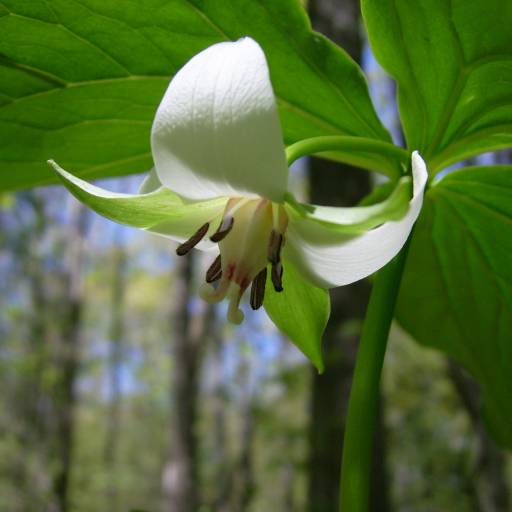
Plant Overview
Often called the "Nodding Wakerobin," this shy woodland beauty is a master of hide-and-seek. Native to the damp forests of North America, it is famous for its elegant, "nodding" flower that tucks itself beneath its large leaves as if shielding itself from the rain. It is a quintessential spring ephemeral, appearing briefly to signal the true end of winter.
🔍 How to Identify
- 🍃 The Rule of Three: Like all members of its genus, it features a single whorl of three large, diamond-shaped leaves that meet at a single point on the stem.
- 🌸 Hidden Blooms: The solitary flower has three white, recurved petals that gracefully arch backward, revealing dark purple or pink anthers.
- 📉 The Nodding Habit: Unlike other Trilliums that hold their flowers high, this species has a curved flower stalk (pedicel) that causes the blossom to hang downward, hiding it under the leaf canopy.
🏡 In Your Garden
- 💧 Moisture Seekers: These plants are naturally found in swamps, bogs, and damp deciduous woods. In a garden setting, they demand "goldilocks" soil—consistently moist and rich in organic matter, but never sitting in a stagnant puddle.
- ⏳ Slow and Steady: Trilliums are slow growers and can take up to seven years to bloom from a seed. They resent being moved once established because they grow from a brittle underground rhizome; choose their "forever home" in a shady spot carefully.
⚠️ Safety & Toxicity
- 🤢 Mildly Toxic: The plant, particularly the berries and rhizome, contains saponins. While not typically deadly, ingesting them can cause significant stomach upset, nausea, and vomiting.
- 🐾 Pet Caution: Keep an eye on curious pets. While most animals find the leaves unpalatable, the red berries that appear in late summer can be tempting and should not be eaten.
✨ Fun Fact
Nodding Trilliums rely on "myrmecochory"—a fancy word for seed dispersal by ants! The seeds have a fleshy, oily attachment called an elaiosome that ants find delicious. They carry the seeds back to their nests, eat the snack, and "discard" the seed in their nutrient-rich waste tunnels, effectively planting the next generation.

Detailed Care Instructions
To grow Trillium cernuum, also known as nodding trillium or whip-poor-will flower, follow these steps:
- Location: Choose a suitable location for planting. Trillium cernuum thrives in well-draining soil and prefers partial to full shade. It is often found growing in deciduous forests.
- Soil Preparation: Prepare the planting area by removing any weeds, grass, or debris. Trillium cernuum prefers humus-rich, loamy soil. You can amend the soil with organic matter like compost to improve fertility and drainage.
- Planting: Plant the trillium cernuum rhizomes in early spring or early fall. Dig a hole that is wide and deep enough to accommodate the rhizome without crowding. Place the rhizome in the hole with the growing tip facing upwards, and cover the rhizome with soil, leaving the growing tip just at or slightly below the soil surface.
- Watering: Trillium cernuum prefers consistent moisture, especially during its active growing season. Water the plant regularly, keeping the soil evenly moist but not waterlogged. Mulching around the plant can help retain moisture and suppress weeds.
- Fertilizer: Trillium cernuum generally does not require much fertilization. However, you can apply a balanced organic fertilizer or compost in early spring to provide some nutrients.
- Maintenance: Remove any competing weeds or grass from around the plant to prevent them from overtaking it. Trillium cernuum can take a few years to establish and may not flower immediately. Be patient and provide the plant with proper care.
Remember, trilliums are protected in some areas, so it's important to check local regulations before planting or harvesting them.

Place in a window with dappled sun or a spot in the middle of a room. Or directly in a window facing west or east.

Trillium Cernuum is a plant that requires moderate watering. It is important to water the plant when the soil becomes slightly dry. Overwatering can lead to root rot, which can be detrimental to the plant's health. It is important to water the plant at its base, instead of spraying water over the leaves, to prevent fungal growth. It is also recommended to use room temperature water. During the winter, it is best to reduce watering to allow the plant to go into a dormant state. It is important to ensure proper drainage to prevent water from collecting around the roots.
To fertilize this plant, it is important to use a slow-release fertilizer with a low nitrogen content, preferably one high in phosphorus and potassium. Apply the fertilizer in late fall or early spring, when the plant is dormant. Avoid over-fertilizing, as this can lead to increased leaf growth at the expense of flower production. Always follow the instructions on the fertilizer packaging, and water the plant thoroughly after application.
Trillium cernuum is a type of plant that requires well-drained soils with high organic matter content. The ideal soil type would be loamy and slightly acidic, with a pH range between 5.5 and 6.5. It is important to ensure that the soil is not compacted or waterlogged, as this can lead to root rot or other diseases. Additionally, it is recommended to top-dress the soil with compost or a slow-release fertilizer to provide necessary nutrients for the plant's growth and development. Overall, the soil should be nutrient-rich, well-aerated, and free-draining to promote optimal Trillium cernuum growth.
Trillium cernuum is propagated through a process known as division. In late summer or early fall, when the plant has gone dormant, carefully dig up the clump and divide the rhizomes. Each division should contain at least one healthy growing point and a portion of the plant's root system. Replant the divisions immediately at the same depth as the original plant. Water thoroughly and mulch around the newly planted divisions to help retain moisture and moderate soil temperatures. With proper care, the divisions should begin to grow the following spring.








