Plant Overview
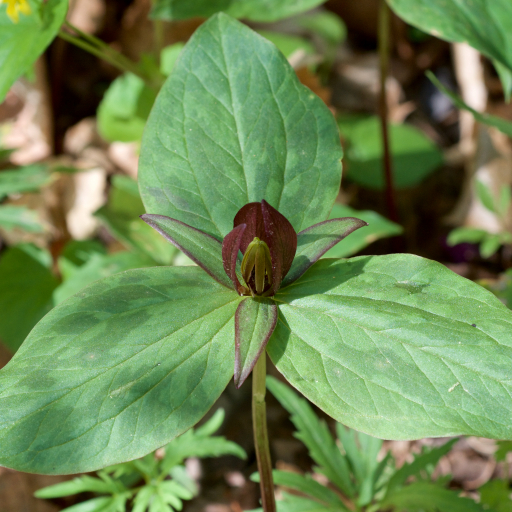
Known as the "Toadshade" or "Wake-robin," this woodland gem is the introvert of the forest floor. Native to the central and eastern United States, its name sessile refers to the unique way its flower sits directly on the leaves without a supporting stalk. It is a classic "spring ephemeral," appearing like magic in early spring and vanishing back into the earth once the summer heat arrives.
🔍 How to Identify
- 🍃 The Rule of Three: True to its name (Tri-llium), everything comes in threes: three leaves, three sepals, and three maroon petals.
- 🎨 Mottled Foliage: The wide, oval leaves are beautifully splashed with shades of lime green, silver, and deep forest green, resembling camouflage.
- 🍷 The Stalkless Bloom: The flower is a deep, moody maroon or brownish-purple. Unlike other lilies, it never fully "opens" its petals, keeping a secretive, bud-like appearance.
🏡 In Your Garden
- 🌳 The Woodland Niche: These plants are perfect for "shade gardening." They crave the dappled light found under deciduous trees, where they can soak up the sun before the trees leaf out in late spring.
- 🛑 Look, Don't Touch: Toadshade hates being moved. They grow from brittle underground rhizomes and have a very low tolerance for being transplanted or having their flowers picked. Picking a Trillium flower can actually starve the plant, preventing it from blooming again for several years.
- 🍂 Soil Secrets: They thrive in rich, "leaf mold" soil. In your garden, they appreciate a thick mulch of fallen leaves to mimic their natural forest home.
⚠️ Safety & Toxicity
- 🐾 Mildly Toxic: The plant contains saponins. While not typically lethal, ingesting the berries or rhizomes can cause significant stomach upset, nausea, and vomiting in both humans and curious pets.
- 🖐️ Conservation Status: In many regions, Trilliums are protected. Never harvest them from the wild, as they are slow to mature—sometimes taking up to seven years to bloom from a seed!
✨ Fun Fact
Trilliums use a "delivery service" called Myrmecochory. Their seeds have a fatty, protein-rich attachment called an elaiosome that ants find delicious. Ants carry the seeds back to their underground nests, eat the snack, and "discard" the seed in their waste tunnels—effectively planting the Trillium in a perfectly fertilized underground nursery!

Detailed Care Instructions
| Humidity | Normal |
| Lighting | Shade |
| Difficulty | Easy |
| Hibernation | Cold Period |
| Hardiness Zones | 4 - 8 |
Here are some tips on how to grow Trillium Sessile plants:
- Choose the right location: Trillium Sessile plants prefer shaded or partially shaded areas with moist, well-drained soil. They thrive under trees or in woodland settings.
- Soil preparation: Prepare the soil before planting by loosening it and removing any weeds or debris. Trillium Sessile plants prefer humus-rich, loamy soil with good organic matter content.
- Planting: Plant the Trillium Sessile bulbs or rhizomes in early spring or fall, as they are typically dormant during these seasons. Dig a hole that is deep enough to cover the bulbs with 1-2 inches of soil. Space each plant about 12-18 inches apart.
- Watering: Keep the soil consistently moist but not waterlogged. Apply water whenever the top inch of soil feels dry. Trillium Sessile plants prefer moist conditions, so regular watering is important, especially during dry periods.
- Mulching: Apply a layer of organic mulch around the plants to help retain moisture and suppress weed growth. Avoid mulch touching the base of the plants, as it can lead to rot.
- Fertilization: Trillium Sessile plants generally don't require much fertilizer. However, if your soil is lacking in nutrients, you can apply a balanced, slow-release fertilizer once a year in early spring.
- Maintenance: Remove any weeds that may compete with the Trillium Sessile plants for nutrients. Avoid disturbing the plants' roots as they establish and grow.
- Propagation: Trillium Sessile plants can be propagated through division or by planting the seeds. Division is typically done in early spring or fall when the plants are dormant. Seeds can be collected from mature plants in early summer and should be sown immediately.
- Overwintering: Most Trillium Sessile plants are hardy and can tolerate cold temperatures. However, if you live in an extremely cold climate, providing a layer of mulch over the plants' roots during winter can offer extra protection.
- Patience: Trillium Sessile plants are slow growers and may take a few years to reach maturity and bloom. Be patient and provide proper care, and you will eventually enjoy their beautiful flowers.
Remember to check with local garden centers or botanical gardens for specific guidance on growing Trillium Sessile plants in your region, as they may have specific requirements based on the climate and soil conditions.

Place in a window with dappled sun or a spot in the middle of a room. Or directly in a window facing west or east.

Trillium Sessile is a perennial plant that requires consistent moisture to thrive. When watering Trillium Sessile, it is important to avoid both over-watering and under-watering. Over-watering can cause the roots to rot, while under-watering can damage the plant's leaves and stunt growth.
To water Trillium Sessile properly, follow these steps:
1. Check the soil moisture: Before watering the plant, check the soil moisture by inserting your finger into the soil up to the first knuckle. If the soil feels moist, wait before watering. If it feels dry, it is time to water.
2. Water the plant: When watering Trillium Sessile, use a watering can or a gentle hose spray. Avoid watering from overhead, as this can damage the delicate leaves and flowers. Instead, water around the base of the plant, allowing the water to soak into the soil slowly.
3. Monitor the soil moisture: After watering, check the soil moisture again. The goal is to keep the soil consistently moist, but not waterlogged. If the soil is still moist, wait before watering again. If it feels dry, it may be time to water again.
4. Adjust watering frequency: The frequency of watering Trillium Sessile will depend on the weather, soil type, and other factors. In general, during hot, dry weather, the plant may need to be watered more frequently. During cooler, wetter weather, it may need less water.
By following these steps, you can help your Trillium Sessile plant stay hydrated and healthy.
To fertilize this plant, use a balanced fertilizer with an N-P-K ratio of 10-10-10. Apply the fertilizer in the spring before new growth appears, and again in the fall after the leaves have died back. Use a low-dose fertilizer to avoid burning the plant's roots. Water the plant thoroughly after fertilizing to help the nutrients reach the roots. Avoid fertilizing during the plant's dormant period in the summer.
Trillium Sessile, like all plants, requires a specific type of soil to thrive. It prefers a well-draining soil that is rich in organic matter. The ideal soil should be slightly acidic, with a pH ranging from 5.5 to 6.5.
The soil should be well-aerated and have good water-holding capacity, but not be waterlogged, as this can cause root rot. It is also important to avoid soils that are heavy in clay or sand, as these can lead to poor drainage or insufficient water-holding capacity.
When planting Trillium Sessile, it is recommended to add organic matter to the soil, such as compost or peat moss, to improve nutrient availability and water retention. Additionally, incorporating a slow-release fertilizer into the soil can help support the plant's growth and development.
Overall, a healthy and well-draining soil is key to the success of Trillium Sessile.
Trillium Sessile plant can be propagated through a variety of methods, including division, seed propagation, and tissue culture.
Division is the simplest method of propagation and involves dividing the rhizomes of mature plants during the dormant season. Care should be taken to ensure that each division has a portion of rhizome attached to it, and the divisions should be replanted immediately in a suitable growing medium.
Seed propagation involves collecting seeds from mature plants and sowing them in sterile potting soil. The pots should be kept moist and warm until germination occurs, which can take several weeks to months depending on the species. Seedlings should be grown on until large enough to be transplanted into their permanent location.
Tissue culture is a more technical method of propagation that involves taking small pieces of plant tissue and growing them in a laboratory under sterile conditions. This method is particularly useful for propagating rare or endangered species, as it allows for large numbers of identical plants to be produced quickly.
Regardless of the method chosen, it is important to ensure that plants are grown in suitable soil conditions with adequate moisture and light to encourage strong growth.








