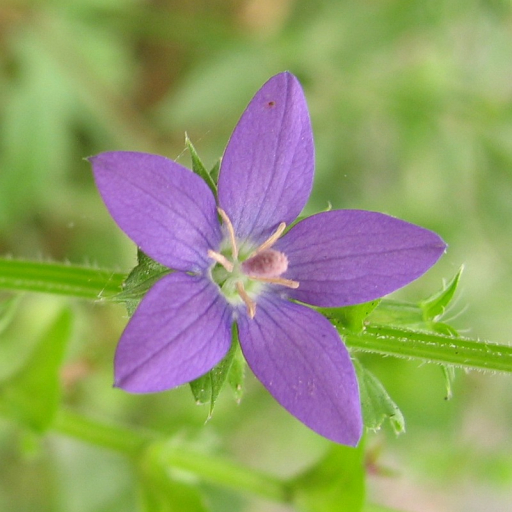
Plant Overview
Often called the Clasping Venus’ Looking-Glass, this charming wildflower is a master of the "self-hug." Its common name comes from an ancient European myth involving a fallen mirror belonging to Venus, the goddess of beauty, which supposedly turned into flowers wherever it shattered. In your garden, it appears as a delicate, vertical tower of tiny green cups overflowing with vibrant purple stars.
🔍 How to Identify
- 🍃 Clasping Leaves: The most distinct feature is the heart-shaped leaves that "clasp" or wrap entirely around the hairy stem, creating a series of little bowls or cups.
- 💜 Two-Tiered Blooms: It produces two types of flowers. The lower ones never open and self-pollinate (cleistogamous), while the upper ones open into beautiful five-lobed, violet-purple stars.
- 📏 Stiffly Upright: The plant grows on a single, unbranched stem that stands straight up, usually reaching about 4 to 12 inches in height, covered in fine white hairs.
🏡 In Your Garden
- 🌱 The Pioneer Spirit: This plant is often one of the first to pop up in "disturbed" soil, such as the edges of garden beds or areas where you’ve recently dug. It is an annual, meaning it completes its life cycle in one year but drops plenty of seeds for next spring.
- 🦋 Pollinator Magnet: While the lower flowers pollinate themselves, the showy top flowers are highly attractive to native sweat bees, hoverflies, and small butterflies, making it a great addition to a wilder, eco-friendly lawn.
⚠️ Safety & Toxicity
- 🟢 Non-Toxic: Triodanis perfoliata is generally considered non-toxic to humans and common household pets like dogs and cats.
- 👐 Skin Sensitivity: While not poisonous, the hairy stems can be slightly scratchy or irritating to those with very sensitive skin if handled roughly.
✨ Fun Fact
The "Venus' Looking-Glass" name actually refers to the seeds of its European cousins, which are so shiny and flat they resemble tiny hand mirrors. However, this American native kept the name because its cup-shaped leaves look like they are holding a reflection of the sky!

Detailed Care Instructions
To grow Triodanis Perfoliata (also known as clasping Venus' looking-glass or roundleaf triodanis), you can follow these steps:
- Select appropriate growing conditions: Triodanis Perfoliata prefers full sun to partial shade. It can tolerate a wide range of soil types, but well-drained soil is ideal.
- Obtain seeds or transplants: Seeds of Triodanis Perfoliata can be purchased from nurseries or online suppliers. It's also possible to propagate the plant by collecting seeds from mature plants or by dividing existing plants.
- Prepare the soil: Ensure that the soil is loose and free from weeds. Add compost or organic matter to improve soil fertility and drainage if needed.
- Sow the seeds or plant the transplants: If sowing seeds directly in the ground, choose a location where the plants can receive adequate sunlight. Plant the seeds in well-spaced rows or scatter them evenly in the area. Cover the seeds lightly with soil and gently water the area.
If using transplants, dig a hole slightly larger than the root ball of the plant. Place the plant in the hole, cover with soil, and water well.
- Watering and care: Keep the soil consistently moist but not waterlogged until the plants are established. Afterward, Triodanis Perfoliata is relatively drought-tolerant and can withstand dry periods without much watering. Water only when the soil becomes dry.
- Mulching: Apply a layer of organic mulch around the plants to help retain moisture, suppress weed growth, and maintain an even soil temperature.
- Fertilization: Triodanis Perfoliata usually doesn't require much fertilization. However, you can apply a balanced organic fertilizer once or twice during the growing season if desired.
- Pruning: Trim off any dead or damaged leaves or stems to promote healthier growth and keep the plant tidy.
- Pest and disease control: Triodanis Perfoliata is generally not susceptible to significant pest or disease issues. However, keep an eye out for common garden pests like aphids or slugs and take appropriate measures to control them if necessary.
- Propagation: If you want to propagate more Triodanis Perfoliata plants, you can collect seeds from existing plants or divide established plants in early spring.
Remember to always follow any specific instructions provided with the seeds or seedlings you purchase, as cultivation methods may vary slightly depending on the particular variety of Triodanis Perfoliata you are growing.

Place in a window with dappled sun or a spot in the middle of a room. Or directly in a window facing west or east.

To water this plant, it is important to first ensure that the soil is dry to the touch before watering. Overwatering can lead to root rot and other issues. When watering, it is recommended to provide a thorough soak, allowing the water to penetrate deep into the soil. It is best to water early in the morning or late in the evening to avoid evaporative loss. Avoid getting the foliage wet as this can encourage disease. Adjust watering frequency based on environmental factors such as temperature, humidity, and sunlight.
To fertilize this plant, mix a balanced fertilizer with equal amounts of nitrogen, phosphorus, and potassium. Apply the fertilizer to the soil around the base of the plant, being careful not to get any on the leaves or stem. Water the plant thoroughly after fertilizing to help the nutrients reach the roots. Repeat the fertilization process every four to six weeks during the growing season.
The ideal soil for Triodanis Perfoliata plants is a well-draining soil that is slightly acidic. The soil should have a pH level of around 6.0 to 6.5 to allow the plant to easily absorb nutrients. It is recommended to mix perlite or sand with the soil to ensure proper drainage and to promote healthy root growth. The soil should also be rich in organic matter, such as compost or aged manure, to provide the plant with the necessary nutrients for growth. Additionally, Triodanis Perfoliata plants prefer soil that is moist but not waterlogged, so be sure to avoid overwatering.
- Collect seeds from mature Triodanis Perfoliata plants in mid to late summer.
- Clean the seeds by removing any plant debris or remaining chaff.
- Place the seeds in a container filled with damp sand or potting soil.
- Keep the container in a cool, dry location for several weeks to allow the seeds to stratify, or undergo a period of cold and moist conditions that are necessary for germination.
- After stratification, plant the seeds in small seedling pots or directly into the ground in the spring when the soil has warmed up.
- Water regularly and provide adequate sunlight for optimal growth.
- Once the seedlings have grown to a suitable size, transplant them into larger pots or into their final growing location.
Common pests of the clasping venus' looking-glass include Spider mites, larvae. Make a habit of checking your clasping venus' looking-glass frequently for pests so that any infestations can be caught and managed early.








