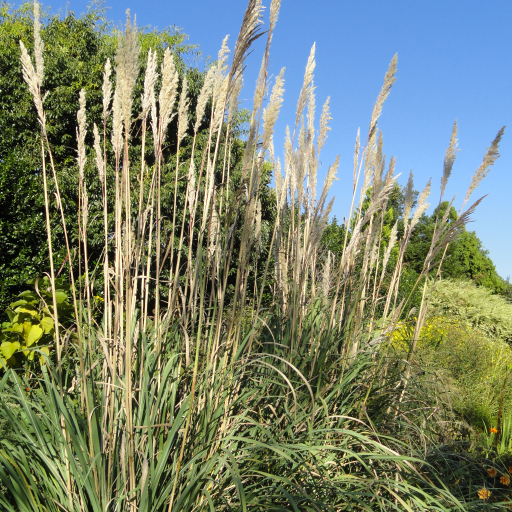
Plant Overview
Known as the "Hardy Pampas Grass" or "Ravenna Grass," this giant of the botanical world commands attention with its towering, architectural presence. Originally hailing from the Mediterranean and Western Asia, it provides a dramatic silhouette that persists even through the biting winds of winter. It is the go-to choice for gardeners in cooler climates who crave the majestic, feathery plumes usually associated with tropical landscapes.
🔍 How to Identify
- 🌾 Towering Plumes: Large, feathery flower spikes that emerge silvery-purple and fade to a creamy white, often reaching heights of 10 to 12 feet.
- 🍃 Blade Structure: The leaves are long, arching, and gray-green, typically featuring a very prominent white mid-vein running down the center.
- 🏗️ Growth Habit: It forms a massive, dense basal clump. While the foliage stays around 4 feet tall, the flower stalks shoot upward like sky-high rockets in late summer.
🏡 In Your Garden
- ☀️ Sun Seeker: This grass is a true sun-worshipper; if it doesn't receive full, intense light, those magnificent stalks will lose their strength and "flop" over.
- 🌬️ Natural Screen: Due to its sheer scale and sturdy stems, it functions beautifully as a living privacy fence or a windbreak for large open spaces.
- ✂️ The Spring Haircut: Because it stores energy in its deep roots, the entire plant should be cut back to about 6 inches in late winter to allow the fresh, vibrant green growth to emerge without being choked by old debris.
⚠️ Safety & Toxicity
- 🛑 Physical Hazard: While the plant is not chemically poisonous, the leaf edges are incredibly sharp and can cause painful "saw-like" cuts on bare skin.
- 🐾 Pet & Child Safety: It is generally considered non-toxic to cats, dogs, and humans, though the rough texture makes it unappealing for curious nibblers.
- 🧤 Protective Gear: Always wear thick gloves and long sleeves when pruning or dividing this plant to protect yourself from its serrated foliage.
✨ Fun Fact
In parts of the American Southwest, this "gentle giant" has become a bit of a rebel. Because a single plant can produce thousands of wind-borne seeds, it has escaped many gardens to colonize riverbanks, earning it a spot on several invasive species lists!

Detailed Care Instructions
One way to water this plant is to use a watering can with a narrow spout to pour water directly onto the soil at the base of the plant. The soil should be evenly moist but not waterlogged, so it's important to water slowly and allow the water to soak in before adding more. It's also a good idea to let the soil dry out slightly between waterings, as this plant prefers well-draining soil and can be sensitive to overwatering. Another option is to use a drip irrigation system or a watering spike to provide a consistent, slow release of water over time. Whatever method you choose, be sure to pay attention to the plant's watering needs and adjust your approach based on factors like temperature, humidity, and the season.
The best type of soil to use with this particular plant is rich in nutrients. It should also be well-draining to prevent waterlogging. A mixture of loam, sand and peat moss works well. It is important to avoid using heavy soils as they can cause root rot and prevent growth. Additionally, the soil should be kept moist but never excessively wet to avoid damaging the roots. Finally, fertilizing the soil once a month during the growing season will help ensure the plant gets the necessary nutrients to thrive.








