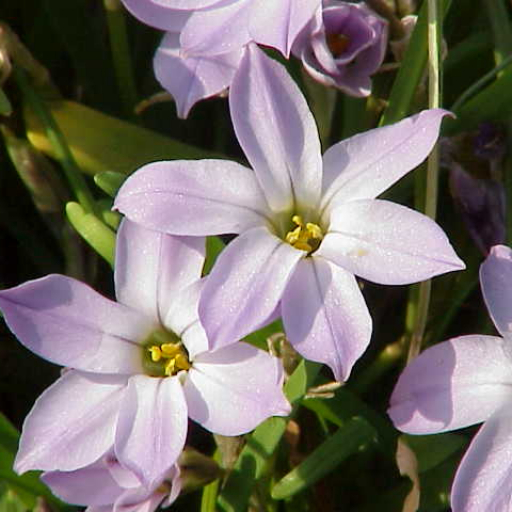
Plant Overview
Often called the Spring Starflower, Tristagma uniflorum is a charming, low-growing bulb from South America that blankets gardens in a constellation of blooms just as winter fades. While its delicate, honey-scented flowers suggest a fragile nature, this plant is surprisingly tough and spreads eagerly to create a "milky way" effect across your lawn or borders. Interestingly, despite its sweet-smelling blossoms, its leaves give off a distinct onion-like aroma when crushed.
🔍 How to Identify
- ⭐ Starry Blooms: Look for solitary, six-petaled flowers shaped like perfect stars. They range in color from icy white and pale silvery-blue to deep violet, often with a darker midline vein on each petal.
- 🍃 Grass-like Foliage: The leaves are narrow, flat, and floppy, resembling thick blades of grass. They have a subtle glaucous (blue-green) tint and typically emerge before the flowers.
- 🧄 The "Scent Test": If you are unsure of the ID, gently bruise a leaf. A true Spring Starflower will immediately release a pungent scent of garlic or onion, a trait inherited from its cousins in the Allium family.
🏡 In Your Garden
- 🌱 Naturalizing Specialist: This plant is famous for "naturalizing," meaning it will happily multiply and spread on its own over time. It is perfect for tucking under deciduous trees where it can soak up the early spring sun before the tree canopy fills in.
- 💤 Summer Dormancy: Don't panic when the plant completely disappears in late spring or early summer! It is simply retreating into its bulb to survive the heat. Avoid digging in its area during this time to protect the sleeping bulbs.
⚠️ Safety & Toxicity
- 🐾 Toxic to Pets: While it isn't usually deadly in small amounts, the plant contains compounds that are toxic to dogs, cats, and horses.
- 🤢 Ingestion Risks: If eaten by humans or pets, it can cause significant stomach upset, including vomiting and diarrhea. Because the leaves smell like onions, curious pets might be tempted, so it is best kept in areas they cannot easily access.
✨ Fun Fact
The Spring Starflower has a bit of an "identity crisis" in the botanical world. Over the years, scientists have moved it between several different groups, which is why you will still find it sold under the names Ipheion uniflorum or Brodiaea uniflora in many garden centers!

Detailed Care Instructions
| Humidity | Normal |
| Lighting | Full Sun |
| Difficulty | Medium |
| Hibernation | Cold Period |
| Hardiness Zones | 4 - 10 |
To grow Tristagma uniflorum, also known as the spring starflower or the Chilean blue crocus, you can follow these steps:
- Purchase bulbs: Buy Tristagma uniflorum bulbs from a reputable source. You can find them in garden centers, nurseries, or through online vendors. Make sure the bulbs are healthy and firm.
- Choose a planting location: Select a well-drained spot in your garden that receives full sun to partial shade. Tristagma uniflorum prefers moderately fertile soil.
- Prepare the soil: Clear the area of weeds and debris. Loosen the soil with a garden fork or tiller to a depth of around 6 inches. Mix in organic matter like compost or well-rotted manure to improve soil fertility and drainage.
- Plant the bulbs: Dig holes that are 3 to 4 inches deep and about 2-3 times the size of the bulbs. Place the bulbs in the holes with the pointed end facing upwards. Space the bulbs about 6 inches apart to allow for future growth.
- Cover and water: Gently backfill the holes, covering the bulbs with soil. Water thoroughly after planting to ensure good soil contact. Keep the soil moist but not waterlogged during the growing season.
- Maintenance: As the plants emerge, continue to water regularly, especially during dry spells. Remove any weeds that may compete with the plants for nutrients and water.
- Fertilization: Tristagma uniflorum usually doesn't require excessive fertilization. However, if your soil is poor, you can apply a balanced, slow-release fertilizer in early spring, following the manufacturer's instructions.
- Pruning: After flowering, allow the foliage to die back naturally. This will help provide nutrients for the bulbs to store and use for next year's growth. Avoid cutting the foliage until it has turned yellow or brown.
- Overwintering: In colder regions, Tristagma uniflorum may need some winter protection. Apply a layer of mulch around the plants to insulate the soil and protect the bulbs during freezing temperatures.
- Divide and propagate: Tristagma uniflorum bulbs can be divided every few years to multiply your plants. Wait until the foliage has died back, then carefully dig up the bulbs. Separate the offsets from the parent bulbs and replant them in a new location following the same steps as above.
By following these guidelines, you should be able to successfully grow Tristagma uniflorum plants in your garden.

Place in a window with dappled sun or a spot in the middle of a room. Or directly in a window facing west or east.

Tristagma uniflorum is a perennial flowering plant that belongs to the Asparagaceae family. It is important to water this plant based on its specific requirements to maintain its health and productivity.
When watering Tristagma uniflorum, it is essential to make sure that the soil is evenly moist, but not soggy. Overwatering can lead to root rot and other fungal diseases. It is important to avoid watering the plant from above the foliage as this can cause the flowers to rot.
A good way to water Tristagma uniflorum is to use a watering can or a drip irrigation system. This way, the water goes directly to the roots and does not sit on the foliage. It is important to water the plant deeply, allowing the water to penetrate to the roots. Watering once or twice a week is usually sufficient, but the frequency may vary depending on the climate and soil conditions.
It is important to keep an eye on Tristagma uniflorum during periods of drought. The plant may need more frequent watering to maintain its health and vigor. Mulching around the base of the plant can also help retain moisture in the soil and reduce water loss through evaporation.
In conclusion, watering Tristagma uniflorum is essential to maintain its health. It is important to water the plant deeply and avoid overhead watering. The frequency of watering may vary depending on the climate and soil conditions. Proper watering can help to ensure that the plant produces healthy and vibrant flowers.
- Use a balanced fertilizer with equal amounts of nitrogen, phosphorus, and potassium.
- Apply the fertilizer in the early spring before growth begins.
- Use a slow-release fertilizer to avoid over-fertilization.
- Spread the fertilizer evenly around the base of the plant.
- Water the plant thoroughly after fertilizing to help the nutrients soak into the soil.
- Repeat fertilizing every six weeks during the growing season.
- Do not fertilize during the plant's dormant period.
Tristagma Uniflorum is a plant that requires a well-draining soil. It prefers a soil that is slightly acidic to neutral and rich in organic matter. The soil should be moist but not overly wet, as it can lead to root rot. A sandy loam soil is ideal for this plant, as it provides good drainage. It is also important to ensure that the soil is not compacted, as this can make it difficult for the plant's roots to grow and absorb nutrients. In addition, a light top-dressing of compost or organic matter can be applied to the soil to help improve its quality and fertility.
To propagate this plant, you can start by dividing its rhizomes in the late summer or early fall. First, dig up the plant and gently separate the rhizomes into smaller pieces, making sure each piece has roots and a shoot. Plant each division in a well-draining soil mixture, making sure to keep the soil moist but not waterlogged.
Another method of propagation is through seed germination. Collect seeds from the plant after it has finished flowering and the seed pods have dried. Sow the seeds in a seed-starting mixture and water lightly. Place the seed tray in a warm, sunny location and keep the soil moist until the seeds germinate.
Once the seedlings have sprouted, they can be transplanted into larger containers or directly into the garden. Make sure to plant them in well-draining soil in a location that receives full sun to partial shade. Water regularly and fertilize as needed to encourage healthy growth.
Common pests of the springstar include Spider mites, snails. Make a habit of checking your springstar frequently for pests so that any infestations can be caught and managed early.








