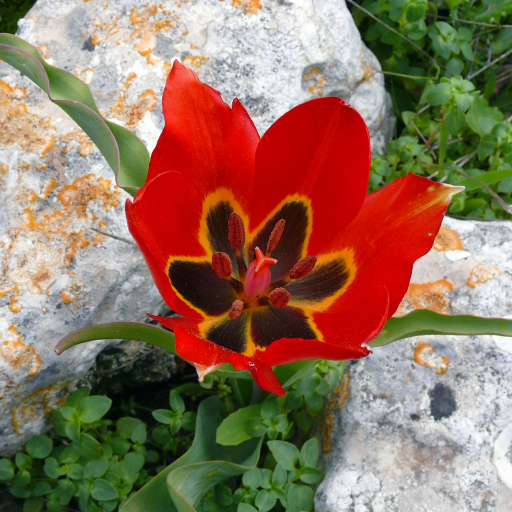
Plant Overview
Often called the "Sun's Eye Tulip," Tulipa agenensis is a wild, botanical species that looks like it stepped straight out of a Persian tapestry. Native to the sun-drenched hills of the Eastern Mediterranean, it is famous for its fiery red petals and a mysterious, dark center that seems to stare back at you. This isn't your average garden-center hybrid; it is a rugged, ancient survivor of the Levant.
🔍 How to Identify
- 🌷 Petal Shape: Features brilliant crimson-red, pointed (lanceolate) petals that open wide into a star shape when the sun is at its peak.
- 👁️ The Central Eye: A dramatic, coal-black blotch at the base of the inner petals, strikingly outlined by a thin, glowing yellow border.
- 🍃 Foliage Style: Slender, lance-shaped leaves with a distinct blue-green (glaucous) tint and slightly wavy edges that hug the ground.
🏡 In Your Garden
- ☀️ Summer Slumber: This tulip is a "geophyte" adapted to dry climates. It requires a hot, bone-dry summer dormancy to survive. If your garden is frequently irrigated in July and August, the bulbs may rot; they prefer being "baked" in the soil.
- 🪨 Rockery Specialist: Because it hates "wet feet," it thrives best in rock gardens, scree beds, or Mediterranean-style landscapes where drainage is instant and the soil is slightly alkaline.
⚠️ Safety & Toxicity
- 🐾 Toxic to Pets: Like all members of the Tulipa genus, this plant contains tuliposides. If ingested by dogs or cats, it can cause drooling, vomiting, and gastrointestinal distress.
- 🧤 Skin Irritation: Gardeners with sensitive skin may develop "Tulip Finger," a mild form of contact dermatitis, after handling the bulbs. Wearing gloves during planting is recommended.
✨ Fun Fact
- 📜 The Ancient Traveler: While native to the Middle East, this tulip has been found growing wild in French vineyards for centuries. It is believed to have been accidentally "stowed away" as bulbs in the luggage of Crusaders or ancient traders returning from the Holy Land!

Detailed Care Instructions
| Humidity | Normal |
| Lighting | Full Sun |
| Toxicity | Poisonous |
| Difficulty | Easy |
| Hibernation | Cold Period |
| Hardiness Zones | 4 - 10 |
To grow Tulipa Agenensis plant, also known as the Red-Flowered Tulip, you can follow these steps:
- Choose a suitable location: Tulips prefer well-drained soil in an area that receives at least six hours of direct sunlight a day. Make sure the location is also protected from strong, drying winds.
- Prepare the soil: Tulips prefer fertile, loamy soil with a slightly acidic pH. Improve the soil by adding organic matter, such as compost, to enhance drainage and nutrient content.
- Plant the bulbs: Plant the Tulipa Agenensis bulbs in the fall, about 4 to 6 inches deep and spaced 4 to 6 inches apart. Place the bulbs with the pointed end facing up.
- Water the bulbs: After planting, thoroughly water the bulbs to settle the soil and encourage root growth. Keep the soil moist but not waterlogged throughout the growing season, tapering off watering as the flowers begin to fade and the foliage dies back.
- Fertilize: Before planting, mix in a slow-release or organic bulb fertilizer into the soil. This will provide the necessary nutrients for the bulbs. You can also apply a balanced fertilizer early in the spring as the foliage emerges.
- Mulch the area: After planting, apply a layer of organic mulch, such as straw or wood chips, around the bulbs. This will help maintain soil moisture, regulate soil temperature, and suppress weed growth.
- Protect against pests: Tulips are occasionally attacked by pests like aphids and squirrels. To deter squirrels, you can cover the planting area with chicken wire or use other deterrents. To control pests, use organic insecticides if necessary.
- Allow the foliage to die back naturally: After the tulips have bloomed, allow the foliage to die back naturally. This ensures that the nutrients from the leaves are returned to the bulb for next year's growth. Do not cut back the leaves until they turn yellow or brown.
- Divide and replant: Every 3-4 years, you may need to dig up the bulb clusters and separate them. Replant the healthy bulbs at the appropriate depth and spacing to encourage continuous growth.
- Enjoy the blooms: With proper care, Tulipa Agenensis will reward you with beautiful red flowers in the spring. Be patient, as it may take a couple of seasons for the tulip bulbs to establish and produce their best blooms.
Remember to follow the specific care instructions for the Tulipa Agenensis variety you have, as different varieties may have slightly different needs.

Place in a bright room that is sun drenched almost all day. Or directly in a south-facing window.

To water this plant, it is important to understand its water requirements. It prefers well-drained soil that is moist but not overly wet. Water deeply once a week during the growing season and allow the soil to dry out slightly between waterings. During periods of drought or high temperatures, increase watering frequency to twice a week. Avoid getting water on the foliage as this can increase the risk of fungal diseases. It is also important to ensure proper drainage to prevent waterlogging, which can lead to root rot. Regularly check the soil moisture level to ensure the plant is receiving adequate hydration.
To fertilize Tulipa Agenensis plants, first make sure the soil is moist. Then, apply a slow-release fertilizer that is specifically formulated for tulips directly to the soil. Sprinkle the fertilizer evenly around the base of the plant, being careful not to get any on the leaves or stems. Water thoroughly after fertilizing. Repeat this process once every two to three weeks during the growing season. Finally, avoid fertilizing the plant during the dormant season.
The best soil for Tulipa Agenensis is well-draining and loamy. It should be rich in organic matter, with a neutral pH level between 6.5 and 7.5. The soil should also be light and not compacted, as Tulipa Agenensis bulbs need plenty of oxygen to grow. Additionally, the soil should be watered thoroughly but not allowed to become waterlogged. It is recommended to mix in some sand or small rocks to help with drainage. Overall, the ideal soil for Tulipa Agenensis should be loose, nutrient-rich, and well-aerated.
To propagate this plant, first obtain some healthy bulbs from an established parent plant. They should be firm and free of damage or disease.
Choose a suitable location for planting, with well-draining soil in full or partial sunlight. Dig holes for the bulbs that are 4-6 inches deep and spaced 4-6 inches apart. Place the bulbs in the holes with the pointed end facing up.
Cover the bulbs with soil and water thoroughly. Mulch lightly around the base of the plants to retain moisture and suppress weeds.
Over time, the bulbs will produce new shoots and blooms. Allow the foliage to die back naturally before removing it, as this will help fuel the growth of the bulbs and ensure healthy blooms in the following season.
It is also possible to propagate this plant from seed. Collect the seeds from the parent plant after the blooms have faded and the seed pods have dried and turned brown. Sow the seeds in well-draining soil and keep them moist and warm until they germinate. As the seedlings grow, thin them out to provide adequate space for each plant to mature.








