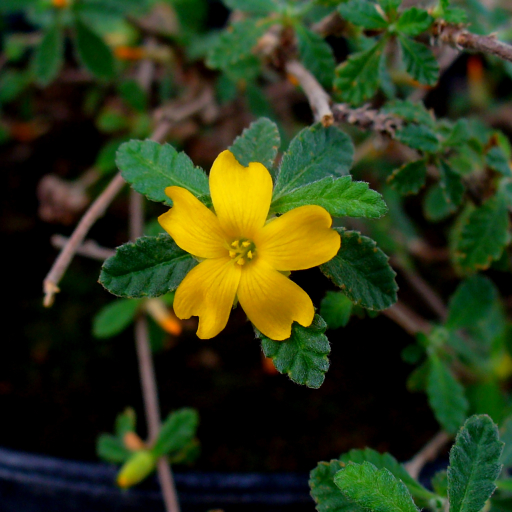
Plant Overview
Commonly known as Damiana, this small, woody shrub is a legendary staple of Mexican folklore and herbal history. Often called the "Old Woman's Broom," it has been used for centuries by the Aztecs and Mayans as a traditional tonic and "love potion." It is prized today for its aromatic, spice-scented leaves and its ability to thrive in harsh, sun-drenched environments where other plants might wither.
🔍 How to Identify
- 🌿 The Leaves: Small, pale green, and wedge-shaped with deeply serrated (toothed) edges. When crushed, they release a distinct, pleasant aroma reminiscent of chamomile or figs.
- 🌼 The Flowers: Small, bright yellow blossoms with five petals. They typically emerge in the late summer and sit tucked among the foliage, attracting bees and butterflies.
- 🪵 Growth Habit: A low-growing, multi-branched shrub that rarely exceeds three feet in height. Its stems often appear slightly reddish or woody as the plant matures.
🏡 In Your Garden
- ☀️ Sun-Seeker Nuance: Damiana is a desert native. While it can survive in partial shade, it requires intense, direct sunlight to produce its signature aromatic oils and vibrant yellow blooms.
- 🏜️ Drainage is Vital: This plant has a high sensitivity to "wet feet." It thrives in rocky, sandy, or poor-quality soils where water drains away instantly. If you are planting it in a pot, use a cactus mix to prevent root rot.
- ✂️ Pruning for Shape: Because it can become "leggy" or sparse over time, a light pruning after the flowering season helps the plant maintain a bushy, attractive shape and encourages fresh growth for the following spring.
⚠️ Safety & Toxicity
- ✅ Status: Generally non-toxic to touch, but should be used with caution as a supplement.
- 🤰 Human Caution: While traditionally used in teas, it should be avoided by pregnant or breastfeeding women and those with diabetes, as it may affect blood sugar levels.
- 🐾 Pets: It is not listed as highly toxic to cats or dogs, but ingesting any fibrous plant material can cause mild digestive upset in curious pets.
✨ Fun Fact
Damiana is a key ingredient in a famous Mexican herbal liqueur that is often used in the "original" Margarita recipes. In fact, some legends claim the very first Margarita ever mixed used Damiana liqueur instead of Triple Sec!

Detailed Care Instructions
| Lighting | Full Sun |
| Hardiness Zones | 9A - 11 |
To grow Turnera Diffusa (also known as Damiana), you can follow these steps:
- Select a suitable location: Damiana can be grown in both indoor and outdoor settings. It thrives in warm climates and requires full sunlight for at least 6-8 hours a day.
- Soil preparation: Damiana prefers well-draining soil. Prepare the soil by mixing organic matter, such as compost or peat moss, to improve its fertility and drainage.
- Planting: Sow the Damiana seeds about 1/4 inch deep in the soil, spacing them 12-18 inches apart. If you're using transplants, dig a hole slightly deeper and wider than the root ball, gently place the plant in the hole, and cover the roots with soil.
- Watering: Keep the soil moist, but not waterlogged, during the growing season. Damiana plants do not tolerate overwatering, so water sparingly and only when the soil feels dry to the touch.
- Fertilization: Apply a balanced, slow-release fertilizer once every couple of months during the growing season to provide the necessary nutrients for healthy growth.
- Pruning: Regularly prune Damiana to maintain its shape and encourage bushier growth. Pruning also helps to remove dead or weak branches.
- Pest control: Monitor the plant regularly for common pests like aphids, whiteflies, or spider mites. Use organic pest control methods or insecticidal soap to control these pests if necessary.
- Harvesting: Damiana leaves can be harvested for medicinal purposes once the plant is established and matured. Harvest individual leaves or cut the whole stem, leaving some foliage behind to allow the plant to recover.
Remember to do your research and consult with local gardening experts or nurseries to ensure that Damiana is suitable for your specific climate and growing conditions.

Place in a bright room that is sun drenched almost all day. Or directly in a south-facing window.

To water this plant, it is important to first consider the conditions in which the plant is growing. The plant should be placed in a well-draining pot with soil that is kept moist but not waterlogged. It is also important to ensure that the plant receives enough sunlight and is not placed in a location with extreme temperatures.
When watering the plant, it is important to use room temperature water and to water the soil around the base of the plant, rather than watering the leaves or flowers directly. It is recommended to water the plant once a week or when the soil feels dry to the touch.
It is also important to not overwater the plant, as this can cause root rot and other issues. It is best to err on the side of underwatering rather than overwatering.
Overall, proper watering and care will help ensure the health and growth of this plant.
- Choose a well-draining pot with drainage holes to prevent waterlogging.
- Use a balanced fertilizer with an N-P-K ratio of 10-10-10 or 20-20-20.
- Dilute the fertilizer according to the instructions on the package.
- Apply the fertilizer to moist soil every 2 weeks during the growing season (spring to fall) using a watering can or spray bottle.
- Do not fertilize during winter as the plant is dormant.
- Avoid over-fertilizing as it may damage the roots and foliage.
The Turnera Diffusa plant requires a well-draining soil with good aeration. It is recommended to use a mix of peat moss, vermiculite, and perlite, as this will provide the plant with the necessary nutrients while allowing excess water to drain away from the roots. The soil pH should be slightly acidic, around 6.0-6.5. It is important to avoid using heavy soils or those that retain too much water, as this can lead to root rot and other problems. Regular fertilization with a balanced fertilizer will also help promote healthy growth.
Turnera Diffusa is a perennial plant that belongs to the family Passifloraceae. Propagation of this plant can be done by using stem cuttings or by layering.
Stem cuttings can be taken during the growing season when the plant is actively growing. Select a healthy stem that is approximately 4-6 inches long, and contains at least 2-3 leaves. Using a sharp, clean pair of scissors, cut the stem at an angle. Remove the lower leaves from the stem, leaving only the top 2 or 3 leaves. Dip the cut end of the stem in rooting hormone, and plant it in a pot filled with well-draining potting soil. Keep the soil moist but not waterlogged, and place the pot in a bright, indirect light. The cutting should root within 4-6 weeks.
Layering is another method of propagation that can be used for Turnera Diffusa. Select a healthy stem that is close to the ground, and remove any leaves from the bottom 6 inches of the stem. Using a sharp knife, make a shallow cut in the stem where it touches the ground. Dust the cut with rooting hormone, and place soil over the cut area. Water the soil, and keep it moist until roots develop, usually within a few weeks. Once the roots have established, the stem can be cut from the mother plant and transplanted.








