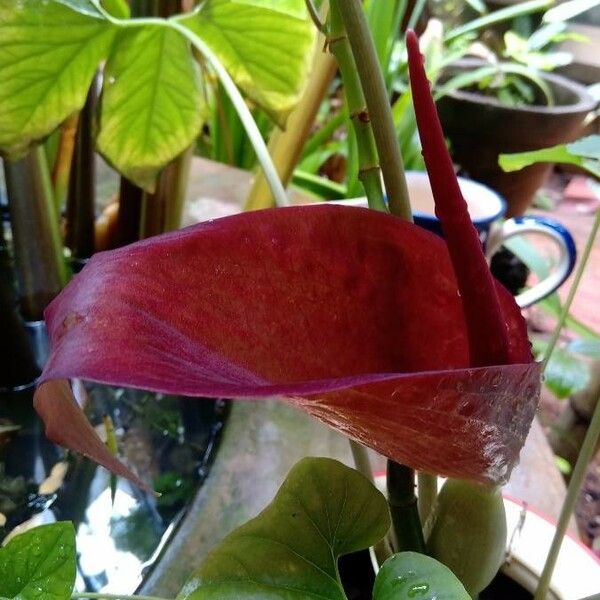
Plant Overview
Commonly known as the Bengal Arum or Three-Lobed Typhonium, this plant is a striking member of the Araceae family that looks like it stepped right out of a prehistoric jungle. While it is often appreciated for its dramatic, velvety dark-purple blooms, it is famous (or perhaps infamous) for its "stink," a clever evolutionary trick used to attract specific pollinators.
🔍 How to Identify
- 🍃 The Foliage: True to its name, the leaves are deeply divided into three distinct lobes, creating a sharp, arrowhead silhouette that stands out in any garden bed.
- 🍷 The Spathe: The "flower" is actually a large, fleshy, heart-shaped bract that is a deep, moody maroon or royal purple on the inside, often appearing velvety to the touch.
- 📍 The Spadix: Protruding from the center of the dark spathe is a long, narrow, rat-tail-like spike (the spadix) that is responsible for emitting the plant's signature scent.
🏡 In Your Garden
- 💧 Moisture Lover: This plant thrives in "monsoon-like" conditions. It prefers rich, loamy soil that stays consistently damp, as it originates from the humid tropical floor of Southeast Asia.
- 💤 The Dormancy Cycle: Don't panic if it disappears! The Bengal Arum grows from a subterranean corm and will naturally die back to the ground during dry or cold seasons, only to re-emerge when the humidity rises.
- 🌑 Shade Seeker: Because its leaves are thin and adapted to forest floors, direct afternoon sun will scorched the foliage. It is best placed under the canopy of larger shrubs or in a shaded corner of a patio.
⚠️ Safety & Toxicity
- 🚫 Toxic if Raw: Like many aroids, the entire plant contains calcium oxalate crystals. If any part is bitten or chewed, it causes intense stinging and swelling of the mouth and throat.
- 🐾 Pet Warning: Keep this plant away from curious cats and dogs. Ingestion can lead to excessive drooling, vomiting, and difficulty swallowing.
- 🖐️ Skin Irritant: Some gardeners find the sap to be a mild skin irritant; it is best to wear gloves when dividing the tubers.
✨ Fun Fact
To ensure pollination, the Bengal Arum mimics the scent of fresh dung or rotting organic matter. This "perfume" attracts dung beetles and flies, who crawl deep into the flower's base, inadvertently transferring pollen while they search for a place to lay eggs!

Detailed Care Instructions
To grow Typhonium Trilobatum, also known as Indian Corpse Plant or Voodoo Lily, follow these steps:
- Planting: Select a well-draining pot or container for indoor cultivation or find a spot with rich, well-drained soil in a partially shaded area if planting outdoors. If you choose indoor cultivation, ensure the pot has drainage holes to prevent waterlogging. Plant the bulb about 2-3 inches deep with the pointed side facing upwards.
- Watering: Keep the soil consistently moist but not waterlogged. This plant prefers slightly damp conditions, so water whenever the top inch of soil feels dry. Avoid over-watering, as it can cause root rot.
- Temperature and Light: Maintain a temperature range of 60-75°F (15-24°C). Although Typhonium Trilobatum prefers shady conditions, provide it with indirect or filtered sunlight for a few hours each day. Direct sunlight might scorch the leaves.
- Humidity: This plant prefers higher humidity levels. To increase humidity, you can mist the leaves with water daily or place a tray with water near the plant to allow for evaporation.
- Fertilization: Feed the Typhonium Trilobatum plant with a balanced, water-soluble fertilizer during its growing season (typically spring and summer). Follow the instructions on the fertilizer package for the correct dosage and frequency.
- Pruning: Trim any dead or yellowed leaves to maintain the health and appearance of the plant. Additionally, removing spent flowers can encourage more blooms.
- Dormancy: During the plant's dormancy period in fall or winter, reduce watering and move the plant to a slightly cooler location (around 55°F or 13°C) to allow it to rest. Resume regular care when new growth starts appearing.
- Repotting: If the roots become crowded or the plant outgrows its pot, you can repot it in a slightly larger container during its dormant period. Use well-draining soil and replant the bulb at the same depth as before.
Note: Typhonium Trilobatum can emit a strong odor when in bloom, which some people find unpleasant.
Watering instructions for this particular plant involve a few steps to ensure proper hydration and avoid overwatering. Here's how to properly water Typhonium Trilobatum:
- Check if the top layer of soil is dry to the touch. Use your finger to feel the soil, and if it feels dry, it's time to water.
- Use room temperature water. Avoid using cold water as it can shock the plant's roots.
- Water slowly and evenly around the base of the plant. Avoid getting water on the leaves as it can cause fungal growth and damage.
- Allow the soil to absorb the water for a few minutes, then check the drainage holes at the bottom of the pot to ensure it's draining properly.
- Do not water again until the top layer of soil has dried out again. Overwatering can lead to root rot, which can be fatal for the plant.
These steps should help keep your Typhonium Trilobatum plant healthy and hydrated without causing any harm.
To fertilize this plant, you can use a balanced fertilizer with an N-P-K ratio of 10-10-10. Apply the fertilizer once every month during the growing season (spring and summer). Mix the fertilizer with water according to the package instructions and pour it around the base of the plant, being careful not to get any on the leaves. Avoid fertilizing during the winter months when the plant is dormant.
When planting Typhonium Trilobatum, it is important to choose a well-draining soil mixture that is rich in nutrients. A mixture of peat moss, perlite, and vermiculite can provide a suitable growing medium for this plant. Additionally, adding organic matter such as compost or aged manure can help improve soil structure and fertility. The soil should also have a pH level between 5.5 and 7.0, which is slightly acidic to neutral. It is important to avoid using heavy clay soils or those with poor drainage, as these can lead to root rot and other problems for the plant.
Typhonium Trilobatum plant can be propagated through the division of its underground rhizomes. Firstly, carefully dig up the plant and separate the rhizomes, making sure each section has at least one growing tip. Secondly, replant the divided sections in a pot or in the ground in a well-draining soil with partial to full shade. Keep the soil moist but not overly watered. Propagation can also be done through stem cuttings with a few nodes and leaves. Cut the stem and place it in a well-draining potting mix and water regularly until the roots develop. It is important to note that handling the plant can cause skin irritation or allergic reactions, so wear gloves and protective clothing.








