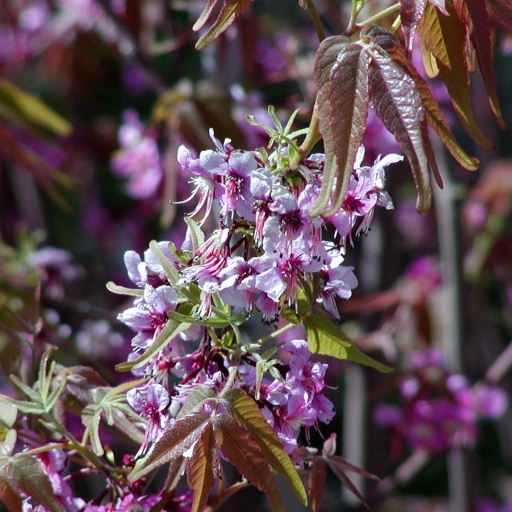
Plant Overview
Often called the "Mexican Buckeye," this native of the Chihuahuan Desert is a master of disguise. While it looks strikingly like a true Buckeye (Aesculus), it is actually a closer relative of the Maples and Soapberries. Known for its explosive spring bloom and golden fall foliage, it is a resilient survivor that brings a dramatic flair to rocky landscapes.
🔍 How to Identify
- 🌸 Floral Display: Clusters of vibrant rose-pink to lavender flowers bloom in early spring, often appearing just before or alongside the new leaves. They emit a sweet, honey-like fragrance.
- 🍃 Leaf Structure: The foliage consists of compound leaves with 5 to 7 leaflets. Each leaflet is narrow, pointed, and has "toothed" or serrated edges with a glossy green surface.
- 🌰 Woody Pods: The most distinct feature is the leathery, three-lobed seed capsule. These pods turn a dark reddish-brown and split open to reveal three shiny, jet-black seeds.
🏡 In Your Garden
- 🪨 Hardy Foundations: This plant is a specialist in limestone and rocky soils. It is exceptionally drought-tolerant once established, making it a "set it and forget it" choice for xeriscaping or wilder garden corners.
- 🌳 Deep Roots: Because it develops a very deep taproot early in life, the Mexican Buckeye is notoriously difficult to transplant. It is best to choose its permanent "forever home" carefully from the start.
- 🦋 Pollinator Magnet: It serves as a vital early-season food source for honeybees and various butterfly species, particularly the Giant Swallowtail.
⚠️ Safety & Toxicity
- 🚫 Highly Toxic: The seeds are the most dangerous part of the plant. They contain saponins and cyanogenic compounds that can cause severe distress if eaten.
- 🧒 Child & Pet Safety: Because the shiny black seeds look remarkably like marbles or edible nuts, they pose a significant risk to curious children and pets. It is best to plant this species away from play areas where fallen seeds might be easily found.
✨ Fun Fact
The Mexican Buckeye is a "monotypic" genus, meaning Ungnadia speciosa is the only species of its kind in the entire world! In the past, children across Texas and Northern Mexico famously used the smooth, heavy seeds as makeshift marbles for games.

Detailed Care Instructions
To grow Ungnadia speciosa (Mexican buckeye) plant, follow these steps:
- Climate and Soil Requirements:
- Ensure that you are living in USDA hardiness zones 5-9, as Mexican buckeye thrives in these regions.
- Choose a planting location that receives full to partial sunlight.
- The soil should be well-draining and moderately fertile.
- Ensure that you are living in USDA hardiness zones 5-9, as Mexican buckeye thrives in these regions.
- Propagation:
- Mexican buckeye can be grown from seeds or propagated through stem cuttings.
- If using seeds, scarify them by soaking in warm water for 24 hours before planting. This will help improve germination rates.
- Sow the scarified seeds in a pot or directly into the ground at a depth of half an inch.
- To propagate using stem cuttings, take a 6-8 inch long cutting from a healthy plant, remove the lower leaves, and dip the cut end in rooting hormone. Plant the cutting in a pot with moist soil and keep it in a warm, humid environment until roots develop.
- Mexican buckeye can be grown from seeds or propagated through stem cuttings.
- Planting:
- Choose a location with sufficient space for the tree to grow, considering it can reach a height of about 15-30 feet (4.5-9 meters).
- Dig a hole that is slightly wider and equal in depth to the root ball of a young Ungnadia speciosa plant.
- Place the plant in the hole, ensuring that the top of the root ball is level with the ground. Refill the hole with soil, gently firming it around the plant.
- Choose a location with sufficient space for the tree to grow, considering it can reach a height of about 15-30 feet (4.5-9 meters).
- Watering and Care:
- After planting, water the young tree thoroughly and provide regular watering during the establishment phase.
- Once established, Mexican buckeye is drought-tolerant and requires watering only during prolonged dry periods.
- Mulching around the base of the plant helps with moisture retention and weed suppression.
- Prune the tree in late winter or early spring to remove any dead or damaged branches and maintain its shape.
- Fertilize sparingly in early spring with a balanced slow-release fertilizer.
- After planting, water the young tree thoroughly and provide regular watering during the establishment phase.
- Pest and Disease Control:
- Mexican buckeye is relatively pest-resistant, but keep an eye out for aphids, caterpillars, and scale insects. Treat infestations with appropriate insecticides if necessary.
- Providing good air circulation around the plant and avoiding overwatering can help prevent fungal diseases.
By following these steps, you should be able to successfully grow Ungnadia speciosa plant in your garden or landscape.
- Mexican buckeye is relatively pest-resistant, but keep an eye out for aphids, caterpillars, and scale insects. Treat infestations with appropriate insecticides if necessary.

Place in a window with dappled sun or a spot in the middle of a room. Or directly in a window facing west or east.

Ungnadia speciosa is a plant that requires regular watering to thrive and grow. When watering, it is important to water deeply to ensure that the soil is thoroughly saturated. This is especially important during the hot summer months when the plants need more water to survive. It is also important to water the plant at the base to avoid getting the leaves wet, which can lead to fungal diseases.
When determining how often to water, it is important to take into account the weather and the soil type. If the soil is sandy, it may require more frequent watering than soil that is more clay-based. In general, the plant should be watered about once a week, but this can vary depending on the conditions.
To water, use a watering can or hose with a spray nozzle. Gently water the soil around the plant, making sure to get it thoroughly wet. If using a hose, use a gentle setting to avoid disturbing the soil or damaging the plant.
In addition to regular watering, it is important to make sure the plant is planted in well-draining soil and receives adequate sunlight. These factors will help ensure that the plant stays healthy and does not suffer from issues like root rot or sunburn.
To nourish this plant, use a balanced fertilizer with equal amounts of nitrogen, phosphorus, and potassium. Apply the fertilizer around the base of the plant, avoiding direct contact with the roots or foliage. Water thoroughly after fertilizing to help the nutrients penetrate into the soil and reach the plant's roots. Repeat every 4 to 6 weeks during the growing season, but stop fertilizing in late summer or early fall to avoid encouraging new growth before winter dormancy.
When planting this particular plant, it is recommended to use well-draining soil that is slightly acidic with a pH level between 6.0 and 6.5. The soil should be rich in organic matter and have good structure to ensure proper airflow and drainage. It is also important to avoid soil that is compacted or heavy in clay. A mix of topsoil, compost, and sand is a good option for planting Ungnadia Speciosa. Additionally, the soil should be kept moist but not waterlogged, as this can lead to root rot. Fertilizer should be applied sparingly, as this plant does not require a lot of nutrients.
Ungnadia Speciosa plant can be propagated through various methods, such as seed propagation, division, stem cuttings and layering.
Seed Propagation:
To propagate Ungnadia Speciosa plant through seeds, collect fresh seeds in the fall after the fruits have ripened and fallen from the tree. Soak the seeds in water for 24 hours to soften the seed coat and enhance germination. Sow the seeds in a well-draining soil mix, at a depth of about 1 inch, and water them. The seeds should germinate within a few weeks.
Division:
Ungnadia Speciosa plant can also be propagated through division. This method is best done in the fall or early spring, when the plant is not actively growing. Carefully dig up the plant and divide the rhizomes into smaller clumps with a sharp knife. Plant each clump in a pot or directly into the soil, making sure to water them well.
Stem Cuttings:
To propagate the plant through stem cuttings, choose healthy, non-flowering stems and cut them into 6-inch long pieces with clean shears. Remove the lower leaves and dip the cut end into rooting hormone powder. Place the cuttings in a soilless potting mix, making sure to keep the soil moist but not wet. The cuttings should root within 4-6 weeks.
Layering:
Another propagation method is layering. Choose a healthy stem and bend it until it touches the ground. Make a small cut on the underside of the stem, where it touches the soil, and cover it with soil or moss. Water the area well, and within a few weeks, roots should start to grow from the cut area. When the plant has rooted well, cut the stem where it meets the parent plant, and plant the new plant in a pot or directly in the ground.








