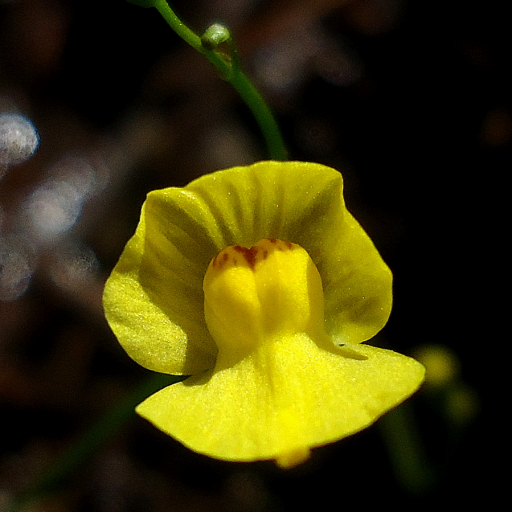
Plant Overview
Known as the Humped Bladderwort, this delicate aquatic plant is a master of disguise and one of nature’s most sophisticated hunters. While it looks like a harmless tangle of floating threads topped with cheerful yellow flowers, beneath the water's surface, it operates a series of high-speed suction traps. This cosmopolitan species is found on almost every continent, thriving in still ponds where it provides both beauty and natural pest control.
🔍 How to Identify
- 🌿 The Foliage: Unlike many plants, it lacks true roots. Instead, it forms a dense, submerged mat of hair-like green filaments (stolons) that float freely or anchor loosely in the mud.
- 🎈 The Bladders: If you look closely at the submerged stems, you’ll see tiny, translucent pear-shaped sacs. These are the "bladders" that give the plant its name, used to capture microscopic prey.
- 🌼 The Bloom: During the growing season, it sends up slender stalks above the waterline. These hold small, bright yellow flowers that look remarkably like tiny snapdragons or orchids.
🏡 In Your Garden
- 💧 Water Quality: In a home pond or "bog jar," this plant acts as a natural filter. It prefers soft, acidic water and strictly avoids "hard" water with high mineral content, which can clog its delicate traps.
- ☀️ Light & Growth: It thrives in full sun to partial shade. Because it is a "vacuum cleaner" for small organisms, it is excellent for controlling mosquito larvae and water fleas in outdoor water features. However, be mindful that in a small, nutrient-rich pond, it can grow aggressively and may need occasional thinning.
⚠️ Safety & Toxicity
- ✅ Status: Non-toxic and safe for humans and common household pets.
- 🐟 Aquatic Life: While harmless to adult fish, its traps can occasionally catch very tiny, newly hatched fish fry or shrimp larvae. If you are breeding delicate aquatic species, it is best to keep them separate from the Bladderwort.
✨ Fun Fact
The Humped Bladderwort holds a world record for speed! Its underwater traps are the fastest moving parts in the plant kingdom; they can "inhale" prey in less than a millisecond—far quicker than the blink of a human eye.

Detailed Care Instructions
| Humidity | Normal |
| Lighting | Full Sun |
| Difficulty | Medium |
| Hibernation | Cold Period |
| Temperature | 17°C - 27°C |
| Hardiness Zones | 6 - 9 |
To grow Utricularia gibba, also known as the humped bladderwort or bladderwort, you will need to follow these steps:
- Obtain seeds or plant divisions: Utricularia gibba can be propagated either by seeds or divisions. You can purchase seeds or obtain plant divisions from other enthusiasts or online sellers.
- Select a suitable container: Utricularia gibba is a small aquatic plant, so choose a small container like a glass jar or aquarium that can hold enough water. Ensure it has no leaks and can be easily covered.
- Prepare the planting medium: Fill the container with a suitable planting medium, such as a mixture of 50% peat moss and 50% perlite or sand. It is best to keep the medium well-draining as this plant prefers moist, but not waterlogged, conditions.
- Plant the seeds or divisions: If using seeds, sprinkle them lightly on the planting medium. If using divisions, plant them gently, ensuring the roots are buried slightly into the medium. Avoid burying the leaves.
- Add water: Fill the container with distilled water or rainwater to a depth of 1-2 inches (2.5-5 cm) above the planting medium. Tap water may contain chemicals harmful to the plant.
- Provide adequate lighting: Utricularia gibba requires a good amount of bright, indirect light for about 8-10 hours a day. Placing it near a window or using artificial lighting can help meet this requirement.
- Maintain suitable temperature and humidity: Utricularia gibba thrives in warm temperatures between 68-82°F (20-28°C). Additionally, maintaining a humidity level of around 60-80% is ideal for its growth.
- Avoid disturbing the water surface: Utricularia gibba uses tiny bladder traps to capture and digest small organisms. Disturbing the water surface, such as by splashing or overfeeding, can interfere with its feeding mechanism.
- Monitor and maintain water level: Regularly check the water level and top it up with distilled water or rainwater to maintain the appropriate depth. Avoid overfilling or letting the water level drop too low.
- Occasionally fertilize: Utricularia gibba is a carnivorous plant that gains additional nutrients from its prey. However, you can occasionally supplement its diet with diluted aquatic plant fertilizer to promote healthy growth. Use a fertilizer specifically formulated for carnivorous plants and follow the instructions carefully.
- Regularly remove any debris or dead plant matter: To maintain the health of the plant, remove any debris or dead plant matter to prevent rot and maintain water quality.
With proper care and attention to its specific requirements, you should be able to successfully grow Utricularia gibba.

Place in a window with dappled sun or a spot in the middle of a room. Or directly in a window facing west or east.

Utricularia Gibba is a carnivorous plant that is native to wetlands and bogs. It has a unique mechanism for trapping its prey, which involves small bladder-like structures on the leaves that suck in small aquatic organisms like water fleas and mosquito larvae. When it comes to watering this plant, there are a few things to keep in mind:
1. The soil should always be moist, but not waterlogged. This can be achieved by placing the pot in a saucer of water, or by watering the plant from above and allowing all excess water to drain away.
2. Utricularia Gibba prefers to be grown in nutrient-poor soils, so fertilizer should be avoided. Instead, it relies on the nutrients it gains from trapping and digesting its prey.
3. Because this plant is so water-dependent, it is important to keep an eye on the water level in the saucer or pot. If the water dries up, the plant will suffer or even die.
4. It is best to use distilled or rainwater to water this plant, as tap water can contain high levels of minerals and other substances that can harm it.
Overall, Utricularia Gibba is an interesting and unique plant that requires special care when it comes to watering. By following these tips, you can help your plant thrive and catch plenty of prey.
To fertilize this carnivorous plant, make a solution using distilled water and a specialized carnivorous plant fertilizer that contains low levels of nitrogen and high levels of phosphorus and potassium. Dilute the solution to half strength and carefully add it to the plant's soil or water tray every two weeks. Avoid using tap water or fertilizers containing urea or ammonia, as they can harm the plant. Always follow the manufacturer's instructions for the specific fertilizer you are using, and be sure not to over-fertilize, as this can also be detrimental to the plant's health.
Utricularia Gibba plant prefers a soil that is low in nutrients and has poor water retention. It requires a substrate that is airy, free-draining and well aerated to allow its roots to access air. A mixture of perlite, sand, and peat moss or coconut coir is a suitable soil blend for this plant. The soil mix should be moist but not waterlogged to prevent root rot. Avoid using soils that are too rich in nutrients or too dense as they can suffocate the plant roots. Additionally, it is crucial to avoid using tap water with high mineral content as this can turn the soil acidic, which is unsuitable for Utricularia Gibba plant. Rainwater, distilled water or reverse osmosis water are the best options for watering the plant.
Utricularia Gibba is a carnivorous plant known for its small size and unique trapping mechanism. Propagating the plant can be achieved through several methods, including division, seed propagation, and leaf or stem cuttings.
To propagate the Utricularia Gibba plant through division, carefully remove the plant from its pot and separate the clumps of roots and stems. The best time to do this is during the plant's growing season, typically in spring or summer. Place each division in a separate container with appropriate soil and water regularly until new growth appears.
Seed propagation is also a viable method for propagating Utricularia Gibba. Collect mature seeds from the plant and plant them in a well-draining soil mix. Keep the soil moist and place the container in a bright location with high humidity. Germination can take several weeks to months, and new growth will appear once the plant has established itself.
Leaf or stem cuttings can also be taken to propagate Utricularia Gibba. Cut a healthy stem or leaf from the parent plant and place it in moist soil, keeping it in a high humidity location. In a few weeks, new roots and stems should appear, indicating successful propagation.








