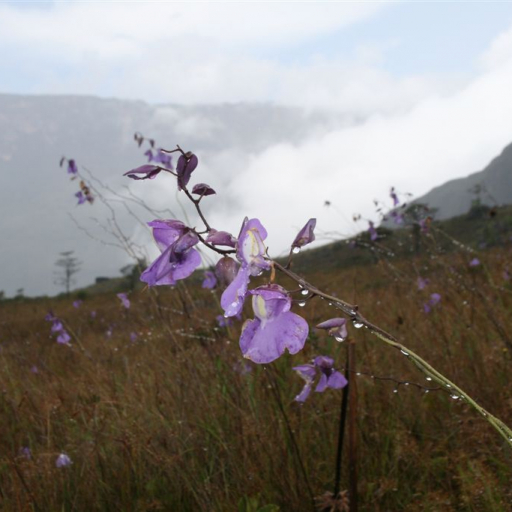
Plant Overview
Often hailed as the "King of Bladderworts," Utricularia humboldtii is a majestic carnivorous plant named after the legendary explorer Alexander von Humboldt. Native to the high-altitude "lost worlds" of the South American Tepuis, this plant is an architectural marvel that has evolved to live in the tiny pools of water found inside the leaves of giant bromeliads. It is widely considered one of the most beautiful and sophisticated members of the bladderwort family.
🔍 How to Identify
- 🌸 Imperial Blooms: It produces some of the largest flowers in the genus, featuring striking lilac or deep purple petals with a prominent yellow blotch at the throat, held high on tall, sturdy stalks.
- 🍃 Paddle-Shaped Foliage: Unlike many bladderworts that have hair-thin leaves, this species boasts thick, leathery, bright-green leaves shaped like tiny paddles or spoons.
- 🕸️ Submerged Snares: Beneath the surface of the water (or damp moss), it hiddenly operates complex "bladders"—tiny, vacuum-sealed traps that snap shut in milliseconds to swallow microscopic prey.
🏡 In Your Garden
- ☁️ The High-Altitude Specialist: Because it originates from the misty Guiana Highlands, it craves high humidity and cool nights. It is not a "beginner" plant; it thrives best in a terrarium or a dedicated orchid house where the air remains moist and moving.
- 💧 Pure Hydration Only: This plant is extremely sensitive to minerals. It should only be watered with rainwater, distilled water, or reverse osmosis water. It prefers a loose, airy substrate like live Sphagnum moss rather than traditional potting soil.
⚠️ Safety & Toxicity
- ✅ Safe for Humans and Pets: Utricularia humboldtii is non-toxic to people, cats, and dogs. It poses no chemical threat to the touch.
- 🦟 A Micro-Predator: While safe for us, it is a fierce predator in the microscopic world. It actively hunts mosquito larvae and tiny aquatic organisms, making it a "hidden helper" in controlling pests in damp environments.
✨ Fun Fact
Utricularia humboldtii is a botanical explorer! It sends out long, arching runners (stolons) through the air to "scout" for neighboring bromeliads. Once it finds a new pool of water in a nearby plant, it anchors itself and moves in, effectively hopping from one host to another across the forest.

Detailed Care Instructions
To grow Utricularia humboldtii (a bladderwort plant), you can follow these steps:
- Choose the right conditions: Utricularia humboldtii grows naturally in wetlands or boggy conditions. Create an environment that replicates these conditions, such as a terrarium or a tray with a layer of wet sphagnum moss.
- Prepare the growing medium: Use a mix of peat moss and perlite to create an acidic and well-draining substrate for the plant. Avoid using regular potting soil, as it retains too much moisture.
- Planting: Carefully transplant the Utricularia humboldtii plant into the prepared growing medium. Make sure not to damage the delicate roots or rhizomes. Place the plant on top of the damp substrate and press lightly to secure it.
- Watering: Fill the tray or terrarium with distilled water or rainwater. Ensure that the plant is always surrounded by water, keeping the substrate consistently moist. Avoid using tap water, as it may contain chemicals that can harm the plant.
- Light: Utricularia humboldtii prefers bright, indirect light. Place the plant in a location that receives moderate to bright light but avoids direct sunlight. T5 fluorescent lights can also be used for indoor cultivation.
- Feeding: Utricularia humboldtii is insectivorous, primarily relying on capturing and digesting small organisms using its bladder traps. In their natural environment, they catch insects or microorganisms. However, if you have a crowded tank, occasional feeding using fruit flies, small insects, or specialized carnivorous plant food may be beneficial.
- Maintenance: Keep an eye on the water level, ensuring that it does not dry out. Maintain the humidity within the terrarium or tray by covering it with a glass or plastic lid. If the plant starts to produce flowers, you may choose to let them bloom or remove them to redirect the plant's energy towards vegetative growth.
Remember to research and understand the specific care requirements of Utricularia humboldtii to provide it with the optimal growing conditions.
Utricularia Humboldtii is a type of plant which requires a specific method of watering in order to ensure its health and survival. The best way to water this plant is to place it in a tray with water up to the height of the soil. This allows the plant to absorb water from the bottom without getting its leaves wet. Additionally, it is important to avoid overwatering, as this can lead to root rot and other issues. As such, it is recommended to check the soil moisture level before watering and only do so when the top inch of the soil is dry to the touch. In general, this plant requires consistent but moderate watering, so it is important to establish a watering schedule that works best for the needs of the plant.
To fertilize this plant, use a balanced liquid fertilizer diluted to half strength, as this plant is sensitive to excess nutrients. Fertilize it regularly, approximately every 2-4 weeks during the growing season. During the dormant season, reduce frequency to once a month. Take care not to over-fertilize, as this can lead to stunted growth or damage. Always be sure to follow the manufacturer's instructions for the specific fertilizing product being used.
The ideal soil for Utricularia Humboldtii should be free-draining and contain a mixture of organic materials and mineral perlite. The soil pH should be slightly acidic, around 6.0-7.0. The plant prefers a moist but well-draining soil that doesn't stay waterlogged for long periods. A good mix can be made by using a blend of sphagnum peat moss, coarse sand, perlite, and orchid bark. The plant benefits from regular feeding with a diluted fertilizer solution and should not be allowed to dry out completely. It is important to avoid using any soils that contain high levels of fertilizers or chemicals as they can damage the plant's delicate root system.
Utricularia Humboldtii plant can be propagated through division or by taking stem cuttings.
To divide the plant, carefully remove it from its pot or growing medium and gently separate the individual plant sections. Each section should have its own set of leaves and a healthy root system. Replant the divided sections in pots or the desired growing medium.
To propagate by stem cuttings, select a healthy stem with at least two sets of leaves and cut it just below a leaf node. Dip the cut end in rooting hormone and plant it in a container with well-draining soil or growing medium.
Keep the new plants in a moist environment with high humidity and bright, indirect sunlight. Water regularly and avoid overwatering. Within a few weeks, new growth should appear, indicating successful propagation.








