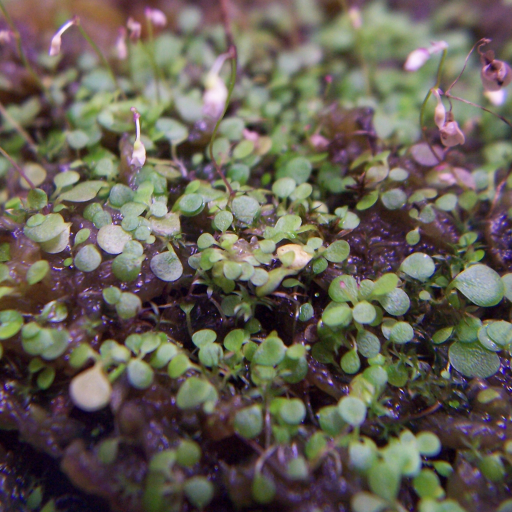
Plant Overview
Often called the "Striped Bladderwort," this tiny marvel is a master of botanical deception. At first glance, it looks like a miniature orchid floating atop mossy rocks, but beneath its delicate beauty lies a sophisticated subterranean hunter. This species is a favorite among terrarium enthusiasts who treat it like a "living jewel" due to its intricate flowers and fascinating carnivorous lifestyle.
🔍 How to Identify
- 🌸 The Flower: The blooms are tiny but spectacular, featuring a ruffled white or pale lilac "skirt" (the lower lip) decorated with a bright yellow blotch and delicate purple stripes or veins.
- 🍃 The Foliage: Unlike common garden plants, its leaves are minute, rounded, or kidney-shaped rosettes that hug the surface. They are often so small they are easily mistaken for a patch of moss.
- 🕸️ The Traps: Hidden beneath the moss or substrate are "utricles"—microscopic, translucent bladders. These are the plant's stomach and weapon, used to vacuum up tiny organisms.
🏡 In Your Garden
- 💧 The "Cloud Forest" Vibe: In nature, this plant is often lithophytic, meaning it grows on wet rocks near waterfalls. To keep it happy at home, it needs high humidity and a substrate that stays consistently damp but never stagnant.
- 🧪 No Soil Allowed: This plant will perish in standard potting soil. It requires a nutrient-poor medium, such as live Sphagnum moss or a peat/perlite mix. It gets its "fertilizer" by catching microscopic prey, so mineral-heavy water or soil will actually overwhelm its delicate system.
⚠️ Safety & Toxicity
- ✅ Safe for Roommates: Utricularia striatula is non-toxic to humans, cats, and dogs. It poses no threat to anything larger than a water flea.
- 🛡️ Fragility Warning: While it isn't poisonous, it is incredibly fragile. Physical handling can easily damage the tiny leaves and the "stolons" (stems) that connect the traps, so it is best kept as a "look-but-don't-touch" specimen in a glass enclosure.
✨ Fun Fact
The suction traps of the Bladderwort are considered the fastest-moving structures in the entire plant kingdom. When a tiny organism touches a "trigger hair," the trap door swings open and shut in less than a millisecond—literally faster than the blink of a human eye!

Detailed Care Instructions
To grow Utricularia Striatula plant, follow these steps:
- Choose a suitable growing medium: Utricularia Striatula prefers a mix of sphagnum peat moss and perlite or a mixture of peat moss and river sand. This combination provides good drainage and promotes root growth.
- Select a pot or container: Utricularia Striatula does best in shallow containers or trays. Make sure the container has drainage holes to prevent waterlogging.
- Plant the seeds or plantlets: Utricularia Striatula can be propagated from seeds or plantlets. Plant seeds or gently separate plantlets from established plants and place them on the growing medium. Avoid burying the plantlets; gently press them onto the surface of the soil.
- Provide proper lighting: Utricularia Striatula requires bright, indirect light to thrive. Place the pot in a location that receives bright, filtered sunlight or use artificial grow lights if necessary. Avoid exposing the plant to direct sunlight as it can scorch the leaves.
- Maintain high humidity: Utricularia Striatula prefers high humidity levels. You can achieve this by placing the pot on a tray filled with water and pebbles to increase humidity through evaporation. Alternatively, use a humidifier or mist the plant regularly.
- Water appropriately: Utricularia Striatula requires consistently moist soil. Water the plant regularly, ensuring the soil is never fully dry. Use distilled or rainwater as tap water may contain chemicals that can harm the plant.
- Avoid overfeeding: Utricularia Striatula is a carnivorous plant that obtains nutrients from trapping and digesting small insects. In a terrarium or greenhouse setting, it will usually find its own food. However, if you choose to feed it, you can offer small insects such as fruit flies or mosquito larvae occasionally.
- Maintain optimal temperature: Utricularia Striatula prefers temperatures between 21-27°C (70-80°F). Avoid exposing the plant to extreme temperature fluctuations or cold drafts.
- Monitor for pests: Keep an eye out for common pests like aphids, spider mites, or scale insects. If you notice any infestations, treat them with an appropriate insecticidal soap or horticultural oil.
Remember, Utricularia Striatula is a delicate plant that requires careful attention to its growing conditions. With proper care and attention, you can enjoy the unique beauty of this species in your collection.

Place in a window with dappled sun or a spot in the middle of a room. Or directly in a window facing west or east.

Utricularia Striatula is a sensitive type of plant that requires specific watering techniques. It is recommended to use purified water or rainwater to water this plant, as it is sensitive to chlorine and other chemicals commonly found in tap water.
When watering, it is important to avoid getting water on the leaves, which can cause damage. The best method is to water from the bottom of the pot by placing it in a tray of water and allowing the plant to soak up the moisture.
It is important not to let the soil dry out completely, as this can cause stress to the plant and lead to wilting or death. However, overwatering can also be harmful, so it is important to let the soil drain properly and avoid letting the plant sit in standing water.
The frequency of watering will depend on the environment and growing conditions, but generally, it is recommended to water every few days to once a week. It is important to monitor the soil moisture level and adjust accordingly.
To fertilize this plant, you can use a liquid fertilizer solution that is low in nutrients, such as a 1-1-1 ratio, or a quarter-strength solution of a balanced fertilizer. Apply the fertilizer once every two weeks by adding it to the water that you use for watering. It is important to not over-fertilize this plant as it can be sensitive to high nutrient levels. It is also recommended to flush the soil with plain water every few months to prevent the build-up of excessive fertilizer salts.
Utricularia Striatula plant requires a soil mixture that is acidic and nutrient-poor. A suitable soil mix can be made by combining peat moss, coarse sand, and perlite in equal proportions. It is important to ensure that the soil mix is well-drained, as this plant is sensitive to waterlogging. Additionally, the soil should be kept moist but not soaked, as excess moisture can cause the plant to rot. It is recommended to use rainwater or distilled water for watering, as tap water can contain minerals that are harmful to the plant.
To propagate this particular plant, one should first gather the necessary materials such as a pair of sterilized scissors or clippers, a clean container filled with distilled water or rainwater, and a small amount of peat moss or sphagnum moss.
Next, select a healthy portion of the plant that includes both leaves and stem, with a length of approximately 3-4 inches. Use the sterilized scissors or clippers to make a clean cut through the stem, being careful not to damage any of the surrounding tissue.
Remove any leaves from the lower portion of the stem, leaving only two or three at the top. Dip the stem into a rooting hormone powder (if desired), and then place it into the container of distilled or rainwater.
Ensure that the leaves are above the water line and that the stem is submerged in the water. Place the container in a warm, bright location with indirect sunlight.
After a few weeks, small roots should begin to emerge from the submerged portion of the stem. Once these roots have grown to be approximately 1 inch in length, carefully transplant the new plant into a small pot filled with a mix of peat moss or sphagnum moss and sand or perlite.
Place the pot in a warm, bright location with indirect sunlight and keep the soil consistently moist (but not waterlogged). With proper care, the new plant should begin to establish itself and grow into a healthy specimen.








