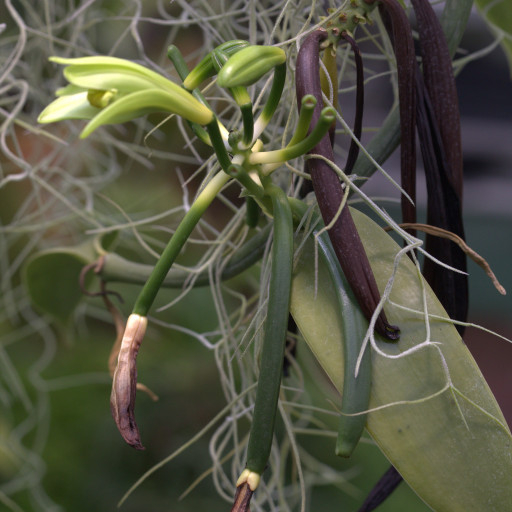
Plant Overview
Known as the "Vanilla Orchid" or "Flat-leaved Vanilla," this botanical celebrity is the primary source of the world’s favorite flavor. Native to the tropical forests of Mexico and Central America, it is a climbing vine that bridges the gap between delicate orchids and productive crops. It’s a true tropical treasure that weaves together the worlds of ancient Aztec history and modern culinary delight.
🔍 How to Identify
- 🍃 Succulent Leaves: Thick, bright green, and lance-shaped leaves that grow alternately along the vine. They have a slightly waxy texture designed to store moisture.
- 🧗 Climbing Habit: A vigorous "liana" (climbing vine) that uses zig-zagging stems and white aerial roots to cling onto trees or support structures.
- 🌸 Ghostly Blooms: Elegant, pale greenish-yellow flowers that appear in clusters. Each blossom is famously fleeting, opening for only a single morning before fading.
🏡 In Your Garden
- 🚿 Humidity is King: This orchid thrives in "steamy" environments. It craves high humidity (around 80%) and prefers its aerial roots to be misted regularly, mimicking the damp air of a rainforest canopy.
- 🧗 Support System: Because it is a natural climber, it requires a sturdy trellis or a "totem" covered in sphagnum moss. This allows its aerial roots to anchor firmly, which encourages the plant to reach maturity and eventually flower.
- 🐝 The Human Pollinator: In its native habitat, it relies on specific stingless Melipona bees. If you want to harvest vanilla beans at home, you must play matchmaker and hand-pollinate the flowers with a toothpick during their brief four-hour opening window.
⚠️ Safety & Toxicity
- 🛡️ General Safety: Vanilla Planifolia is considered non-toxic to cats, dogs, and horses, making it a "pet-safe" choice for indoor jungles.
- 🧪 Sap Sensitivity: Use caution when pruning or taking cuttings. The milky sap contains calcium oxalate crystals, which can cause mild skin irritation or a "vanillism" rash in sensitive individuals.
- 🚫 Raw Parts: While the cured beans are a kitchen staple, the raw green pods and leaves are not edible and should not be consumed.
✨ Fun Fact
For centuries, the secret to producing vanilla beans was a mystery outside of Mexico. In 1841, a 12-year-old enslaved boy named Edmond Albius on the island of Réunion discovered a simple manual pollination method using a blade of grass. His technique is still used by vanilla farmers worldwide today!

Detailed Care Instructions
| Humidity | Normal |
| Lighting | Part Sun |
| Difficulty | Medium |
| Temperature | 18°C - 25°C |
| Hardiness Zones | 10A - 11B |
To grow a Vanilla Planifolia plant, also known as Vanilla orchid, follow these steps:
- Climate: Vanilla orchids thrive in warm and humid environments. They need temperatures between 60-85°F (15-30°C) and humidity levels of around 80%. If you live in a cooler or dry climate, consider growing the plant indoors or in a greenhouse.
- Light: Vanilla orchids prefer bright, indirect sunlight. Avoid exposing them to direct sunlight, as it can scorch the leaves. Place them near a window with filtered light or use fluorescent grow lights if growing indoors.
- Soil: Use a well-draining potting mix that retains some moisture. A mix of orchid bark, sphagnum moss, and perlite is ideal.
- Container: Choose a container with good drainage holes and ensure that it is large enough for the root system to grow. A plastic or clay pot works well.
- Watering: Keep the soil consistently moist but not soaking wet. Water the plant when the top inch of soil feels dry. Make sure to water the roots thoroughly but avoid letting the plant sit in standing water.
- Fertilization: Use a balanced orchid fertilizer, diluted according to the instructions on the package. Feed the plant every two weeks during the growing season (spring and summer) and reduce feeding in the dormant season (fall and winter).
- Support: Vanilla orchids are epiphytes, so they naturally climb and require support. Provide a stake or trellis system to allow the plant to climb and spread its aerial roots.
- Pollination: Vanilla orchids require hand-pollination in most cases since their natural pollinators are absent in cultivation. Gently transfer pollen from the anther to the stigma using a toothpick or small brush.
- Pruning: Regularly prune the plant to promote growth and maintain its shape. Remove any dead or yellowing leaves or flowers.
- Repotting: Repot the orchid every 1-2 years or when the pot becomes crowded or the plant outgrows its current container. Use fresh potting mix and carefully transfer the plant to its new pot.
- Patience: Vanilla orchids are slow-growing plants, and it can take several years for them to reach maturity and produce flowers. Be patient, and with proper care, your Vanilla Planifolia plant will eventually yield vanilla pods.
Remember to research and understand the specific needs of Vanilla orchids as they can be challenging to grow. It's also recommended to consult local gardening experts or join a horticulture society for further guidance.

Place in a window with dappled sun or a spot in the middle of a room. Or directly in a window facing west or east.

To water this plant, first, check the soil moisture level by touching the soil with your finger. If it feels dry, then it is time to water the plant. Use room temperature water and pour it slowly onto the soil until it starts draining out of the bottom of the pot. Make sure not to water the leaves as it can cause damage or disease. Wait for the soil to dry out completely before watering again, as overwatering can cause root rot and other problems. It is recommended to water this plant, keeping in mind the specific environmental conditions and lighting in the area.
To fertilize this plant, use a balanced fertilizer with equal amounts of nitrogen, phosphorus, and potassium. Dilute the fertilizer to half strength and apply once a month during the growing season. Be careful not to over-fertilize as it can harm the plant.
Vanilla Planifolia plant requires a specific type of soil to thrive. The soil should be porous and well-draining, with a pH level between 5.5 and 7.5. It should be rich in organic matter, such as peat moss, compost, or well-rotted manure. The soil should also be able to hold moisture, but not be waterlogged.
It is recommended to use a mix of soil and other materials to provide the best conditions for the Vanilla Planifolia plant. For example, a ratio of 2 parts peat moss, 2 parts perlite, and 1 part vermiculite can be used to create a well-draining, moisture-retaining soil mix.
Additionally, it is important to avoid using soil that is too heavy or clay-based, as this can lead to poor drainage and root rot. Regular fertilization is also important for the health and growth of Vanilla Planifolia plant.
Vanilla Planifolia is a plant that can be propagated through several means. One way to do so is by taking stem cuttings from a mature plant. The stem cutting should be about 4-6 inches long and have at least three nodes. The cutting should be taken from the plant's healthy and vigorous growth.
The bottom two leaves should be removed from the cutting, and the cutting should be dipped in rooting hormone before planting it in a well-draining potting mix. The potting mix should be kept moist but not waterlogged, and the cutting should be placed in a warm, humid environment to encourage rooting.
Another way to propagate Vanilla Planifolia is by layering. This is done by bending a low-hanging branch of the plant down to the ground and covering a section of it with soil. After a few weeks, roots should form, and the branch can be cut from the parent plant and potted up.
Finally, Vanilla Planifolia can also be propagated from seeds. The seeds should be soaked for several hours in water before being planted in a well-draining potting mix. The soil should be kept moist, and the seedlings should be grown in a warm, humid environment until they are large enough to be transplanted.
Common pests of the bourbon vanilla include Scale insect, mealybugs, spider mites, thrips. Make a habit of checking your bourbon vanilla frequently for pests so that any infestations can be caught and managed early.








