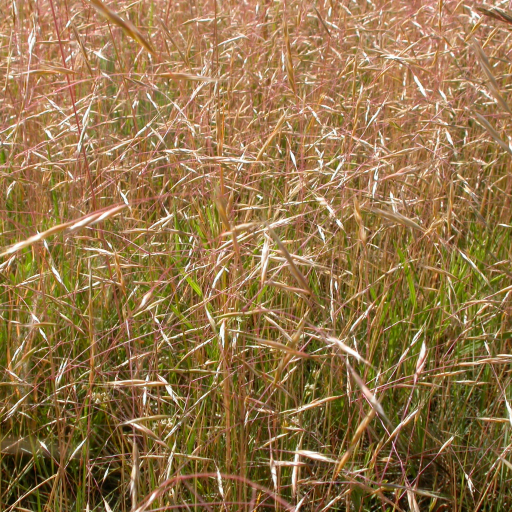
Plant Overview
Often called "North Africa Grass" or "Wiregrass," Ventenata dubia is an unwelcome guest in many North American landscapes. This slender, deceptively delicate-looking grass is a master of takeover, quickly transforming lush meadows into "wire" fields. While it might catch the light with a beautiful silvery sheen, it is a tough, competitive annual that has earned a reputation as a major ecological troublemaker.
🔍 How to Identify
- 🌾 The Stems: The stalks are extremely thin, stiff, and wiry—hence the name "Wiregrass." If you run your fingers along them, they feel rough and have distinct reddish-purple tints at the joints (nodes).
- ✨ The Seed Heads: It produces large, airy clusters that look like tiny oat plants. These clusters have a shimmering, silvery-green appearance when young, turning a parched tawny-gold as they dry.
- 🌀 The Awns: Each seed features a long, bent hair called an "awn." These hairs are sensitive to moisture and will actually twist and uncoil as humidity changes.
🏡 In Your Garden & Landscape
- 🌱 Aggressive Competition: This plant is considered a noxious weed in many regions. It thrives in disturbed soil and is particularly fond of areas that stay wet in the winter but bake dry in the summer. It can quickly choke out desirable lawn grasses or wildflowers.
- 🚜 Agricultural Nuisance: Because the stems contain high amounts of silica, they are very "glassy" and tough. Livestock usually refuse to eat it, and it can even dull the blades of hay-cutting equipment. If you see it appearing in your pasture, it is best to manage it early before it goes to seed.
⚠️ Safety & Toxicity
- 🟢 Status: Generally non-toxic to humans, dogs, and cats.
- 🐕 Physical Irritation: While not chemically poisonous, the long, stiff seeds (awns) are designed to hitchhike. They can become painfully lodged in a pet's fur, ears, or between their toes, occasionally leading to skin irritation or infections if not removed.
✨ Fun Fact
The seeds of Ventenata dubia are "self-planting." Because the awns twist and turn in response to moisture, the seed effectively "walks" across the ground and drills itself into cracks in the soil!

Detailed Care Instructions
To grow Ventenata Dubia plant, or ventenata grass, follow these steps:
- Soil: Ensure the soil is well-drained, loamy, and fertile. Ventenata Dubia prefers alkaline soils with a pH range of 5.5-7.5.
- Planting Time: Plant ventenata grass seeds in the early spring or late fall when soil temperatures are between 41-59°F (5-15°C).
- Seed Collection or Purchase: Collect seeds directly from mature ventenata plants if available. Otherwise, purchase certified seeds from reputable suppliers or nurseries.
- Seed Preparation: Treat the seeds with a fungicide to prevent fungal infections before planting. This step is optional but helps to increase germination rates.
- Planting Method: There are two primary options for planting ventenata grass: drilling or broadcasting.
- Drilling: Use a seed drill to plant the seeds at a depth of 0.25-0.5 inches (0.6-1.3 cm) in rows with 4-6 inch (10-15 cm) spacing between them.
- Broadcasting: Spread the seeds evenly over the planting area and then lightly rake them into the soil. Coconut coir or straw mulch can be used to cover the seeds lightly.
- Drilling: Use a seed drill to plant the seeds at a depth of 0.25-0.5 inches (0.6-1.3 cm) in rows with 4-6 inch (10-15 cm) spacing between them.
- Watering: Water the planted area immediately after sowing to ensure good seed-soil contact. Keep the soil moist until the seeds germinate.
- Germination: Germination typically takes about 10-14 days, but it can vary. Maintain consistent soil moisture during this period.
- Thinning: Once the ventenata grass reaches a height of 2-3 inches (5-7.6 cm), thin the seedlings to allow for proper growth. Leave 4-6 inches (10-15 cm) of spacing between the plants.
- Maintenance: Regularly water the plants to maintain soil moisture and provide adequate sunlight. Fertilize annually with a balanced, slow-release fertilizer to promote healthy growth.
- Weed Control: Ventenata Dubia is relatively resistant to weed competition. However, remove any intrusive weeds manually to avoid competition for nutrients and sunlight.
- Harvest: Ventenata Dubia is typically harvested for hay or forage production during its seeding stage. Cut the grass when the seedheads have formed but are still green. Allow the cuttings to dry before baling.
By following these steps, you can successfully grow Ventenata Dubia plant.

Place in a bright room that is sun drenched almost all day. Or directly in a south-facing window.

To water this plant, make sure to thoroughly wet the soil around its roots. Avoid getting water on the plant leaves as this can cause fungal growth or disease. Depending on the climate and soil conditions, watering frequency may vary. It is best to monitor the soil moisture levels regularly and adjust watering as necessary. In general, it is better to water deeply less frequently than to give the plant shallow waterings more often. Additionally, it is important to make sure the plant has good drainage to avoid overwatering or root rot.
The fertilizing requirements for this plant are specific and need to be followed for optimal growth. Apply a balanced fertilizer with a ratio of 10-10-10 in early spring before new growth appears. Follow up with a second application in mid to late summer. Avoid over-fertilizing as it can lead to excessive vegetative growth and weaken the plant's overall health. Additionally, ensure the fertilizer is water-soluble and well mixed with soil to ensure adequate nutrient absorption.
The soil best suited for this plant is a mixture of well-draining, sandy loam soil with enough organic matter to retain moisture. A pH range of 6.0 to 7.5 is preferred. The soil should be rich with nutrients like phosphorus and potassium to aid in the plant's growth. It is also important to make sure the soil does not become waterlogged, as this can cause root rot and other issues. Additionally, the soil should have proper aeration to allow for root development and prevent compaction. Adding mulch to the soil surface can help to maintain moisture and prevent weed growth.
- Collect the seeds – Collect seed heads from mature plants in late summer to early fall when the seeds are dry and have turned brown. Cut off the seed heads and place them in a paper bag. Leave the bag in a warm, dry place for a few days to allow the seeds to fully dry.
- Prepare the soil – Ventenata Dubia prefers well-draining soil that is nutrient-rich. Clear the area where you want to plant the seeds of any weeds or debris and work some compost into the soil. Rake the soil smooth.
- Sow the seeds – Scatter the seeds over the prepared area, spacing them about 1-2 inches apart. Gently press the seeds into the soil with your hand. Do not cover the seeds with soil, as they need light to germinate.
- Water – Water the area well after planting the seeds. Keep the soil moist but not waterlogged until the seeds germinate.
- Germination – Ventenata Dubia seeds typically germinate within 7-10 days. The seedlings will have two leaves, known as cotyledons, which look different from the adult leaves. Thin out the seedlings if they are too crowded.
- Care – Once the seedlings are established, they will require less water. Water once a week, deep enough to soak the soil. Fertilize with an all-purpose fertilizer every two to four weeks.
- Transplanting – When the seedlings reach about 3-4 inches tall, they can be transplanted to their permanent location. Choose a location with full sun to partial shade. Plant the seedlings about 6-8 inches apart, and water well after planting. Keep the soil moist until the seedlings are established.








