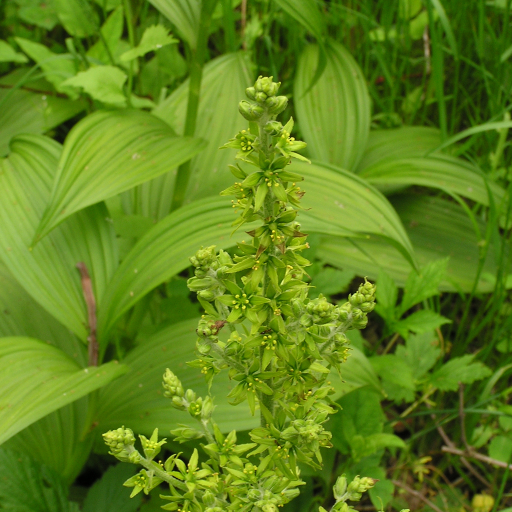
Plant Overview
Often called the Green False Hellebore or Indian Poke, Veratrum viride is a striking, architectural perennial that commands attention in the damp woodlands and marshes of North America. While its lush, accordion-folded leaves might look like a tropical decoration, this plant carries a mysterious and perilous history. It is a master of disguise, frequently appearing in early spring just as edible wild leeks emerge, leading to a dangerous game of botanical "look-alikes."
🔍 How to Identify
- 🍃 Ribbed Foliage: The leaves are large, oval, and deeply "pleated" or ribbed, giving them a distinct textured appearance similar to a folding fan.
- 🌀 Spiral Arrangement: Leaves grow in a tight, spiraling pattern around a thick, central stalk, which can reach heights of 3 to 6 feet when in bloom.
- 💚 Star-Shaped Blooms: In early summer, the plant produces a large, branching cluster (panicle) of small, yellowish-green flowers that blend in with the surrounding greenery.
🏡 In Your Garden
- 💧 Wetland Warrior: This plant is a "hydrophile," meaning it thrives in saturated soils. It is a perfect choice for bog gardens, rain gardens, or the muddy edges of a pond where other perennials might suffer from "wet feet."
- 🐌 Slow & Steady: It grows from a thick underground rhizome and is notoriously slow to establish. It resents being moved due to its complex root system, so it’s best to plant it in a permanent, shady spot and leave it undisturbed.
⚠️ Safety & Toxicity
- 🚫 High Toxicity: WARNING: All parts of this plant are highly toxic if ingested. It contains potent steroidal alkaloids that can cause a dangerous drop in blood pressure and heart rate.
- 🐾 Pet & Livestock Danger: It is lethal to cats, dogs, and horses. In the wild, it is known for poisoning sheep and cattle who accidentally graze on its succulent green shoots in early spring.
- 🧤 Contact Warning: Some people develop skin irritation or a rash simply from handling the foliage. It is highly recommended to wear gloves when pruning or transplanting.
✨ Fun Fact
- 🏹 The Ordeal of Leadership: Some Indigenous tribes in the Pacific Northwest historically used this plant in a "leadership test." Potential chiefs would ingest a small, controlled portion of the toxic root; the man who survived the ordeal or recovered the fastest was believed to possess the spiritual power required to lead the tribe. (Please, never attempt this—leave the testing to history!)

Detailed Care Instructions
| Color | White, Yellow, Green |
| Soil Ph | Acidic To Alkaline |
| Humidity | Dry |
| Lighting | Shade |
| Toxicity | Toxic |
| Soil Type | Rich, Well-Draining |
| Bloom Time | Summer |
| Difficulty | Easy |
| Plant Type | Herbaceous Perennial |
| Hibernation | Cold Period |
| Mature Size | 2 To 6 Feet Tall |
| Native Area | United States And Canada |
| Sun Exposure | Full Sun To Partial Shade |
| Hardiness Zones | 3-8 |
To grow Veratrum Viride (also known as Indian hellebore), follow these steps:
- Choose a suitable location: Veratrum Viride prefers partial to full shade, as it naturally grows in forested areas. Select a spot with well-draining soil that stays consistently moist.
- Prepare the soil: Loosen the soil in the selected area using a garden fork or tiller. Remove any weeds or large rocks, and mix in organic matter such as compost or peat moss to improve drainage and fertility.
- Planting: Dig a hole that is slightly wider and deeper than the root ball of the Veratrum Viride plant. Place the plant in the hole, making sure that the crown (where the stem meets the roots) is level with or slightly above the soil surface. Backfill the hole with soil, gently firming it around the plant.
- Watering: Water the newly planted Veratrum Viride thoroughly and keep the soil moist, but not saturated. Provide regular deep waterings, especially during dry periods.
- Mulching: Apply a layer of organic mulch, such as wood chips or shredded leaves, around the base of the Veratrum Viride plant. Mulching helps retain moisture, suppress weeds, and regulate soil temperature.
- Fertilizing: Veratrum Viride generally does not require heavy feeding, but you may add a slow-release, balanced fertilizer in spring if the leaves appear pale or stunted.
- Maintenance: Remove any weeds that may compete for nutrients and moisture. Also, monitor for pests or diseases, as Veratrum Viride can be susceptible to slug damage. Protect the plant from strong winds to prevent bending or breaking.
- Propagation: Veratrum Viride can be propagated through division. In early spring or late fall, lift the plant from the ground and carefully separate the root mass into several sections, ensuring that each section has viable roots and buds. Replant the divisions immediately.
Note: Veratrum Viride contains toxic alkaloids and should be handled with care. Keep it out of reach of children and pets, and avoid contact with skin or ingestion.

Place in a bright room that is sun drenched almost all day. Or directly in a south-facing window.

To effectively water this plant, it is important to provide it with consistent moisture levels. One way to accomplish this is to check the soil daily and water thoroughly whenever the top inch of soil feels dry to the touch. It is important to ensure that the water is able to penetrate deep into the soil, as this plant has a deep root system and requires deep watering. However, it is important not to overwater the plant, as this can lead to root rot and other issues. Therefore, it is recommended to water slowly and deeply, allowing the water to soak in before repeating the process. Additionally, it is important to avoid getting water directly on the leaves of the plant, as this can lead to fungal issues.
The Veratrum Viride plant should be fertilized in early spring with a balanced, slow-release fertilizer. Use a fertilizer with equal parts nitrogen, phosphorus, and potassium, with a ratio of 10-10-10 or 5-5-5. Apply the fertilizer at a rate of one pound per 100 square feet of soil. Water the fertilizer into the soil thoroughly after application. Avoid over-fertilizing as this can lead to excessive growth and weaken the plant.
Veratrum viride plant requires a specific type of soil that is rich in organic matter and moist. The soil should be well-draining and have a pH level between 5.5 and 7.5. It also needs to be a good nutrient-rich soil that can provide adequate nutrition to the plant. Additionally, the soil should be free from any harmful pathogens or debris that may adversely affect the growth of the plant. It is recommended to use a mixture of peat moss, compost, and loamy soil to provide the perfect growing environment for the plant.
To propagate this particular plant, you should first gather the seeds from mature plants that have already produced seed pods. The seeds should be collected at the end of the growing season, typically towards the end of summer or beginning of fall.
Once you have gathered the seeds, you should prepare a suitable seed bed or container with well-draining soil. You can use a mixture of peat moss, perlite, and sand to create a plant-friendly growing medium.
After you have prepared the soil, you should sprinkle the seeds evenly across the surface and gently press them into the soil with your finger or a small tool. Make sure not to cover the seeds with too much soil, as they need to get light to grow successfully.
Next, you should water the soil lightly and cover the container or seedbed with plastic wrap or a greenhouse dome to create a humid environment that will encourage germination. Make sure to keep the soil and seeds moist but not overly wet, as too much water can cause them to rot.
After a few weeks, the seeds should start to sprout. Once they have grown large enough to handle, you can transplant them into individual small pots or a larger container filled with a soil mixture suited to their growth requirements.
Make sure to give your young plants enough light, warmth, and water to help them grow strong and healthy. With proper care, they should be ready to transplant into a larger garden or outdoor growing space within a few months.








