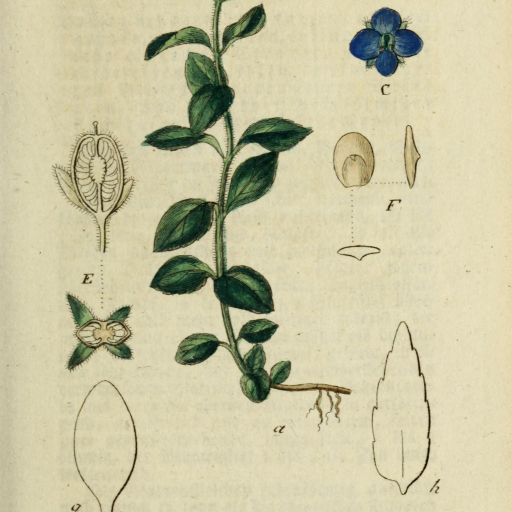
Plant Overview
Known as the "Sapphire of the Summits," the Alpine Speedwell is a tiny but tough traveler found in the high-altitude meadows and rocky crevices of the Northern Hemisphere. This resilient perennial is a master of survival, hugging the ground to avoid harsh mountain winds while displaying clusters of vibrant, deep-blue flowers that seem to mirror the alpine sky.
🔍 How to Identify
- 🌸 The Flowers: Dense, short spikes of tiny, four-lobed blossoms. They are characterized by a deep indigo or violet-blue hue, often with a subtle white "eye" or center.
- 🍃 The Foliage: Small, oval to elliptical leaves that grow in opposite pairs along the stem. They are typically a dark, glossy green and may be slightly hairy or smooth depending on the specific subspecies.
- 🌱 Growth Habit: A low-growing, mat-forming plant that rarely reaches more than 4 to 6 inches in height, spreading via short underground runners to create a lush groundcover.
🏡 In Your Garden
- 🪨 The "Cool Feet" Rule: In a home garden, this plant mimics its mountain home by requiring excellent drainage. It thrives in rock gardens or "scree" beds where its roots can stay cool and moist under stones while its leaves soak up the sun.
- ❄️ Heat Sensitivity: Because it is an arctic-alpine species, it struggles in humid, tropical heat. It is best suited for northern climates or high-altitude gardens where nighttime temperatures drop significantly.
⚠️ Safety & Toxicity
- ✅ Safe Status: Veronica alpina is generally considered non-toxic to humans, dogs, and cats. It is a very "friendly" addition to a family garden.
- 🧤 Skin Sensitivity: While not poisonous, some individuals with sensitive skin may experience very mild irritation from the tiny hairs on the stems. General gardening gloves are usually more than enough protection.
✨ Fun Fact
The genus name Veronica is believed to be a tribute to Saint Veronica. In Christian folklore, she wiped the face of Jesus with her veil, and his image was miraculously imprinted on the cloth; some say the delicate markings and "face-like" appearance of the Speedwell flower petals remind observers of that sacred image.

Detailed Care Instructions
To successfully grow Veronica Alpina, also known as Alpine Speedwell, you should follow these steps:
- Choose the right location: Veronica Alpina thrives in full sun to partial shade. Ensure the area has well-draining soil and good air circulation.
- Prepare the soil: Before planting, amend the soil with organic matter such as compost or peat moss to improve drainage and fertility.
- Planting: Dig a hole slightly larger than the plant's root ball and place it in the hole, ensuring the top of the root ball is level with or slightly above the soil surface. Backfill the hole and gently firm the soil around the plant.
- Watering: Initially, water the plant deeply and ensure the soil stays evenly moist until it establishes. Once established, Veronica Alpina is drought-tolerant but will still benefit from occasional watering during prolonged dry periods.
- Mulching: Apply a layer of mulch around the plant, but ensure it doesn't touch the stems. Mulch helps retain moisture, suppresses weeds, and protects the roots from extreme temperatures.
- Pruning: Veronica Alpina typically doesn't require much pruning. However, you can trim back any dead or damaged growth in late winter or early spring to promote new growth.
- Fertilizing: Alpine Speedwell generally doesn't need excessive fertilization. However, you can apply a balanced, slow-release fertilizer in early spring to provide necessary nutrients.
- Support: Some Veronica Alpina varieties may benefit from staking or support if they have weak stems or tend to flop. Use small stakes or plant supports to keep the plants upright.
- Monitoring pests and diseases: Veronica Alpina is generally resistant to pests and diseases. However, keep an eye out for any signs of aphids, slugs, snails, or powdery mildew. If detected, treat accordingly with appropriate organic or chemical controls.
- Propagation: Veronica Alpina can be propagated by dividing well-established plants in spring or autumn. Carefully lift the plant, divide it into smaller sections with roots attached, and replant them in the desired location.
By following these steps and providing proper care, you should be able to grow healthy and flourishing Veronica Alpina plants.

Place in a bright room that is sun drenched almost all day. Or directly in a south-facing window.

Veronica Alpina is a plant that belongs to the genus Veronica and is commonly referred to as a speedwell. It is an herbaceous perennial that requires regular watering to thrive.
When watering Veronica Alpina, it is important to make sure that the soil is moist but not waterlogged. Overwatering can lead to root rot and fungal diseases, which can be detrimental to the plant's health.
One way to ensure proper watering is to use a watering can or a hose with a gentle spray nozzle. Water should be applied gently to the soil at the base of the plant, making sure not to splash water onto the leaves or flowers.
It is best to water Veronica Alpina in the morning or early evening, when the temperatures are cooler and the water has a chance to be absorbed by the plant before the heat of the day sets in. In warmer weather or dry climates, the plant may require more frequent watering, but be careful not to overwater.
Additionally, it is important to monitor the soil moisture level and adjust watering frequency as needed to ensure the plant is receiving the appropriate amount of water to remain healthy and thrive.
To fertilize this plant, use a balanced, water-soluble fertilizer with an equal ratio of nitrogen, phosphorus, and potassium. Apply the fertilizer once every two to three weeks during the growing season, diluting it to half-strength and watering deeply into the soil to avoid fertilizer runoff. Avoid fertilizing during the dormant season, and only fertilize mature, established plants.
Veronica Alpina requires well-draining soil with a moderate amount of fertility. The soil should be loamy and have a slightly acidic pH range. It's important to avoid soils that are too heavy or too sandy, as these can negatively impact the plant's growth and health. A good soil mix for Veronica Alpina may include a combination of peat moss, perlite, and a high-quality potting mix. It's also recommended to incorporate a slow-release fertilizer into the soil mix before planting. Overall, the soil should provide adequate moisture retention while also allowing for proper drainage.
To propagate this plant, start by taking a stem cutting with a clean, sharp pair of garden shears. Make sure the cutting is at least four inches long and has several leaves on it. Remove any flowers or buds from the stem cutting.
Next, prepare a container with well-draining soil that is moist but not waterlogged. Dip the cut end of the stem cutting into rooting hormone and insert it into the soil, making sure that at least two-thirds of the stem is buried. Pat the soil around the cutting gently to ensure it is secure.
Cover the container with a clear plastic bag and place it in a location with bright, indirect sunlight. Check the soil every few days to make sure it remains moist.
After a few weeks, check to see if roots have formed by gently tugging on the stem cutting. If there is resistance, roots have formed and it is safe to remove the plastic bag and move the container to a brighter location.
Once the plant has grown to a reasonable size, it can be transplanted in a permanent location outside.








