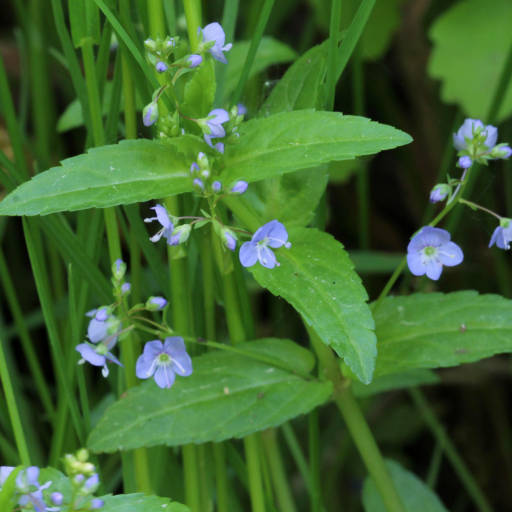
Plant Overview
Known as the American Brooklime, this charming semi-aquatic perennial is nature's own "water-welcoming" carpet. Often found decorating the muddy edges of springs and slow-moving streams, its nickname "Speedwell" comes from an old English greeting meaning "farewell" or "good luck," suggesting the flower was once a lucky charm for travelers.
🔍 How to Identify
- 🌸 The Bloom: Look for tiny, four-petaled flowers in shades of sky blue to pale violet, often decorated with delicate darker veins. The lowest petal is typically narrower than the others.
- 🍃 Fleshy Leaves: Unlike many of its land-dwelling cousins, this plant features succulent, oblong-to-oval leaves that grow in opposite pairs along the stem. They have slightly toothed edges and a smooth, waxy texture.
- 🌱 Creeping Stems: The stems are often reddish and have a habit of "creeping" along the mud. They easily root wherever their joints (nodes) touch the ground, allowing the plant to form dense, lush mats.
🏡 In Your Garden
- 💧 Wet Feet Required: This isn't your average garden plant; it is a true "hydrophile." If you are adding it to a backyard pond or a rain garden, ensure the soil remains consistently saturated or submerged in shallow water.
- 🌿 Natural Filter: In a pond ecosystem, American Brooklime acts as a wonderful biological filter. It helps absorb excess nutrients from the water, which can help keep algae growth in check and provide shelter for small aquatic life.
⚠️ Safety & Toxicity
- ✅ General Safety: American Brooklime is considered non-toxic to humans, cats, and dogs. It has a long history of being used as an edible herb.
- 🧪 Water Quality Warning: While the plant itself is safe, because it grows in slow-moving water, it can harbor parasites or soak up pollutants from the environment. Never forage it for consumption unless you are 100% certain the water source is pristine.
✨ Fun Fact
Early North American settlers and sailors used American Brooklime as a secret weapon against scurvy! Because the leaves stay green late into the season and are packed with Vitamin C, it was often eaten as a "spring tonic" to restore health after long, cold winters.

Detailed Care Instructions
| Humidity | High |
| Lighting | Part Sun |
| Difficulty | Medium |
| Hibernation | Cold Period |
| Temperature | 15°C - 21°C |
| Hardiness Zones | 3A - 8B |
To grow Veronica Americana, also known as American brooklime, you can follow these steps:
- Choose a suitable location: American brooklime prefers moist soil and partial shade. Select a spot in your garden or landscape that receives dappled sunlight or morning sun with afternoon shade.
- Prepare the soil: Ensure the soil is well-draining and rich in organic matter. Add compost or well-rotted manure to improve soil fertility and drainage.
- Sow or transplant: You have two options for starting American brooklime. You can sow seeds directly into the prepared soil in early spring or late summer. Alternatively, you can start the plants indoors in seed trays or pots about 6-8 weeks before the last frost date in your area and then transplant them outdoors once the soil has warmed up.
- Sowing seeds: If you choose to sow seeds directly, scatter them over the prepared soil and gently press them into the surface. Keep the soil consistently moist until the seeds germinate.
- Transplanting: When transplanting seedlings, dig a hole slightly larger than the root ball of each plant and place them at the same depth they were in the seed tray. Firmly press the soil around the roots, ensuring good soil-to-root contact.
- Watering: American brooklime requires consistently moist soil to thrive. Water your plants regularly, especially during dry spells, and make sure the soil stays evenly moist but not waterlogged.
- Mulching: Apply a layer of organic mulch, such as straw or wood chips, around the plants to help retain soil moisture and suppress weed growth.
- Pruning: Trim back any damaged or leggy growth to encourage bushier growth. Regular pruning can help maintain the plant's shape and encourage more compact growth.
- Fertilization: American brooklime generally doesn't require heavy fertilization. If desired, you can feed the plants with a balanced, slow-release fertilizer once or twice during the growing season, following the manufacturer's instructions.
- Pests and diseases: American brooklime is relatively pest and disease resistant. However, keep an eye out for slugs or snails, and take appropriate measures to control them if necessary.
By following these guidelines, you can successfully grow Veronica Americana in your garden or landscape.

Place in a bright room that is sun drenched almost all day. Or directly in a south-facing window.

To water this plant, ensure that the soil is dry before watering. When watering, do not allow water to accumulate on the surface of the soil as this may cause rotting of the roots. Make sure to water the plant directly at the soil level, avoiding getting water on the leaves. It is recommended to water this plant deeply, allowing the water to seep down into the roots. You can check if the plant needs water by testing the soil moisture level with your finger or by using a soil moisture meter. During the winter season, reduce the amount of water given to the plant as it enters a period of dormancy.
To fertilize the Veronica Americana plant, use a balanced fertilizer with equal portions of nitrogen, phosphorus, and potassium. Apply the fertilizer in the early spring, just before new growth emerges. Repeat the application every 6-8 weeks during the growing season. Be sure to follow the manufacturer's instructions regarding the proper amount and frequency of fertilizer application.
The ideal soil for this plant should be well-draining and rich in organic matter. It should have a pH range of 6 to 7.5. The soil should have good water holding capacity, but not be waterlogged. The plant can tolerate different soil types, including clay, loamy, and sandy soils. However, it prefers neutral to alkaline soils. The soil should be prepared before planting, and organic matter such as compost or manure can be added to improve soil quality. The plant is tolerant of moderate drought, so the soil should not be too wet or too dry.
To propagate this plant, you will need to obtain a cutting from a healthy and mature plant. Using sanitized pruning shears, make a clean cut on a stem that is about four to six inches long. Remove any leaves or flowers from the bottom two-thirds of the stem.
Next, prepare a pot with moist potting mix. Make a small hole in the center of the soil with a pencil and gently place the cutting into the hole. Pack the soil firmly around the stem to ensure it stays upright.
Water the cutting until the soil is thoroughly moist but not saturated. Cover the pot with a plastic bag or clear plastic wrap to create a humid environment around the cutting. Place the pot in a bright location but out of direct sunlight.
Check the cutting regularly to ensure the soil remains moist and to see if any roots have formed. Once roots have formed, which typically takes 2-4 weeks, remove the plastic cover and gradually acclimate the plant to normal indoor or outdoor conditions.








