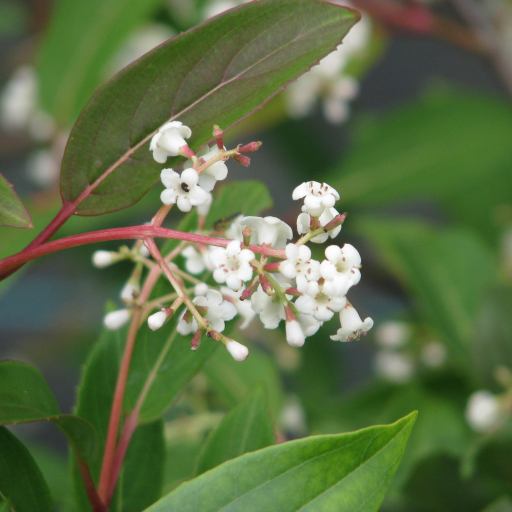
Plant Overview
Known as the "Rosy Viburnum," this elegant Himalayan native is a master of color transformation. It starts the spring season with clusters of fragrant white blossoms that slowly blush into a soft, romantic pink, earning it the species name erubescens (meaning "reddening"). It is a sophisticated choice for gardeners who want a vertical accent that offers visual interest through three different seasons.
🔍 How to Identify
- 🍃 The Blushing Foliage: The leaves are elongated and sharply serrated, often emerging with a subtle bronzy-red tint in spring before maturing into a deep, glossy green.
- 🌸 Color-Changing Blooms: Look for pendulous, drooping clusters of tubular flowers that transition from snowy white to a delicate rose-pink as they age.
- 🍒 Jeweled Berries: In late summer, the plant produces small, oval fruits that start as a waxy, bright red before ripening into a dark, ink-like purple.
🏡 In Your Garden
- 🪴 Woodland Roots: This plant thrives best in "dappled shade," mimicking its original home in the mountain forests of Asia. It prefers consistently moist, slightly acidic soil; if the ground dries out too much, the leaves may wilt and lose their glossy sheen.
- ✂️ Graceful Aging: It has a naturally arching, fountain-like habit. To keep it healthy, avoid heavy "box" pruning; instead, selectively remove the oldest stems at the base after the flowers fade to encourage fresh, vigorous growth.
⚠️ Safety & Toxicity
- 🛡️ Mildly Toxic: While not considered deadly, the Rosy Viburnum should be treated with caution in homes with curious explorers.
- 🐾 Pets & Kids: Ingesting large amounts of the berries or leaves can lead to stomach upset, nausea, or localized irritation in the mouth. Additionally, the sap may cause a mild contact rash on sensitive skin, so wearing gloves during pruning is recommended.
✨ Fun Fact
🏔️ High Altitude Heritage: In its native Himalayan habitat, this resilient shrub can be found growing at altitudes of up to 3,000 meters (nearly 10,000 feet), where it survives thin air and cold mountain winds that would wither many other garden ornamentals.

Detailed Care Instructions
To grow Viburnum erubescens, also known as the Southern Arrowwood, you can follow these steps:
- Select a suitable location: Viburnum erubescens thrives in full sun to partial shade. Choose a spot with well-draining soil that is slightly acidic. The ideal pH range is between 5.5 and 6.5.
- Prepare the soil: Before planting, amend the soil with organic matter like compost or peat moss to improve drainage and fertility. Remove any weeds or grass from the planting area.
- Planting: Dig a hole that is slightly larger than the root ball of the plant. Place the plant in the hole, making sure it is at the same depth as it was in the nursery container. Backfill the hole with soil, gently firming it around the roots.
- Watering: After planting, water the Viburnum erubescens deeply, ensuring the root ball is thoroughly saturated. Water regularly, especially during dry periods, but avoid overwatering, as the plant prefers well-drained soil.
- Mulching: Apply a layer of organic mulch, such as wood chips or bark, around the base of the plant. Mulch helps conserve moisture, suppresses weeds, and regulates soil temperature.
- Pruning and maintenance: Viburnum erubescens generally requires minimal pruning. However, you can prune lightly after flowering to maintain shape and remove any dead or damaged branches.
- Fertilizing: In early spring, you can apply a balanced slow-release fertilizer according to the package instructions. This will help promote healthy growth and abundant blooms.
- Pests and diseases: Viburnum erubescens is generally resistant to pests and diseases, but it can occasionally be affected by aphids, scale insects, or powdery mildew. Monitor the plant regularly, and if necessary, treat with appropriate pesticides or horticultural oils.
- Propagation: Viburnum erubescens can be propagated through semi-hardwood cuttings taken in late summer or early fall. Dip the cuttings in rooting hormone and place them in a well-draining rooting medium. Provide bottom heat and misting to encourage root growth.
By following these steps, you can successfully grow Viburnum erubescens and enjoy its beautiful flowers, fragrance, and fall foliage.

Place in a window with dappled sun or a spot in the middle of a room. Or directly in a window facing west or east.

When watering this plant, it is important to take note of the soil moisture and the environmental conditions where it is located. The soil should be checked for dryness before watering. Watering should be done slowly and thoroughly to ensure that the plant's root ball is thoroughly saturated. Care should be taken to avoid overwatering, which can lead to root rot and other problems. It is also important to avoid getting water on the leaves and flowers of the plant, as this can lead to fungus and disease. Ideally, the plant should be watered in the morning or early afternoon, allowing sufficient time for the foliage to dry before evening. Regularly checking the plant's soil moisture and adjusting watering frequency based on the plant's needs is key to maintaining its health.
To fertilize this plant, use a balanced 10-10-10 fertilizer in early spring before new growth appears and again in early summer after flowering has finished. Apply the fertilizer evenly around the base of the plant, making sure not to get any on the foliage or stems. Water the plant thoroughly after fertilizing to help the nutrients penetrate the soil. Avoid fertilizing in late summer or fall, as this can encourage new growth that may not have time to harden off before winter, leading to winter damage.
The ideal type of soil to use for the Viburnum Erubescens plant is a well-draining, loamy soil with a slightly acidic pH level. The soil should be rich in organic matter and have good water retention properties. It is important to avoid using soil that is too heavy or compacted, as this can lead to poor drainage and root rot. Additionally, it is recommended to mix in some sand or perlite to improve drainage and aeration. Overall, the soil should be nutrient-rich and well-suited for the Viburnum Erubescens plant to thrive and grow healthy.
Viburnum Erubescens plant can be propagated by taking semi-hardwood cuttings in the early autumn. Select healthy stems with a thickness of about 1 cm, and a length of about 10-15 cm. Cut the stem at a 45-degree angle just below a node. Remove the leaves from the lower half of the stem. Dip the cut end in rooting hormone powder. Plant the stem in a pot filled with well-draining soil mixture consisting of equal parts of sand and peat moss. Water the plant thoroughly and cover the pot with a plastic bag to create a humid environment. Place the pot in a bright, but indirect light. Keep the soil moist, but not too wet. After about 8-10 weeks, the stem should have developed roots and can be transplanted into a larger pot or directly into the ground.








