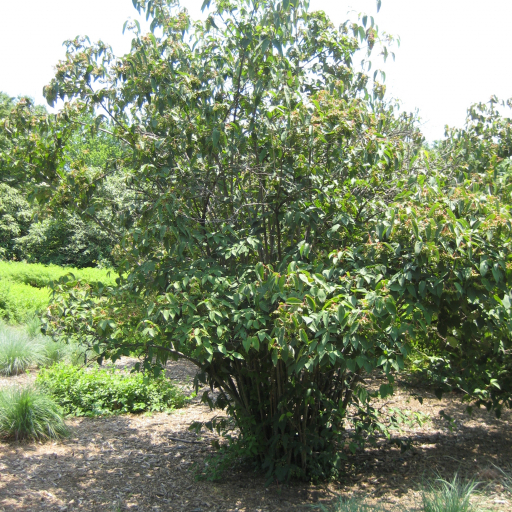
Plant Overview
Often called the Tea Viburnum, this elegant Chinese native is the undisputed showstopper of the autumn garden. While many shrubs begin to fade as summer ends, Viburnum setigerum waits for the first chill to ignite its branches with heavy, dangling clusters of brilliant red berries. It earned its common name from monks on Mount Omei who traditionally harvested its leaves to brew a sweet, medicinal tea.
🔍 How to Identify
- 🍃 Lance-Shaped Leaves: The foliage is dark green, long, and pointed (ovate-lanceolate). The leaves have a distinct, slightly leathery texture and often develop a subtle metallic sheen.
- 🌼 Flat-Topped Blooms: In late spring, the shrub produces "cymes"—flat clusters of tiny, creamy-white flowers that serve as a landing pad for butterflies.
- 🍒 Drooping Berry Clusters: The most iconic feature is the heavy, pendulous clusters of glossy, egg-shaped berries that transition from orange to a brilliant, glowing scarlet by October.
🏡 In Your Garden
- ☀️ Sun for Jewels: While this Viburnum is quite shade-tolerant, the "rule of thumb" is that more sun equals more berries. If planted in deep shade, the plant remains healthy but will sacrifice its colorful fruit display.
- ✂️ Managing the "Leggy" Look: This species has a naturally upright, multi-stemmed habit that can become "leggy" (tall and thin at the bottom) over time. To keep it lush, perform "renewal pruning" by cutting the oldest stems down to the ground every few years.
- 🐝 Pollination Partners: Though it is somewhat self-fertile, you will get a much more dramatic "wow factor" of berries if you plant more than one specimen nearby to encourage cross-pollination.
⚠️ Safety & Toxicity
- 🐾 Pet Warning: Like many Viburnums, the berries and leaves contain saponins. While birds love them, they can cause stomach upset, vomiting, or drooling in dogs and cats if consumed in large quantities.
- 👶 Child Safety: The berries look like candy but are generally considered unpalatable and mildly toxic to humans. They may cause nausea or diarrhea if eaten raw.
- 🧤 Sap Sensitivity: Some individuals may experience mild skin redness or itching when pruning the branches. Wearing gloves is recommended if you have sensitive skin.
✨ Fun Fact
In its native China, this plant was so revered by monks that the tea brewed from its leaves was often gifted to visiting pilgrims as a "sweet dew" to provide energy for their journey up the sacred mountains.

Detailed Care Instructions
To grow Viburnum setigerum (tea viburnum), follow these steps:
- Choose the right location: Viburnum setigerum prefers full sun to partial shade. Ensure that the selected spot receives at least 6 to 8 hours of sunlight per day.
- Soil preparation: Prepare the soil by removing any weeds or grass. Viburnums prefer well-draining soil rich in organic matter. If the soil is heavy clay or sandy, amend it with compost or well-rotted manure to improve its fertility and drainage.
- Planting: Dig a hole that is slightly larger and deeper than the root ball of the plant. Place the Viburnum setigerum in the hole, ensuring that the top of the root ball is level with the soil surface. Backfill the hole with soil, gently firming it around the roots.
- Watering: After planting, water the plant thoroughly. Keep the soil moist but not waterlogged, especially during the first growing season to help establish the roots. Once established, Viburnum setigerum is moderately drought-tolerant.
- Mulching: Apply a layer of organic mulch, such as wood chips or shredded bark, around the base of the plant. This will help retain moisture, suppress weed growth, and regulate soil temperature.
- Pruning: Viburnum setigerum generally does not require regular pruning. However, you can trim back any dead, damaged, or diseased branches. Pruning can be done in late winter or early spring before new growth emerges.
- Fertilizing: Feed the plant with a balanced slow-release fertilizer in early spring and again in late spring. Follow the product instructions for application rates. Avoid over-fertilizing, as it can lead to excessive vegetative growth with reduced flowering.
- Pests and diseases: Viburnum setigerum is relatively resistant to pests and diseases, but it may occasionally be affected by aphids, scale insects, or powdery mildew. Monitor your plant regularly and take appropriate action if any issues arise.
By following these guidelines and providing proper care, your Viburnum setigerum plant should thrive and grow well.

Place in a bright room that is sun drenched almost all day. Or directly in a south-facing window.

Viburnum setigerum is a plant that requires regular watering to ensure optimal growth and health. Here are some details on how to provide adequate water to this specific plant without mentioning its common names:
1. Determine the watering needs: Viburnum setigerum prefers a consistently moist soil but not waterlogged conditions. Assess the plant's specific requirements by considering its location, soil type, and weather conditions.
2. Consider the plant's age and stage: Younger plants generally require more frequent watering compared to well-established ones. Newly planted Viburnum setigerum may need watering every 2-3 days initially, while mature ones may only require watering once a week.
3. Observe signs of water stress: Monitor the plant for signs of water stress, such as wilting leaves or a dull appearance. These indicate insufficient moisture levels. Adjust your watering frequency accordingly.
4. Water deeply and evenly: When watering Viburnum setigerum, make sure to provide a thorough soak rather than surface watering. This encourages the roots to grow deeper into the soil, creating a strong and resilient plant. Apply water evenly around the base, covering the entire root zone.
5. Time your watering: Water Viburnum setigerum in the early morning or late evening when temperatures are cooler. Avoid watering during the hottest parts of the day, as the excessive heat may cause water to evaporate before it reaches the plant's roots.
6. Use appropriate watering techniques: Use a gentle stream or sprinkler to water the plant, ensuring the water is delivered evenly and without causing damage. Avoid using high-pressure jets or over-watering, as these can lead to root rot or other problems.
7. Consider the weather: Adjust your watering schedule based on the weather conditions. In hot and dry periods, you may need to increase the frequency of watering, while during cool and rainy periods, you can reduce it to avoid waterlogging.
8. Mulch to retain moisture: Apply a layer of organic mulch, such as bark chips or compost, around the base of Viburnum setigerum. This helps retain moisture, prevents weed growth, and regulates soil temperature. Mulching also reduces the frequency of watering required.
Remember, these guidelines serve as general recommendations and may need to be adjusted based on the specific needs and conditions of your Viburnum setigerum plant. Regular monitoring and observation will help you provide the appropriate amount of water for its optimal growth and health.
To effectively fertilize Viburnum Setigerum plant, you can follow these instructions:
- Begin fertilizing in early spring, just as new growth starts to emerge.
- Choose a balanced slow-release fertilizer with an N-P-K ratio of 10-10-10 or 20-20-20.
- Read and follow the manufacturer's instructions regarding the application rate specific to your plant's size and age.
- Spread the fertilizer evenly around the base of the plant, avoiding direct contact with the stem. Keep it at least 6 inches away from the plant.
- Gently work the fertilizer into the top inch of soil, making sure it is well-distributed and incorporated.
- Water the plant thoroughly after fertilizing to help dissolve and distribute the nutrients into the root zone.
- Avoid over-fertilizing, as it may lead to excessive growth and reduce flowering.
- Repeat the fertilization process annually, preferably in early spring, to support healthy growth and blooming of the Viburnum Setigerum plant.
For planting Viburnum Setigerum, it is recommended to use well-draining soil with a slightly acidic pH range of 5.5-6.5. The soil should be rich with organic matter and able to hold moisture without becoming waterlogged. It is important to avoid heavy soils with a clay texture, as they can retain too much water and lead to root rot. Additionally, the soil should be worked to a depth of at least 12 inches before planting to ensure proper root development. The use of a slow-release fertilizer during planting can promote healthy growth. Regular watering, particularly during dry periods, is also recommended to keep the soil moist and prevent stress on the plant.
To propagate Viburnum setigerum, you can follow these steps:
- Select a healthy and mature plant from which to take cuttings. Look for a plant that is at least 2-3 years old and has strong, disease-free branches.
- Take softwood or hardwood cuttings during late spring or early summer when the plant is actively growing. Softwood cuttings are taken from the current season's growth, while hardwood cuttings are collected from previous year's growth. Both types can be successful for propagation.
- Prepare a rooting medium by mixing equal parts of peat moss and perlite. Fill a small container or a seed tray with this mixture, ensuring it is moist but not waterlogged.
- Take cuttings that are around 4-6 inches in length, using a sharp and clean pair of pruning shears or a knife. Remove any leaves from the lower half of the cutting, leaving a few leaves at the top.
- Dip the lower end of each cutting in rooting hormone powder. This will help stimulate the development of roots.
- Make small holes in the prepared rooting medium, either using a pencil or your finger. Space the holes around 2-3 inches apart.
- Insert the cuttings into the holes you made in the rooting medium, making sure at least two nodes are buried underground. Nodes are the areas where leaves emerge.
- Gently press the rooting medium around the cuttings to ensure good contact and stability.
- Place the container or seed tray in a warm location with bright, indirect sunlight. Maintain a temperature between 65-75°F (18-24°C) to encourage root development.
- Keep the rooting medium consistently moist, but not excessively wet. Use a misting spray bottle or cover the container with a plastic bag to create a humid environment for the cuttings.
- Wait patiently, as rooting can take several weeks to a few months. Monitor the cuttings for any signs of growth, such as the emergence of new leaves, which indicates successful rooting.
- Once the cuttings have developed strong root systems, carefully transplant them into individual pots filled with a well-draining potting mix. Provide them with proper care, including adequate sunlight, regular watering, and fertilization.
By following these propagation steps, you can successfully propagate Viburnum setigerum and grow new plants from cuttings.








