Plant Overview
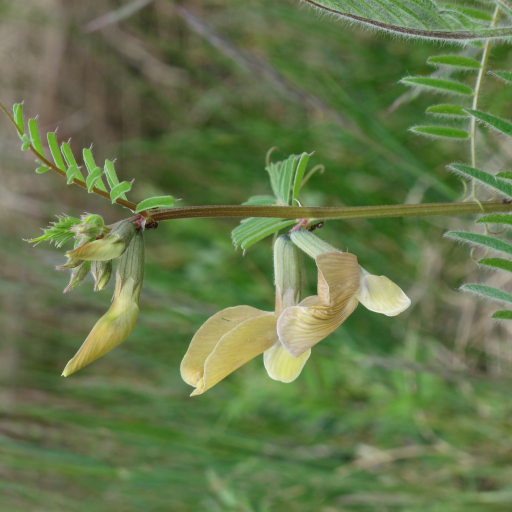
Commonly known as the Large-yellow Vetch, this delicate climber is a master of subtle beauty in the meadow. While many of its cousins sport tiny, purple blooms, Vicia grandiflora stands out with surprisingly oversized, buttery-yellow blossoms that look like miniature orchids. It is often celebrated by organic gardeners as a "green manure" because of its secret talent for healing and enriching the earth from beneath the soil.
🔍 How to Identify
- 🌼 The Blooms: Features large, pea-like flowers that are pale yellow or creamy, often tinged with a soft purple or green vein toward the center.
- 🌿 The Foliage: Feathery, compound leaves (pinnate) arranged in pairs along a central stem, ending in a thin, wiry climbing tendril.
- 🥨 The Stems: Slender, slightly hairy, and somewhat square-shaped, reaching out to scramble over neighboring plants or garden fences.
🏡 In Your Garden
- 🧪 Soil Alchemist: This plant is a "nitrogen fixer." It has a symbiotic relationship with soil bacteria that allows it to pull nitrogen from the air and store it in the ground, naturally fertilizing the area for future plants.
- 🦋 Pollinator Magnet: Its deep nectar wells are a favorite for long-tongued bumblebees and early-season butterflies, making it a fantastic choice for a rewilding project or a wildlife-friendly corner.
- 🌱 Growth Habit: Because it uses tendrils to "hook" onto things, it doesn't need a heavy trellis—a simple string or even a neighboring sturdy plant is enough for it to climb.
⚠️ Safety & Toxicity
- 🐾 Mildly Toxic: While the plant is generally safe to handle, the seeds (contained in small, pea-like pods) should never be eaten.
- 🧒 Caution: Keep out of reach of curious children and pets. Consuming large quantities of Vetch seeds can cause digestive upset or, in rare cases, a condition called lathyrism due to specific amino acids found in the seeds.
✨ Fun Fact
Vetches are famous for their "sleeping" habits. This is a phenomenon called nyctinasty, where the leaves fold together at night to protect themselves from the dew and then "wake up" and unfold as soon as the morning sun hits them!

Detailed Care Instructions
To grow Vicia grandiflora plants, also known as the bigflower vetch, follow these steps:
- Choose a suitable location: Vicia grandiflora plants prefer full sun to partial shade. They can tolerate various soil types but prefer well-drained soil.
- Prepare the soil: Before planting, ensure the soil is loose, fertile, and free of weeds. You can amend the soil with compost or organic matter to improve its quality.
- Germinate the seeds: Start by soaking the seeds in water for 24 hours before sowing. This helps speed up germination. After soaking, plant the seeds directly in the prepared soil, sowing them at a depth of 1-1.5 inches.
- Provide water: Keep the soil moist but not saturated. Regularly water the plants, especially during dry spells or when there is a lack of rainfall.
- Support structures: Vicia grandiflora plants can grow up to 6 feet tall and require support to prevent falling over. You can use stakes or trellises to provide structure and support.
- Mulch: Adding a layer of organic mulch around the base of the plant helps retain moisture, suppress weed growth, and regulate soil temperature.
- Fertilize: Vicia grandiflora plants are nitrogen-fixing legumes, meaning they can acquire nitrogen from the air. However, if you notice slow growth or yellowing leaves, you can apply a balanced, slow-release fertilizer to encourage healthy growth.
- Pruning and maintenance: Keep an eye out for any pests or diseases and take necessary actions to prevent or treat them. Prune the plants if they become too crowded or to encourage branching.
- Harvesting: Vicia grandiflora plants produce attractive purple flowers followed by seed pods. You can harvest the pods once they turn brown and slightly dry. The seeds can be used for propagation or for sowing in the following season.
By following these steps, you should be able to successfully grow Vicia grandiflora plants in your garden.

Place in a bright room that is sun drenched almost all day. Or directly in a south-facing window.

To water this particular plant, it is important to maintain the soil's moisture level. The best way to ensure this is by watering the plant deeply and slowly, allowing the water to penetrate the soil. It is recommended to water the plant about once a week, or when the top inch of soil feels dry to the touch. When watering, avoid getting water on the leaves and focus on the soil around the base of the plant. Additionally, this plant prefers well-draining soil, so be sure not to over-water, which can lead to root rot.
To fertilize this plant, use a balanced fertilizer with equal parts nitrogen, phosphorus, and potassium. Apply the fertilizer in early spring before the plant begins to grow, and once again in mid-summer. Avoid over-fertilization, as it can cause excessive foliage growth at the expense of flower production. Water the plant well after fertilizing to help the nutrients penetrate the soil and reach the roots.
For Vicia Grandiflora plant, it is best to use a well-draining soil with a pH level between 6.0-7.5. The soil should be rich in organic matter and have good water retention capacity. It is recommended to mix the soil with a slow-release fertilizer before planting the seeds. Additionally, the soil should be kept moist but not waterlogged.
To propagate this plant, start by collecting seeds from mature plants. The seeds should be sown in well-draining soil in a pot or directly in the garden in the spring or fall. Keep the soil moist but not waterlogged and maintain consistent moderate temperatures.
Another method of propagation is through stem cuttings. Select a healthy stem about 4-6 inches in length and make a clean cut with sharp shears. Remove the lower leaves from the stem and dip the end in rooting hormone. Plant the stem in well-draining soil and keep the soil moist until roots develop.
Finally, this plant can also be propagated through division. This is best done in the spring or fall when the plant is not actively growing. Dig up the entire plant and carefully separate the roots into smaller sections. Replant the sections in well-draining soil and water thoroughly.








