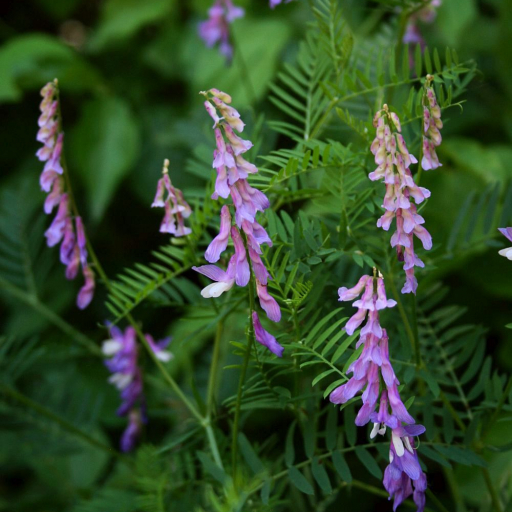
Plant Overview
Known for its elegant, draping habit and vibrant purple blooms, the Fine-leaved Vetch is a delicate "hitchhiker" of the meadow world. Often called the "Slim-leaf Vetch," this perennial member of the pea family is native to Europe and Western Asia but has traveled far as a beneficial wildflower. It is a master of vertical movement, using its thin tendrils to weave through grasses like living lace.
🔍 How to Identify
- 🌿 Feathery Foliage: The leaves are divided into 6 to 12 pairs of very narrow, linear leaflets, giving the plant a soft, airy appearance compared to its bulkier cousins.
- 🟣 One-Sided Blooms: It produces long, striking clusters (racemes) of 15 to 30 violet-purple flowers. Interestingly, all the flowers tend to face the same direction on the stalk.
- 🧗 Climbing Tendrils: At the very tip of each leaf, you will find branched, thread-like tendrils that the plant uses to grip onto nearby vegetation for support.
🏡 In Your Garden
- 🌱 The Soil Healer: This plant is a "nitrogen fixer." It works with specialized soil bacteria to turn atmospheric nitrogen into a form other plants can use, making it an excellent choice for rejuvenating tired soil.
- ☀️ Meadow dweller: In a garden setting, it thrives in sunny spots with well-drained soil. Because it is a scrambler, it’s best tucked into a wildflower patch where it can lean on sturdier grasses or a low trellis without smothering smaller neighbors.
⚠️ Safety & Toxicity
- 🐾 Mildly Toxic: Like many members of the Vicia genus, the seeds can be harmful if eaten in large quantities. They contain cyanogenic glycosides and other compounds that can cause "lathyrism" (a neurological condition) if consumed as a major part of a diet.
- 👶 Keep Away from Kids: While the purple flowers are tempting, ensure children do not snack on the small, pea-like pods that appear after blooming, as they can cause severe stomach upset.
✨ Fun Fact
Fine-leaved Vetch is a high-protein "superfood" for the larvae of many butterflies, particularly the stunning Silver-studded Blue. By planting it, you aren't just adding color; you're running a boutique nursery for local pollinators!

Detailed Care Instructions
To grow Vicia tenuifolia plant, also known as the slender vetch or chickling vetch, you can follow these steps:
- Seed selection: Purchase Vicia tenuifolia seeds from a reputable supplier or collect them from mature plants in the wild.
- Planting location: Choose a location that receives full sun to partial shade. Ensure that the soil is well-draining and rich in organic matter.
- Soil preparation: Till the soil to a depth of 6-8 inches and remove any weeds or rocks. Add organic matter, such as compost, to improve soil fertility and moisture retention.
- Seed treatment: To enhance germination, you can soak the seeds in warm water for 24 hours before planting. Alternatively, you can scarify the seeds by gently rubbing them between two sheets of sandpaper to break their hard seed coat.
- Planting: Sow the seeds directly into the prepared soil at a depth of 1-2 inches, spacing them about 4-6 inches apart. Cover the seeds with soil and gently press down to ensure good seed-to-soil contact.
- Watering: After planting, water the soil thoroughly to ensure moisture penetrates to the seeds. Keep the soil consistently moist but not waterlogged during germination and establishment.
- Care and maintenance: Once the plants emerge, thin them to maintain a spacing of about 8-10 inches between plants. Regularly water the plants to keep the soil evenly moist. Mulching around the plants can help conserve moisture and suppress weed growth.
- Fertilizing: Vicia tenuifolia is a nitrogen-fixing legume, so additional fertilization is usually not necessary. However, if your soil is poor, you can apply a balanced organic fertilizer according to the manufacturer's instructions.
- Support: Vicia tenuifolia is a climbing plant that benefits from support. Install trellises, stakes, or other structures to support the growing vines.
- Harvesting: Depending on your intentions, you can harvest the plant for its seeds, leaves, or as a cover crop. For seed harvest, allow the pods to fully ripen and dry on the plant before collecting. For greens, you can cut the young leaves as required.
By following these steps, you should be able to successfully grow Vicia tenuifolia plants.

Place in a bright room that is sun drenched almost all day. Or directly in a south-facing window.

To water the Vicia Tenuifolia plant, you must carefully monitor the soil moisture levels and ensure that it never dries out completely. When watering, apply a slow and steady flow of water to the base of the plant, giving it enough time to fully absorb the moisture without becoming waterlogged. It is important to avoid getting water on the foliage as this can lead to fungal diseases and other issues. Additionally, be mindful of the temperature and humidity levels in the environment, as this will affect the plant's water requirements. During periods of high heat or low humidity, you may need to water more frequently to prevent the soil from drying out too quickly. Finally, be sure to use a well-draining soil mix and a container with adequate drainage holes to prevent water from accumulating in the roots and causing root rot.
For best results, fertilize this plant with a balanced fertilizer in the early spring before new growth appears. Use a low-nitrogen fertilizer as too much nitrogen may make the plant grow too quickly and weaken the stems. Apply the fertilizer evenly around the base of the plant and water thoroughly. Repeat the application every 4-6 weeks throughout the growing season, ending in late summer or early fall. Be sure to follow the manufacturer's instructions regarding dosage and frequency of application.
The ideal soil for Vicia Tenuifolia plants is one that is well-draining and rich in organic matter. The pH level should be slightly acidic to neutral, ranging from 5.8 to 7.0. The soil should also be fertile and provide good aeration to the roots. It is recommended to add compost or well-rotted manure to the soil before planting Vicia Tenuifolia. Additionally, it is important to avoid using heavy clay soils or soils that are prone to waterlogging, as this can lead to root rot and other diseases. Overall, the soil used for Vicia Tenuifolia should be high-quality and able to support the growth and development of the plant.
To propagate this plant, first select a healthy parent plant from which to take cuttings. Use clean, sharp scissors or pruning shears to cut a stem section that is approximately 4-6 inches long, has at least 2 sets of leaves, and is not flowering. Remove the lower leaves from the stem, leaving only the top two sets of leaves intact.
Dip the cut end of the stem in rooting hormone powder, which can be found at most garden centers or online. This will help the cutting develop roots more quickly. Plant the stem in a small container filled with sterile potting soil, and water the soil thoroughly to settle it around the stem.
Cover the container with a clear plastic bag or plastic wrap to create a humid environment around the cutting. Place the container in a warm location with bright, indirect light. Check the soil regularly to ensure that it stays moist but not waterlogged.
After several weeks, the cutting should begin to develop roots. You can gently tug on the stem to check for resistance, which means that the roots are growing. Once the cutting has a good root system, you can transplant it into a larger pot or outdoors, depending on your growing conditions.
Continue to care for the new plant by providing adequate water, light, and nutrients as needed. With proper care, your new Vicia Tenuifolia plant should thrive and grow into a mature plant.








