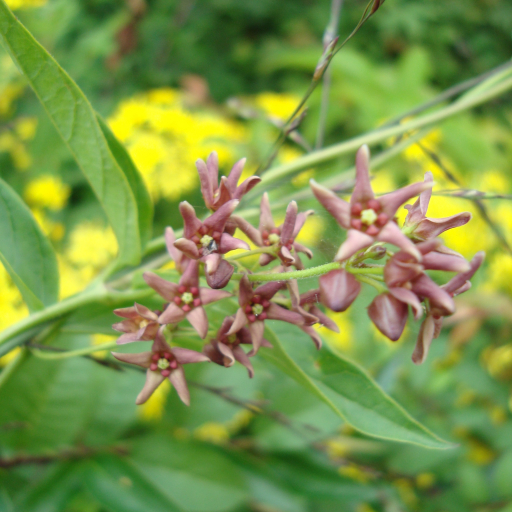
Plant Overview
Often called the Pale Swallow-wort or the "Dog-strangling Vine," this plant is a master of disguise and endurance. Native to the Black Sea region of Russia and Ukraine, it has become a notorious invader in North America. Its scientific name, Vincetoxicum, literally translates to "poisoner of the world," a nod to its stubborn survival skills and chemical defenses.
🔍 How to Identify
- 🍃 The Leaves: Look for smooth, shiny, dark green leaves that grow in opposite pairs along the stem. They are typically oval with a distinct pointed tip.
- 🌸 The Flowers: These tiny, star-shaped blossoms appear in clusters. They are usually a pale, creamy pink to reddish-brown and have five hairless petals.
- 🌀 The Growth: Unlike vines with tendrils, this plant "twines." The entire stem wraps tightly around neighboring plants, fences, or trees to climb, creating a dense, suffocating mat.
🏡 In Your Garden
- 🌱 Root Persistence: This plant is incredibly difficult to eradicate because of its massive, fibrous root crown. If even a small piece of the root is left in the soil, it can regenerate a whole new vine.
- 🌑 Light Adaptability: While it prefers sunny edges of forests, it is dangerously shade-tolerant. It can lurk in the deep shadows of a garden for years before suddenly exploding into growth when a gap in the canopy appears.
⚠️ Safety & Toxicity
- 🚫 Status: Toxic to humans, pets, and livestock.
- 🧪 Details: The plant contains vincetoxin, a compound that can cause severe digestive upset and respiratory issues if eaten. Some people also experience skin irritation or rashes simply by handling the sap without gloves.
✨ Fun Fact
🦋 The Ecological Trap: Because it is related to milkweed, Monarch butterflies are sometimes tricked into laying their eggs on its leaves. Unfortunately, the leaves are toxic to the caterpillars, and they cannot survive, making this plant a major threat to Monarch conservation efforts.

Detailed Care Instructions
To grow Vincetoxicum rossicum (commonly known as black swallow-wort or dog-strangling vine), you can follow these steps:
- Obtain seeds: You can purchase Vincetoxicum rossicum seeds from a local nursery or reputable online seed supplier. Make sure to get fresh seeds to increase the chances of germination.
- Prepare your planting site: Choose a sunny location with well-draining soil. Clear any weeds or grass from the area.
- Scarify the seeds: Vincetoxicum rossicum seeds have a tough outer coat that may inhibit germination. To overcome this, gently rub the seeds with fine sandpaper or soak them in warm water for 24 hours before planting. This process is called scarification.
- Sow the seeds: Plant the scarified seeds about 1/4 inch deep in the prepared soil. Space the seeds at least 12 inches apart to allow for proper growth.
- Watering and maintenance: Keep the soil consistently moist but not waterlogged. Water the newly planted seeds regularly, especially during dry spells. Remove any weeds that compete for nutrients and resources with the growing plants.
- Provide support: As Vincetoxicum rossicum grows, it may require support to climb. Install a trellis or provide stakes for the plants to climb and twine around.
- Monitor and manage pests: Keep an eye out for pests that may attack Vincetoxicum rossicum. Common pests include aphids and spider mites. If you notice an infestation, treat the plants with appropriate organic insecticidal soap or contact your local extension office for advice.
- Pruning: Prune the plant as needed to control its growth and maintain its shape. Remove any dead or diseased parts to promote healthy growth.
- Harvesting seeds: After the plant has matured and flowers have bloomed, it will produce seed pods. Allow the pods to dry and turn brown on the plant before harvesting. Collect the pods and extract the seeds for future propagation.
Note: While Vincetoxicum rossicum is an attractive plant, it is also considered invasive in some areas. Be sure to check whether it is controlled or banned in your region before planting and take necessary precautions to prevent its spread into natural areas.

Place in a window with dappled sun or a spot in the middle of a room. Or directly in a window facing west or east.

Water the plant once every week, making sure to thoroughly saturate the soil around the base of the plant. Ensure that the soil is well-draining but also retains enough moisture for the plant's needs. Avoid overwatering as this can lead to root rot. In hotter months, the plant may require more frequent watering as it can dry out faster. Reduce watering during the dormant period in winter.
To fertilize this plant, use a well-balanced fertilizer with equal parts nitrogen, phosphorus, and potassium. Apply the fertilizer once every month during the growing season, starting in early spring and ending in late summer. Be sure not to over-fertilize, as this can lead to burned roots and other issues. Additionally, be sure to water the plant thoroughly after each fertilization to ensure the nutrients are properly absorbed by the roots.
When planting Vincetoxicum Rossicum, it is important to choose a soil that is rich in organic matter and well-draining. The soil should be fertile and have a pH between 6.0 and 7.5. It is recommended to mix in compost or other organic matter to improve the soil structure and provide necessary nutrients. The plant prefers moist soils but can tolerate some degree of drought. It is best to avoid soils that are too sandy or heavy with clay, as they may not provide adequate drainage or aeration for the roots. Overall, a nutrient-rich, well-draining soil with a neutral pH is ideal for healthy growth and development of Vincetoxicum Rossicum.
To propagate this plant, you can create stem cuttings in the spring or summer. Select a healthy stem that is about 4-5 inches long and has several leaves on it. Cut the stem at a 45-degree angle, just below a leaf node. Remove the lower leaves, leaving just a few at the top of the stem.
Moisten some potting soil and insert the stem cutting into it. Make sure to keep the soil moist, but not waterlogged. Cover the pot with plastic wrap to maintain humidity, but make sure to remove the wrap for a few hours each day to prevent mold growth.
After a few weeks, you should see roots developing from the cutting. Once the roots are established, you can transplant the new plant to a larger container or directly into the ground in a suitable location.








