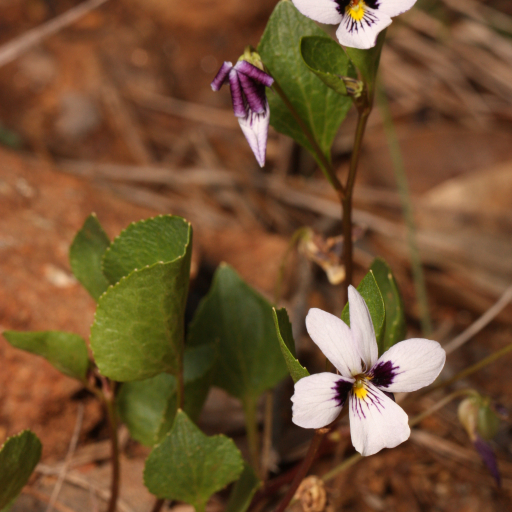
Plant Overview
The Wedgeleaf Violet is a delicate mountain treasure native to the rugged, rocky slopes of the Klamath Mountains in California and Oregon. Often nicknamed the "Butterfly of the Serpentine," this rare wildflower is a specialist that thrives where few others can survive. Its dainty, tri-colored blooms look like tiny, hand-painted masterpieces scattered across the forest floor.
🔍 How to Identify
- 🍃 Wedge-Shaped Leaves: Living up to its name (cuneata meaning wedge-shaped), the leaves are narrow at the base and widen toward the tip, resembling a small slice of pie.
- 🌸 Painted Petals: The flowers are primarily white or pale cream, but the lower three petals feature deep purple "honey guides" (veins) and a bright yellow patch at the center.
- 🎨 Dusky Reverse: If you gently flip a flower over, you will notice the back of the petals often has a distinct, dusky purple or brownish wash, contrasting beautifully with the white face.
🏡 In Your Garden
- ⛰️ The Serpentine Specialist: This violet is famously "serpentine endemic," meaning it has evolved to grow in mineral-rich, heavy-metal soils that would be toxic to most other plants. If you try to grow it, you must provide extremely well-draining, rocky soil rather than rich potting mix.
- 💧 Summer Slumber: Unlike common garden violets that love moisture, the Wedgeleaf Violet is adapted to dry Mediterranean summers. It may go dormant or look a bit "sleepy" during the hottest months, which is a natural defense mechanism against drought.
⚠️ Safety & Toxicity
- ✅ Safe Status: The Wedgeleaf Violet is generally considered non-toxic to humans, cats, and dogs.
- 🌼 Look but Don't Touch: While not poisonous, this is a rare and ecologically sensitive species. It is much better suited for photography than for the dinner table or flower crown, as wild populations are easily disturbed.
✨ Fun Fact
The Wedgeleaf Violet is an evolutionary "tough guy." By growing in serpentine soils high in nickel and magnesium, it avoids competition with faster-growing plants that find those minerals poisonous. It effectively uses a "toxic" neighborhood as its own private sanctuary!

Detailed Care Instructions
To grow Viola cuneata plants, also known as the sand violet or Wedgeleaf violet, follow these steps:
- Climate: Viola cuneata plants are native to various regions in North America, including the Great Plains and the Midwest. They are adapted to dry, sandy soils and prefer cool to moderate temperatures. Ensure your climate is suitable for this plant before attempting to grow it.
- Soil preparation: Viola cuneata plants thrive in sandy, well-draining soil. Prepare the soil by removing any weeds or grass and loosening it to allow good drainage.
- Sunlight: These plants generally need full sun to partial shade. Ensure they receive at least 4-6 hours of direct sunlight each day.
- Planting: Viola cuneata can be grown from seeds or purchased as established plants from a nursery. If starting from seeds, sow them directly into the prepared soil in early spring or fall, following the recommended planting depth on the seed packet.
- Watering: Initially, keep the soil moist until the plants are established. Once established, they are drought-tolerant and require minimal watering. Water them only when the top inch of soil feels dry.
- Mulching: Apply a thin layer of organic mulch around the plants to retain soil moisture and suppress weed growth. Avoid covering the base of the plants with mulch.
- Fertilizing: Viola cuneata plants generally do not require much fertilization. However, you can apply a balanced, slow-release fertilizer once a year in early spring if desired.
- Pruning: These plants generally don't require pruning. However, you can remove spent flowers or trim back any dead or overgrown foliage to maintain their appearance.
- Pests and diseases: Viola cuneata plants are relatively resistant to pests and diseases. However, keep an eye out for snails, slugs, or aphids, and take appropriate measures to control them if necessary.
- Propagation: For propagation, you can collect and sow the seeds from mature plants in late summer or early fall. Store the seeds in a cool and dry place until you are ready to plant them.
Remember to research specific regional growing conditions and requirements for Viola cuneata plants, as they may vary depending on your location.

Place in a bright room that is sun drenched almost all day. Or directly in a south-facing window.

Viola cuneata is a perennial plant that prefers moist soil, so it is important to water it regularly. However, over-watering can lead to root rot, so it is important to find a balance.
To water Viola cuneata, first, check the soil moisture by digging your finger about an inch deep into the soil. If the soil is dry, it is time to water the plant.
Use a watering can or hose with a gentle nozzle to water the plant. Water the soil around the base of the plant, avoiding wetting the leaves and flowers. Be sure to water thoroughly until water runs out of the drainage holes in the bottom of the pot or the root zone in the ground is moist.
Depending on the temperature and humidity, Viola cuneata may require watering once or twice per week. It is best to water in the morning or late afternoon to avoid evaporation and to give the plant sufficient time to absorb the water before nightfall.
In general, Viola cuneata plants require consistent watering to stay healthy and thrive.
For best results, apply a balanced fertilizer in early spring as new growth emerges. Use a slow-release fertilizer every six weeks through early summer. Water the plant well before fertilizing to avoid root burn. Avoid over-fertilizing, which can cause excessive growth and decreased flowering. Always follow the fertilizer manufacturer's instructions.
Viola cuneata is a plant species that thrives in well-drained soils with moderate moisture retention capacities. The ideal soil to use for this plant should have a neutral pH between 6.0 and 7.5. It should be a loamy soil that is rich in organic matter, providing ample nutrients essential for the plant's growth and development. The soil texture should be neither too compact nor too loose, enabling sufficient aeration and water infiltration. It should be a well-draining soil that does not hold water for prolonged periods to prevent root rot. Overall, the soil to use for Viola cuneata should be a fertile, well-aerated, and moisture-retentive loamy soil with a neutral pH.
To propagate this plant, take a healthy mature stem cutting measuring about 4-6 inches in length. Using a sharp and sterilized pair of pruning shears, cut the stem below a set of healthy leaves. Remove the leaves from the lower one-third of the stem, leaving only the top leaves intact.
Fill a pot with well-draining soil, and moisten it thoroughly. Create a hole in the soil with a finger or a pencil and insert the prepared stem cutting. Firmly press the soil around the stem until it's secure.
Cover the pot with a clear plastic bag, creating a mini greenhouse effect that'll help keep moisture in the soil and retain humidity around the cutting. Place the pot in a bright and warm location, out of direct sunlight.
Check the soil daily and keep it evenly moist, but not soaking wet. Mist the cutting with a sprayer every day to ensure it stays humid under the plastic bag.
After four to six weeks, remove the plastic bag and let the plant get used to normal air humidity. Wait for the new growth to appear, which is a sign that the plant has taken root. Gradually increase the amount of light and expose the plant to more direct sun over several weeks. Finally, transplant the new plant to a larger pot or a garden.








