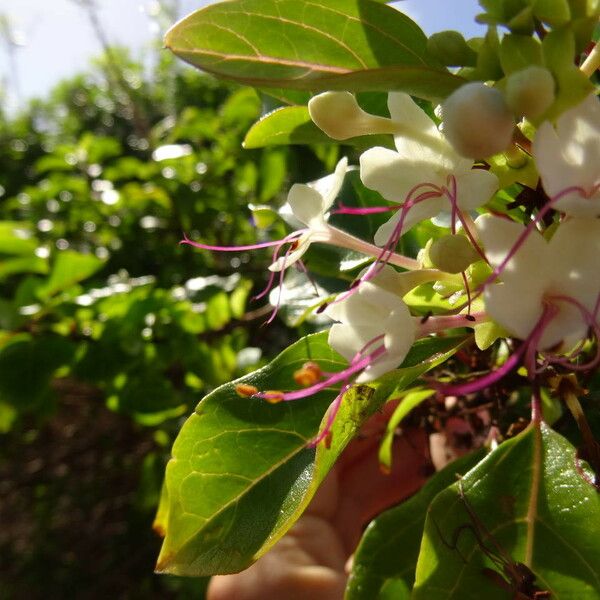
Plant Overview
Known as the "Prickly Myrtle" or "Crab Prickle," Volkameria aculeata is a tough-as-nails tropical shrub that balances elegance with a "keep away" attitude. Native to the Caribbean and tropical Americas, it is a favorite for those needing a beautiful but impenetrable natural fence. While its delicate, spidery white blossoms look soft and inviting, its hidden thorns remind you exactly why it earned its prickly reputation.
🔍 How to Identify
- 🌿 Glossy Foliage: Small, dark green, and oval-shaped leaves that grow in pairs or small clusters along the stems, often appearing very dense.
- 🌸 Spidery Blooms: Clusters of white, tubular flowers featuring remarkably long, protruding purple or reddish stamens that give the blossoms a delicate, "starburst" appearance.
- ⚔️ Defensive Spines: Look closely at the leaf axils; the plant is armed with sharp, woody spines that become more prominent and hardened as the branches age.
🏡 In Your Garden
- 🏝️ Coastal Warrior: This plant is exceptionally tolerant of salt spray and sandy soils. It is a superstar for seaside gardens where the salt-laden wind might kill less hardy species.
- ✂️ The Security Hedge: Because it responds well to aggressive pruning, it is best utilized as a living fence. Regular trimming keeps the growth habit compact and encourages a fresh flush of fragrant flowers that attract butterflies.
- ☀️ Sun Seeker: To get the best floral display, it needs to be in a position with maximum sun exposure. While it survives in partial shade, it often becomes leggy and loses its dense, protective form.
⚠️ Safety & Toxicity
- 🌵 Status: Low chemical toxicity, but high physical risk.
- 🩹 Puncture Hazard: The primary danger is the sharp thorns. Always wear thick, leather gardening gloves when pruning, as the spines can easily pierce standard fabric gloves and cause painful puncture wounds.
- 🐾 Pet Safety: While not specifically listed as highly toxic to pets, the thorns pose a significant risk of eye or paw injury if a dog or cat tries to run through the shrub.
✨ Fun Fact
In many Caribbean islands, this plant was traditionally used to create "living barbed wire." Its growth is so dense and its thorns so efficient that it was the go-to choice for farmers to corral livestock and protect property boundaries before manufactured fencing was widely available.

Detailed Care Instructions

Place in a bright room that is sun drenched almost all day. Or directly in a south-facing window.

The presence of a dry surface layer of soil does not indicate that the plant requires water. Instead, stick your finger 1-2" (3-5 cm) deep in the soil to feel dampness or moisture content. If the soil seems dry, it's time to water your greens. If the soil is still moist, however, it is better not to water your plant and instead wait a day or two. Overwatering or waterlogging raises the risk of root rot. So if the soil takes longer than a week to dry, check the light conditions because it's likely that the plant isn't getting enough light. It's fine if the upper layer of soil is dry between waterings, but the deeper soil layer should always have some moisture.
These plant needs regular fertilizing during growing seasons. Fertilizing your plants in dormant state during the winter, might result in scorching or browning of the leaf tips. If mature plants display signs of nutrient insufficiency, fertilizer administration is necessary to restore the plant to its previous state.
You may use All Purpose Plant Food or Flower Fertilizer or All Purpose Fertilizer for your Haggarbush
Common pests of the haggarbush include Spider mites, aphids, whiteflies. Make a habit of checking your haggarbush frequently for pests so that any infestations can be caught and managed early.








