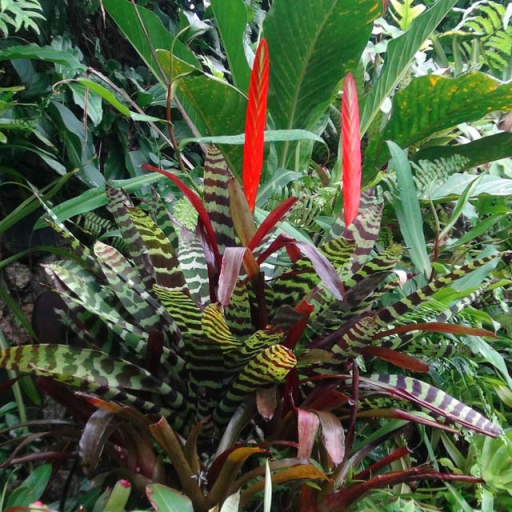
Plant Overview
Known as the "Flaming Sword," the Vriesea splendens is the undisputed showstopper of the bromeliad world. Originating from the misty rainforests of Venezuela and the Guianas, it brings a prehistoric, architectural drama to any indoor space. Its striking contrast of zebra-striped foliage and a glowing, fiery orange spike makes it look less like a common houseplant and more like a piece of living tropical art.
🔍 How to Identify
- 🌿 The Foliage: Long, arching, strap-like leaves that are deep green and marked with bold, horizontal bands of dark purple or brownish-black.
- 🗡️ The Flower Spike: A tall, flattened, brilliant red or orange bract that emerges from the center, resembling a serrated sword. Tiny yellow flowers eventually peek out from the edges.
- ⛲ The Central Tank: A tight rosette of leaves that forms a natural "cup" or "urn" at the base, designed to catch and hold water in the wild.
🏡 In Your Garden
- 💧 The "Cup" Method: Because it is an epiphyte (a plant that grows on trees in nature), its roots are primarily for anchoring rather than drinking. You must keep the central "tank" filled with water, preferably rainwater or distilled water, to keep it hydrated.
- 🌫️ Humidity is Key: This plant breathes through its leaves. It hates dry, air-conditioned environments and thrives best in a humid bathroom or on a pebble tray. If the leaf tips turn brown and crispy, it's a plea for more moisture in the air.
- ☀️ Light Sensitivity: While it loves bright light to keep its colors vivid, direct afternoon sun will scorch the leaves and bleach the "sword." Aim for bright, filtered light.
⚠️ Safety & Toxicity
- 🐾 Pet Friendly: Great news for pet owners! The Flaming Sword is considered non-toxic to cats, dogs, and horses.
- 🦟 Stagnant Water Warning: While the plant itself isn't dangerous, the water sitting in the central cup can become stagnant or harbor bacteria and mosquito larvae if not flushed out and replaced with fresh water once a week.
✨ Fun Fact
🌱 The Grand Finale: The Flaming Sword is "monocarpic," meaning it blooms only once in its entire lifetime. The spectacular sword can last for months, but once it fades, the mother plant will slowly die. However, she leaves a legacy by producing "pups" (small offsets) at her base that you can pot up to start the cycle all over again!

Detailed Care Instructions
| Humidity | High |
| Lighting | Part Sun |
| Difficulty | Medium |
| Hibernation | Cold Period |
| Temperature | 18°C - 25°C |
| Hardiness Zones | 10A - 12B |
To grow Vriesea Splendens, also known as Flaming Sword or Painted Feather, follow these steps:
- Select a suitable container: Choose a pot that has good drainage holes and is slightly larger than the existing plant.
- Potting mix: Use a well-draining, organic potting mix. This plant prefers slightly acidic soil, so you can add some peat moss or coconut coir to the mix.
- Lighting: Vriesea Splendens thrives in bright, indirect light. Place it near a window where it can receive filtered light, but avoid direct sunlight which can scorch the leaves.
- Temperature and humidity: This plant prefers temperatures between 65-80°F (18-27°C) and high humidity levels. You can increase humidity by placing a tray with water near the plant, misting it regularly, or using a humidifier.
- Watering: Keep the soil evenly moist, but not soggy. Water the plant when the top inch of soil feels dry. Avoid overwatering as it can cause root rot. Water the plant directly into the soil, avoiding the central cup-like structure, as it can collect water and lead to rot.
- Fertilization: Feed your Vriesea Splendens with a balanced, water-soluble fertilizer every 2-3 months during the growing season (spring and summer). Follow the package instructions for dosage.
- Pruning: Remove any dead, damaged, or yellow leaves using clean and sharp scissors or pruning shears. Prune back any dead flower spikes to encourage new growth.
- Propagation: Vriesea Splendens can be propagated by using the offsets or pups that grow around the base of the plant. Wait until they are at least one-third the size of the parent plant, then carefully remove and pot them in well-draining soil.
Remember to regularly inspect the plant for signs of pests such as mealybugs or spider mites. If necessary, treat with appropriate pesticides or insecticidal soap.
With proper care and attention to its needs, your Vriesea Splendens should thrive and grow beautifully.

Place in a window with dappled sun or a spot in the middle of a room. Or directly in a window facing west or east.

Vriesea Splendens is a type of tropical flowering plant that requires frequent watering to thrive. When watering this plant, it is important to avoid getting water on the leaves as this can lead to rot and disease.
To water Vriesea Splendens, fill a watering can or pitcher with room temperature water. Slowly pour the water around the base of the plant, making sure to saturate the soil completely. Allow any excess water to drain out of the bottom of the pot.
The frequency of watering will depend on the temperature and humidity levels in your environment. As a general rule, Vriesea Splendens should be watered when the top inch of soil feels dry to the touch.
In addition to regular watering, Vriesea Splendens also benefits from occasional misting to improve humidity levels. Simply mist the leaves with room temperature water using a spray bottle.
Overall, the key to successfully watering Vriesea Splendens is to avoid overwatering and ensure that the plant has adequate drainage to prevent root rot.
- Choose a balanced blend fertilizer with equal amounts of nitrogen, phosphorus, and potassium.
- Apply the fertilizer once every two weeks during the spring and summer growing season.
- Mix the fertilizer with water according to the package instructions.
- Use a watering can to apply the fertilizer solution to the soil around the base of the plant.
- Avoid getting fertilizer on the leaves or flowers of the plant as it can cause damage.
- Reduce the frequency of fertilization during the fall and winter months when the plant is in a dormant state.
- Monitor the plant for any signs of nutrient deficiencies, such as yellowing leaves or stunted growth, and adjust the fertilizer regimen accordingly.
It is recommended to use a well-draining and nutrient-rich potting soil that is specifically formulated for epiphytic plants such as bromeliads. This type of soil typically contains a mixture of organic matter, perlite, and bark chips. It is important to avoid using heavy or compacted soil, as this can prevent air circulation around the roots and lead to root rot. Additionally, adding a layer of sphagnum moss or a few pieces of bark on top of the soil can help maintain moisture levels and protect the plant's roots.
To propagate this plant, you will need to let the mother plant produce pups or offsets. Pups are smaller plants that develop off the main plant's base. Wait for the pups to grow to at least 1/3rd the size of the mother plant before separating them.
To separate the pups, first, remove them from the pot of the mother plant by gently teasing them away from the soil. Try to avoid damaging the roots of the pup or the mother plant.
Next, remove any dead or yellow leaves from the base of the pup and the mother plant. This will help prevent the spread of any potential diseases.
Then, repot the pup in a pot with fresh, well-draining soil mixture. Water the pup thoroughly.
The pup will grow and eventually mature into an adult plant, just like the mother plant.
Common pests of the flaming-sword include Scale insect, mealybugs, spider mites. Make a habit of checking your flaming-sword frequently for pests so that any infestations can be caught and managed early.








