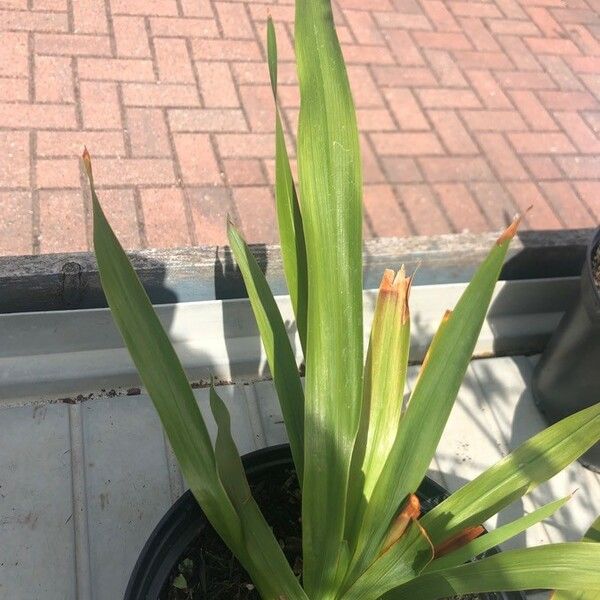
Plant Overview
Often called the "Beatrice Watsonia," this South African native is a showstopping perennial that brings architectural drama and a burst of sunset colors to any landscape. Known for its tall, elegant spikes of trumpet-shaped flowers, it is a favorite among gardeners looking to attract pollinators like bees and sunbirds. In its native Eastern Cape, it is a resilient survivor, painting the hillsides in vibrant shades of orange and apricot.
🔍 How to Identify
- ⚔️ The Foliage: Look for stiff, sword-shaped leaves that are bright green and arranged in a distinct fan-like pattern at the base of the plant.
- 🎺 The Blooms: Its flowers are narrow, tubular "bugles" that curve slightly outward, clustered densely along the top half of a tall, upright stem.
- 📏 The Stature: This plant is a vertical masterpiece, with flower spikes that can reach up to 3 or 4 feet (1.2 meters) in height, standing proudly above the leaves.
🏡 In Your Garden
- 🌞 Sun Seeker: The Watsonia pillansii thrives in full sun; without enough light, the tall flower spikes may become "floppy" as they stretch toward the sun.
- 💧 Drainage is Key: While it enjoys regular water during the spring and summer growing season, the underground corms (bulbs) are sensitive to "wet feet" and can rot if the soil doesn't drain quickly.
- 🌬️ Coastal Toughness: Unlike many tall flowers, its stems are surprisingly flexible and fibrous, making it an excellent choice for windy coastal gardens where other plants might snap.
⚠️ Safety & Toxicity
- 🟢 Status: Low toxicity / Generally safe.
- 🐾 Details: While not considered a high-risk plant, the underground corms (bulbs) can cause mild digestive upset if ingested by curious pets or children. It is always best to keep bulbs out of reach of "diggers."
✨ Fun Fact
The genus Watsonia was named in honor of Sir William Watson, an 18th-century British physician and scientist who was one of the first people to suggest that electricity was a single fluid that moved from "plus" to "minus."

Detailed Care Instructions
To grow Watsonia pillansii (Bugle Lily) plants, here are the steps you can follow:
- Choose the right location: Watsonia pillansii thrives in full sun to partial shade, so select a spot with at least 6-8 hours of direct sunlight.
- Prepare the soil: The plant prefers well-draining soil with a pH of 6.0 to 7.0. If your soil is heavy clay, mix in compost or organic matter to improve drainage.
- Plant the bulbs: Plant the bulbs in late winter or early spring, about 4-6 inches (10-15 cm) deep and 6-8 inches (15-20 cm) apart. Place them with the flat side down and the pointy end facing up.
- Watering: Keep the soil moist but not waterlogged during the growing season. It's essential to water regularly, especially during dry periods.
- Fertilize: Apply a balanced, slow-release fertilizer once in early spring before growth starts. Follow the manufacturer's instructions for dosage and application.
- Mulching: Apply a layer of organic mulch around the plants to retain moisture, suppress weeds, and provide some insulation.
- Maintenance: Remove spent flowers to encourage continuous blooming. After flowering, allow the foliage to die back naturally, as it provides nourishment to the bulbs for the next season.
- Overwintering: In cold climates, where frost is common, Watsonia pillansii should be protected during winter. Provide a layer of mulch or cover the plants with straw or leaves to insulate the bulbs from freezing temperatures.
- Propagation: Watsonia pillansii can be propagated by dividing the bulbs. Dig up clumps of bulbs during dormancy and gently separate them. Replant the individual bulbs in prepared soil, following the spacing guidelines.
By following these steps, you can successfully grow Watsonia pillansii plants and enjoy their beautiful flowers.

Place in a bright room that is sun drenched almost all day. Or directly in a south-facing window.

When caring for this plant, make sure to water it regularly but do not overwater it. Check the soil moisture regularly by sticking your finger into the soil to a depth of about 2 inches. If the soil feels dry, it is time to water. Use a watering can or hose with a gentle flow to water around the base of the plant, avoiding the leaves. Allow the water to soak into the soil deeply. Avoid leaving large puddles of water around the plant as this can cause the roots to rot. It is important to maintain consistent soil moisture to keep the plant healthy but not waterlogged.
To fertilize this plant, apply a balanced fertilizer with an equal ratio of nitrogen, phosphorus, and potassium. Apply the fertilizer to the soil around the base of the plant, avoiding contact with the leaves. Water thoroughly after applying the fertilizer. Fertilize once in early spring and again in mid-summer. Be careful not to over-fertilize, as this can burn the roots and damage the plant.
The most suitable type of soil for Watsonia Pillansii plant is a loamy, well-draining soil. It should be rich in organic matter with a pH level of 6.0-7.0. The soil needs to be moist but not waterlogged, and it should offer good drainage to prevent water accumulation around the roots. Additionally, adding a layer of mulch to the soil surface can help retain moisture and nutrients in the soil over time. The plant should be planted in a location with a good amount of sunlight and should also be well protected from strong winds.
Watsonia Pillansii plant can easily be propagated through division. Start by digging up the plant during its dormant period which is usually in late fall or early winter. Carefully remove the soil from around the base of the plant to expose the underground corms.
Separate the corms by gently pulling them apart or using a sharp knife to cut them apart. Make sure each corm has a healthy root system attached to it. Discard any corms that are damaged or diseased.
Once the corms have been separated, replant them immediately in a well-draining potting mix. Make sure to plant them at the same depth they were growing previously, with the tips of the corms just at or slightly below the soil surface.
Water the newly planted corms and place them in a bright location with indirect sunlight. Keep the soil moist but not waterlogged, and avoid overhead watering to prevent rot.
Within a few weeks, new growth should start to emerge from the corms, indicating successful propagation.








