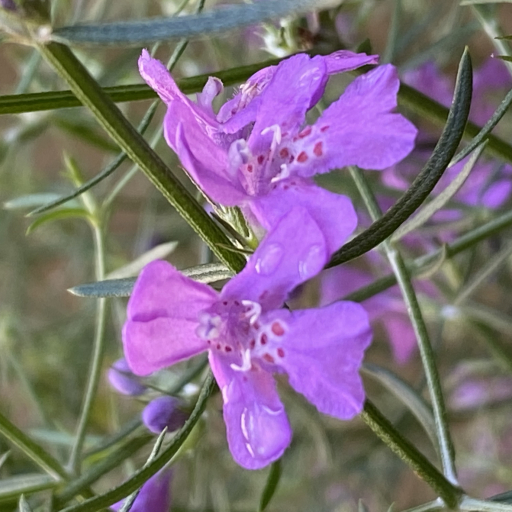
Plant Overview
Often mistaken for the kitchen herb, the Slender Westringia is a hardy Australian native that adds a misty, delicate texture to any landscape. While it won't season your roast potatoes, it earns its "Rosemary Westringia" nickname through its needle-like foliage and tough-as-nails personality. It is a favorite for gardeners who want a Mediterranean aesthetic combined with the rugged resilience of a desert-dweller.
🔍 How to Identify
- 🍃 Foliage: The leaves are very narrow and needle-like, typically growing in "whorls" of three or four around the slender, woody stems.
- 🌸 Floral Details: It produces delicate, tubular flowers that are usually pale mauve, purple, or white, often featuring tiny orange or purple spots inside the throat to guide pollinators.
- 📏 Growth Habit: It has a more open and "airy" upright structure compared to its denser cousins, often reaching between 1 and 1.5 meters in height.
🏡 In Your Garden
- 🏜️ Drought Resilience: As the name eremicola (meaning "desert dweller") suggests, this plant is incredibly water-wise. It thrives in well-draining soil and can survive long periods of dry weather once its root system is established.
- ✂️ Pruning Nuance: Because it has a naturally slender habit, it can become "leggy" or sparse over time. A light trim after its main flowering flush will encourage the plant to bush out and stay tidy.
- 🐝 Wildlife Value: It is a fantastic choice for a habitat garden; the flowers are a constant draw for native bees, butterflies, and small honeyeater birds.
⚠️ Safety & Toxicity
- ✅ Safe for Pets: Westringia eremicola is generally considered non-toxic to dogs, cats, and horses.
- 🚫 Not for Cooking: Even though it is nicknamed "Rosemary Westringia," it is not a culinary herb. It lacks the aromatic oils of true Rosemary (Salvia rosmarinus) and should not be used in food.
- 🧤 Skin Sensitivity: While not toxic, the woody stems and stiff leaves can be slightly scratchy, so gloves are recommended for heavy pruning.
✨ Fun Fact
Despite its appearance, the Slender Westringia is a proud member of the Mint family (Lamiaceae). You can tell by its square-shaped young stems and those characteristic "lipped" flowers that act as a perfect landing pad for insects!

Detailed Care Instructions
To grow Westringia eremicola, also known as the coastal rosemary, you can follow these steps:
- Climate and soil requirements: Westringia eremicola is a sturdy plant that prefers a Mediterranean climate with mild, wet winters and hot, dry summers. It can tolerate a wide range of soil types, including sandy, loamy, and rocky soils. Good drainage is essential to prevent root rot.
- Planting location: Choose a spot in your garden that receives full sun or partial shade. The plant can withstand coastal conditions and salt spray, making it an excellent choice for coastal gardens.
- Propagation: You can propagate Westringia eremicola through seeds or semi-hardwood cuttings. Collect seeds from mature plants or buy them from a reputable nursery. Sow them in well-draining potting mix and keep them moist until they germinate. Alternatively, take 8-10 cm long cuttings from a healthy plant, remove the lower leaves, and plant them in a pot with a mixture of sandy soil and organic compost.
- Planting: Dig a hole in the ground or prepare a container with well-draining soil. Gently remove the plant from its pot and place it in the hole or container. Backfill with soil, firming it around the base of the plant. Ensure that the plant's crown is level with the soil surface.
- Watering: Westringia eremicola is drought-tolerant once established but requires regular watering during its initial growth phase. Water the plant deeply once or twice a week to encourage strong root development. Reduce watering once the plant is well-established.
- Mulching: Apply a layer of organic mulch around the base of the plant to help retain moisture and suppress weed growth. However, avoid mulching directly against the stem, as it can lead to rot.
- Pruning and maintenance: Prune Westringia eremicola after flowering to maintain its shape and compactness. Lightly trim the plant throughout the year to encourage bushier growth. Remove any dead or diseased branches promptly. This plant doesn't require heavy pruning.
- Fertilization: Westringia eremicola is a low-maintenance plant and generally doesn't require excessive fertilization. However, an annual application of a slow-release, balanced fertilizer in spring can help promote healthy growth.
Remember to monitor your Westringia eremicola regularly for any signs of pests, diseases, or nutrient deficiencies. With proper care, this beautiful plant should thrive in your garden.

Place in a bright room that is sun drenched almost all day. Or directly in a south-facing window.

The best way to water this plant is to allow the soil to dry out slightly between waterings. This can usually be determined by sticking your finger about an inch into the soil- if it feels dry, it's time to water. When you do water, be sure to thoroughly saturate the soil, but avoid overwatering as this can lead to root rot. Additionally, it's best to avoid getting water on the leaves and flowers, as this can encourage the growth of fungus and mold. Finally, be mindful of the weather conditions in your area and adjust your watering schedule accordingly- if it's particularly hot and dry, your plant may need more water than usual.
Water the plant thoroughly before fertilizing. Choose a balanced, slow-release fertilizer with a high phosphorous content. Follow the instructions on the label for the appropriate amount for your plant's size and age. Apply the fertilizer evenly around the base of the plant, avoiding the stem and foliage. Water the plant again after fertilizing to help distribute the nutrients throughout the soil. Repeat fertilizing every 2-3 months during the growing season.
When planting Westringia Eremicola, it is important to use a well-draining soil that is rich in organic matter. A sandy loam or a mix of sand, soil, and gravel can be used to provide proper drainage and aeration for the roots. This plant prefers soil that is slightly acidic to neutral, with a pH range of 6.0 to 7.5. You can amend the soil with compost or other organic matter to improve its texture and nutrients. Avoid using heavy clay soils or soils that are prone to waterlogging, as this can lead to root rot and other problems. Overall, a soil that is well-draining, fertile, and slightly acidic is ideal for Westringia Eremicola to thrive.
- Choose a healthy and mature Westringia Eremicola plant from which to obtain cuttings.
- Sterilize pruning shears or a razor blade with rubbing alcohol before taking cuttings.
- Make a clean cut of a stem tip that is around 4-6 inches long.
- Remove the lower leaves from the stem, leaving just a few leaves at the top.
- Dip the cut end of the stem in rooting hormone powder to promote root growth.
- Insert the stem into a pot filled with sterile, well-draining potting mix.
- Water the cutting, then cover it with a clear plastic bag to create a humid environment.
- Keep the cutting in a warm but shaded area, avoiding direct sunlight.
- Check the cutting regularly for signs of new growth, indicating that roots have formed.
- Once the cutting has established roots and new growth, its transplant into a larger pot or the garden bed.








