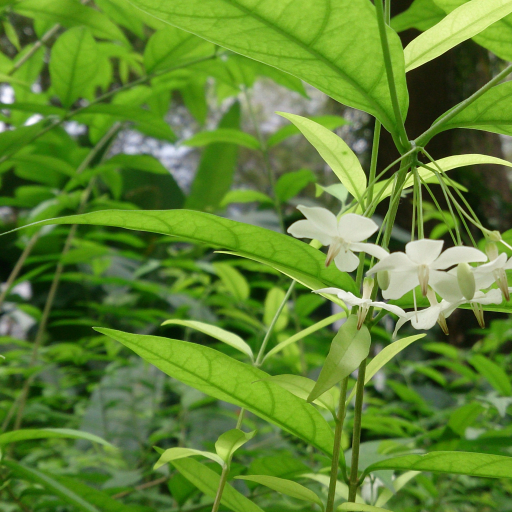
Plant Overview
Known as the Water Jasmine or Sacred Wrightia, this elegant tropical shrub is a staple in Southeast Asian gardens and Buddhist temples. Its name, religiosa, reflects its spiritual importance, as it is often planted near shrines to offer its ethereal, downward-facing white blooms as a natural incense. It is beloved by gardeners for its intoxicating fragrance, which becomes particularly intense during the evening hours.
🔍 How to Identify
- 🌸 The Blooms: Small, five-petaled white flowers that hang gracefully in clusters like delicate, waxy bells. Unlike many jasmine-like plants, these flowers point downward toward the earth.
- 🍃 The Foliage: Thin, pointed, elliptic leaves with a vibrant lime-to-deep green color. The leaves grow in opposite pairs along very fine, twiggy branches.
- 🌳 The Structure: Naturally a multi-stemmed shrub, it features light gray bark that becomes slightly fissured with age. Its flexible wood and small leaf scale make it one of the world’s premier species for Bonsai styling.
🏡 In Your Garden
- 💧 A Thirst for Life: True to its common name, the Water Jasmine thrives in high-moisture environments. It is one of the few woody shrubs that can tolerate "wet feet," making it an excellent choice for pond-side planting or heavy clay soils that retain water.
- ✂️ Pruning for Perfume: This plant is incredibly resilient to trimming. Frequent pinching and pruning not only help maintain a compact shape but actually stimulate the growth of new wood, which is where the fragrant flower clusters emerge.
- ☀️ Tropical Temperament: Being a native of the tropics, it has zero tolerance for frost. If you live in a cooler climate, it must be moved indoors or into a greenhouse as soon as temperatures dip, as it may drop its leaves in protest of the cold.
⚠️ Safety & Toxicity
- 🐾 Mild Irritant: While not nearly as dangerous as its cousin the Oleander, Wrightia religiosa belongs to the Apocynaceae family, which typically contains milky latex.
- 🧪 Sap Caution: The white sap can cause mild skin irritation (dermatitis) for some gardeners. It is best to wash your hands after pruning and keep the plant away from curious pets who might try to chew on the bitter stems.
✨ Fun Fact
In many Southeast Asian cultures, the scent of the Water Jasmine is believed to clear the mind and facilitate deep meditation. It is often the very first scent a visitor encounters when entering a temple garden, intended to provide a "sensory bridge" between the chaotic outside world and the peace of the sacred grounds.

Detailed Care Instructions
To grow a Wrightia religiosa plant, also known as the sacred Buddhist tree, you can follow these steps:
- Climate and location: Ensure that you live in a suitable climate for this plant, as it requires a warm and tropical environment. It is native to Southeast Asia and thrives in USDA hardiness zones 9 to 11. Provide it with a location that receives full to partial sun.
- Soil: The plant prefers well-draining soil, so choose a potting mix that is rich in organic matter. A mix of peat moss, perlite, and compost is suitable.
- Container: Select a wide and deep container as the plant develops an extensive root system. Ensure the pot has drainage holes to prevent waterlogging.
- Watering: Keep the soil moist but not waterlogged. Allow the top inch of soil to dry out before watering again. During the warmer months, you may need to water more frequently.
- Fertilizer: Use a balanced, slow-release fertilizer during the growing season (spring and summer). Follow the instructions on the fertilizer package for the appropriate dosage.
- Pruning: Trim the plant occasionally to maintain its shape and remove any dead or damaged branches. This will also encourage bushier growth.
- Propagation: Wrightia religiosa can be propagated through stem cuttings. Take a 4-6 inch cutting with a clean, sharp knife and remove any leaves from the lower half of the stem. Place the cutting in a well-drained potting mix, mist it with water, and keep it in a warm and humid environment. Roots should develop within a few weeks.
- Pests and diseases: Keep an eye out for common pests like aphids or mealybugs. If infestations occur, treat with an appropriate insecticide or use a gentle insecticidal soap. Ensure good air circulation around the plant to minimize the risk of fungal diseases.
Remember to research and follow any specific care instructions for the Wrightia religiosa plant in your particular region or microclimate.

Place in a window with dappled sun or a spot in the middle of a room. Or directly in a window facing west or east.

To keep this plant healthy and thriving, it is important to ensure that it receives the appropriate amount of water. The best way to water this plant is to check the soil moisture regularly. Use your finger to feel the soil – if it feels dry to the touch, it is time to water. However, if the soil feels damp or wet, do not water yet.
When watering, it is recommended to use room temperature water. Avoid using chlorinated or fluoridated water as it may damage the plant. Allow the water to drain completely from the pot and discard any excess water from the saucer. It is essential not to let the plant sit in standing water as this can lead to root rot.
During the growing season, water the plant regularly once or twice a week, depending on the humidity and temperature of the environment. During the winter months, reduce watering and make sure to let the soil dry out slightly before watering.
It is important to note that this plant prefers slightly acidic soil with good drainage to keep the roots healthy. Overwatering or improper drainage can lead to root rot and other issues that may harm the plant.
- Choose a balanced, slow-release fertilizer with equal parts nitrogen, phosphorus, and potassium.
- Apply the fertilizer in early spring or before the growing season begins.
- Use a diluted fertilizer solution, following the instructions on the package for the proper dilution ratio.
- Water the plant thoroughly before applying the fertilizer.
- Apply the fertilizer evenly around the base of the plant, avoiding contact with the foliage.
- Do not over-fertilize, as this can damage the plant's roots and leaves.
- Repeat the application every 4-6 weeks during the growing season.
- Stop fertilizing in the fall or when the plant stops visibly growing.
The ideal soil for Wrightia Religiosa plant is a well-draining, loamy or sandy soil that is slightly acidic with a pH level between 5.5 to 6.5. It should be rich in organic matter and nutrients, including nitrogen, phosphorus, and potassium.
The soil should be able to retain moisture, but not become waterlogged, as this can cause root rot and damage to the plant. It is important to avoid using heavy clay soils or those that are prone to compaction.
In general, it is recommended to use a high-quality potting mix or a combination of equal parts of peat moss, perlite, and vermiculite. Additionally, some gardeners add a small amount of sand for improved drainage.
It is important to regularly monitor the soil moisture levels and adjust watering accordingly to avoid over or under-watering the plant. Adding a layer of mulch around the base of the plant can help to conserve soil moisture and provide additional nutrients as it decomposes over time.
To propagate this type of plant, one can take stem cuttings from healthy and mature parent plants. These stem cuttings should be at least 6 inches long and should have 2-3 nodes. Remove any leaves from the lower half of the stem and allow it to dry for a few hours. Then, dip the cut end in rooting hormone powder and plant it in a pot filled with well-draining soil or sand. Water thoroughly, and cover the pot with a plastic bag to maintain humidity. Place the pot in a bright and warm location but avoid direct sunlight. Keep the soil moist, and within a few weeks, the cutting should have rooted and started to grow. Once the new plant has become established, it can be transferred to a larger pot or planted outdoors.
Common pests of the water jasmine include Scale insect, mealybugs, spider mites. Make a habit of checking your water jasmine frequently for pests so that any infestations can be caught and managed early.








