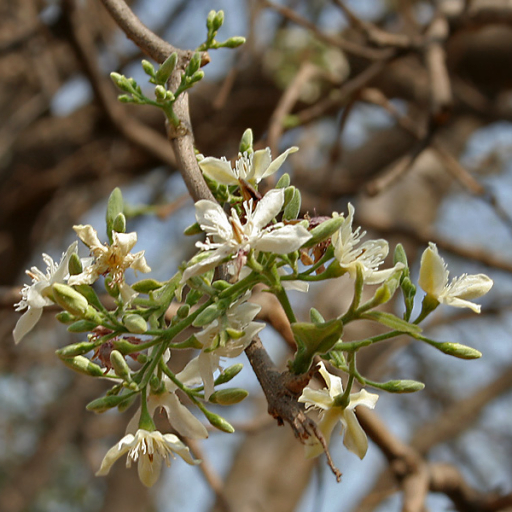
Plant Overview
Often called the Sweet Indrajao or the Pala Indigo Plant, Wrightia tinctoria is a graceful deciduous tree deeply rooted in Indian heritage. Known for its delicate, jasmine-scented white blooms and its historical role as a source of blue dye, it transitions beautifully from a wild forest dweller to a slender, ornamental landscape tree.
🔍 How to Identify
- 🌼 The Flowers: Small, star-shaped, pure white blossoms that grow in clusters. They emit a soft, sweet fragrance and have a unique "fringe" in the center, eventually turning a pale yellow before they drop.
- 🍃 The Foliage: Pointed, elliptic leaves that grow in opposite pairs. A key identifying trait is the milky white sap (latex) that leaks out immediately if a leaf or stem is broken.
- 🎋 The Seed Pods: One of its most striking features; long, pendulous green pods that always grow in pairs, often joined at the very tips, resembling a pair of slender daggers.
🏡 In Your Garden
- ☀️ Sun & Resilience: This tree is a sun-lover and is remarkably drought-tolerant once established. It is perfect for xeriscaping or "low-maintenance" gardens in warmer climates where water might be scarce.
- 🪵 Growth Habit: Because it is deciduous, it will drop its leaves in the winter or dry season. Don't panic—this is a natural "hibernation" strategy to conserve energy before the spectacular spring flowering.
⚠️ Safety & Toxicity
- 🐾 Sap Warning: Like many members of the Apocynaceae family, the milky latex can be a skin irritant. It may cause redness or itching if it gets on the skin of humans or the paws of pets.
- 🚫 Not for Consumption: While parts of the tree are used in traditional medicine, the raw plant and sap should not be ingested. Always wash your hands after pruning to avoid accidental contact with eyes or mouth.
✨ Fun Fact
- 🎨 The Toy Tree: The wood of Wrightia tinctoria is incredibly white, smooth, and easy to turn on a lathe. It is the primary wood used to create the world-famous, brightly colored Channapatna toys in India, which are lacquered with natural dyes to keep them safe for children.

Detailed Care Instructions
Here are some steps you can follow to grow Wrightia Tinctoria, also known as Blue Marble:
- Choose the right location: Wrightia Tinctoria plants prefer bright, indirect sunlight, so place them near a window that receives partial sun. They also require warm temperatures, ideally between 60-85°F (15-29°C).
- Soil requirements: Use a well-draining potting mix that contains equal parts of peat moss, perlite, and sand. This will ensure good drainage and prevent the roots from sitting in water.
- Planting: Select a pot that is about twice the size of the plant's root ball. Fill the pot with the potting mix, leaving enough space for the plant's roots. Gently remove the plant from its nursery pot and place it in the new pot. Fill in the remaining space with the potting mix and lightly pat it down to secure the plant.
- Watering: Water Wrightia Tinctoria moderately, allowing the top inch of soil to dry out between waterings. Overwatering can lead to root rot, so make sure to check the moisture level of the soil before watering.
- Fertilization: Feed the plant with a balanced liquid fertilizer every 4-6 weeks during the growing season (spring and summer). Follow the instructions on the fertilizer package for the correct dosage.
- Pruning: Prune the plant regularly to maintain its shape and encourage bushier growth. You can trim off any dead or diseased branches, as well as prune for size control if needed.
- Propagation: Wrightia Tinctoria can be propagated through stem cuttings. Take a 4-6 inch cutting from a healthy plant, remove the lower leaves, and dip the cut end in rooting hormone. Place the cutting in a pot filled with moist potting mix and keep it in a warm, humid location. The cutting should root within a few weeks.
- Pests and diseases: Watch out for common houseplant pests like aphids, mealybugs, and spider mites. Regularly inspect the plant and apply appropriate insecticidal soap or neem oil to eradicate any infestations.
By following these guidelines, you should be able to successfully grow and care for Wrightia Tinctoria.

Place in a bright room that is sun drenched almost all day. Or directly in a south-facing window.

If you want to properly water this plant, you should first consider the natural environment it grows in. This particular plant prefers a well-draining soil that is kept moderately moist. Avoid letting the soil dry out completely between waterings, but also make sure not to overwater as this can cause root rot.
When watering, slowly pour water into the soil until it starts to come out of the bottom of the pot. Allow excess water to drain away before returning the plant to its usual location. During the warmer months, you may need to water more frequently, while in the winter, you can reduce the frequency of watering to allow the soil to dry out a bit more.
One useful tip is to check the soil moisture level by sticking your finger into the soil up to your second knuckle. If the soil feels dry, it is time to water. If it feels moist, wait a few more days before checking again.
Overall, providing consistent moisture and avoiding extremes in soil moisture levels is key to keeping this plant healthy and happy.
To fertilize this plant, mix a slow-release fertilizer with equal parts of peat moss, perlite, and sand. Apply the fertilizer mixture around the base of the plant, avoiding direct contact with the stem. Water the plant thoroughly after fertilizing. Repeat this process every 3-4 months during the growing season. Avoid over-fertilizing, as this can lead to root burn and other issues.
The ideal soil for Wrightia Tinctoria plant would be a well-draining soil mix that includes a combination of organic matter, sand, and rocky material. The soil should have a pH level between 6.0 and 7.5. The plant thrives in soil that is slightly acidic to alkaline. Avoid using heavy soils or soils that retain too much moisture as this could cause root rot and impede the growth of the plant. It is recommended to use a good quality potting mix to ensure proper growth of the plant. Additionally, the soil should be well-aerated to allow for good drainage and avoid waterlogging. Regular fertilization with a balanced fertilizer is also important for the plant's growth and health.
Wrightia Tinctoria can be propagated by stem cuttings. First, select a stem that is healthy and free from any pests or diseases. Then, using a sharp and sterile pair of pruning shears, take a cutting that is about 6-8 inches long from the top of the stem. Remove any leaves from the lower one-third of the cutting.
Next, dip the cut end of the stem into a rooting hormone powder to promote root growth. Then, plant the cutting in a pot filled with a well-draining soil mixture. Water the cutting thoroughly and place a clear plastic bag over the pot to create a humid environment for the cutting to root.
Place the pot in a bright and warm location but out of direct sunlight. Check the pot regularly to ensure that the soil is moist and mist the cutting if it appears to be drying out. After about 4-6 weeks, the cutting should start to produce new growth, which is a sign that it has rooted. At this point, the plastic bag can be removed, and the cutting can be gradually acclimated to its new environment.








