Plant Overview
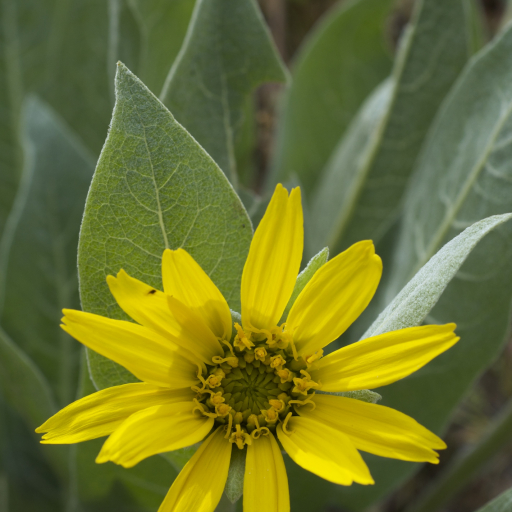
Often mistaken for its cousin W. mollis, the Wyethia helenioides—commonly known as Gray Mule’s Ears—is a striking California native that transforms dry hillsides into golden meadows. Its velvety, oversized leaves truly look like the ears of a mule emerging from the earth. It is a resilient survivor of the chaparral and open woodlands, perfectly adapted to the rugged beauty of the American West.
🔍 How to Identify
- 🌿 The Leaves: The most iconic feature! They are large, lance-shaped, and covered in fine, silvery-white hairs. This "fuzz" gives the plant a distinct grayish-green hue and a soft, felt-like texture.
- 🌻 The Blooms: Bright, cheery yellow flowers that resemble sunflowers. Each flower head sits atop a sturdy stem, reaching out from the center of the leafy clump to catch the sun.
- 📏 Growth Habit: It is a low-growing, clumping perennial. Unlike garden sunflowers that tower overhead, Mule's Ears create a lush, fountain-like mound of foliage close to the ground.
🏡 In Your Garden
- 🏜️ The Taproot Secret: This plant is a master of drought resistance because of its massive, woody taproot. Because this root grows so deep, the plant is extremely difficult to transplant once established. Always choose its "forever home" carefully when planting seedlings.
- 🦋 Pollinator Magnet: It plays a vital role in local ecosystems. In early spring and summer, it acts as a primary landing pad for native bees and butterflies, providing a high-energy nectar source when other wildflowers might still be dormant.
⚠️ Safety & Toxicity
- 🟢 General Safety: Wyethia helenioides is generally considered non-toxic to humans and pets. It does not carry the high-risk alkaloids found in some other wild daisy-family plants.
- 🧤 Skin Irritation: While not poisonous, the dense "peach fuzz" on the leaves can be a mechanical irritant. People with sensitive skin may experience a mild, itchy rash after handling the foliage without gloves.
✨ Fun Fact
- 🛶 The Explorer's Legacy: The genus was named after Nathaniel Jarvis Wyeth, an 18th-century ice merchant and rugged explorer who discovered the plant while trying to establish a fur-trading route to the Pacific Northwest!

Detailed Care Instructions
To grow Wyethia Helenioides plant, also known as woolly mule's ears or California compass plant, you can follow these steps:
- Climate and Location: This plant is native to California and thrives in arid or semi-arid regions with a Mediterranean climate. Ensure that you provide a sunny location with well-draining soil. If you live in a region with hot summers, provide partial shade during the hottest part of the day.
- Soil Preparation: Prepare the soil by removing any weeds, rocks, or debris. Till the soil to a depth of about 6-8 inches and mix in organic matter, such as compost or well-rotted manure, to improve drainage and soil fertility.
- Planting: Plant Wyethia Helenioides in the spring after the last frost date or in the fall for a better chance of establishment before winter. Dig a hole that is about twice the size of the plant's root ball. Gently place the plant in the hole, ensuring that the top of the root ball is level with or slightly above the soil surface. Backfill the hole and firm the soil gently around the plant's base.
- Watering: Water the plant deeply after planting to help settle the soil around the roots. Afterward, provide regular watering until the plant becomes established. Once established, Wyethia Helenioides is drought-tolerant and requires minimal watering. However, during excessively dry periods, provide deep watering to help the plant thrive.
- Mulching and Weed Control: Apply a layer of organic mulch around the plant, leaving some space around the stem to prevent moisture accumulation. Mulch helps retain moisture, suppress weeds, and regulate soil temperature.
- Fertilizer: Generally, Wyethia Helenioides does not require regular fertilization. However, if your soil lacks nutrients, you can apply a balanced organic fertilizer or compost once a year in early spring.
- Pruning: These plants do not require much pruning. However, you can remove any dead or damaged leaves or flowers to maintain the plant's aesthetic appeal.
- Pests and Diseases: Wyethia Helenioides is generally resistant to pests and diseases. However, keep an eye out for any signs of aphids, caterpillars, or powdery mildew, which can occasionally affect the plant. If necessary, use organic insecticidal soap or a suitable horticultural spray to control pests.
Remember that Wyethia Helenioides is a native plant, and it is beneficial for pollinators and wildlife. By growing this plant, you are also supporting local ecosystems and biodiversity.

Place in a bright room that is sun drenched almost all day. Or directly in a south-facing window.

1. First, assess the soil moisture level around the plant.
2. If the soil is dry to the touch, it is time to water.
3. Slowly and evenly pour water around the base of the plant, making sure not to splash water onto the leaves.
4. Allow the water to soak into the soil.
5. Repeat watering when the soil becomes dry again.
6. Be careful not to overwater, as this can lead to root rot.
7. Monitor the plant for signs of stress, such as wilting or yellowing leaves, which may be a sign of either too much or too little water.
8. Adjust watering as needed based on the plant's specific needs and environmental conditions.
To fertilize this plant, use a balanced fertilizer with an N-P-K ratio of 10-10-10 or similar. Apply the fertilizer in early spring just before new growth appears and then again in mid-summer. Follow the package instructions for dosage and application methods. Avoid over-fertilizing as it can cause damage to the plant.
The best soil to use with this plant is a well-draining soil mix, which is rich in nutrients and organic matter. The soil should have a pH level of 6.0 to 7.5, and it should be able to retain moisture without becoming waterlogged. The plant requires a soil that is slightly acidic or neutral, loamy and moderately fertile. You can use compost or potting soil that is designed for plants that need good drainage and prefer slightly acidic or neutral soils. It's also important to avoid soil that is too compacted or too sandy, as this can lead to water stress and poor growth. A combination of well-decomposed organic matter, such as leaf mold or compost, with coarse sand or grit may be necessary to promote proper drainage in heavy or clayey soils. Regular supplemental watering is crucial during the growth season, preferably twice per week, to maintain good plant health and promote deep root growth.
To propagate this plant, collect the seeds once they become mature and start to dry out. Then, plant them in the soil, ensuring that the seed is not too deeply buried. Provide regular watering and light until the seedlings are established. Alternatively, the plant can be divided by carefully separating the roots and replanting the divided sections in soil.








