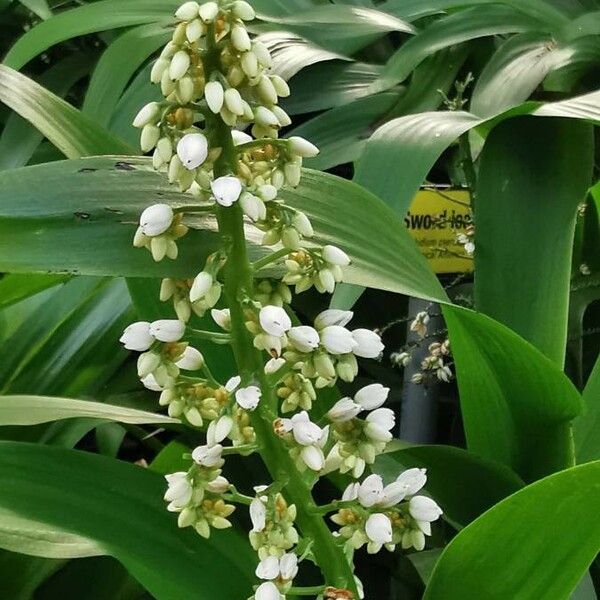
Plant Overview
Known as the Caribbean Sword Lily or Lamb’s Tail, this tropical perennial brings an architectural elegance to any plant collection. Native to the lush rainforests of Central and South America, it is famous for its striking "fan-shaped" growth habit that mimics a handheld folding fan. Despite its name and appearance, it isn't a true lily, but rather a member of the bloodwort family, prized for its ability to thrive in the humid shadows of the jungle floor.
🔍 How to Identify
- 🗡️ The Foliage: The leaves are long, sword-shaped, and arranged in a distinct, flattened fan (equitant). They grow in a single plane, creating a 2D effect that looks like a botanical sculpture.
- ❄️ The Blooms: Small, delicate, star-shaped flowers appear on a central stalk. While the species name caeruleum suggests blue, the flowers are often a milky white or very pale lavender-blue.
- 🟠 Vibrant Seeds: Following the bloom, the plant produces small, round berries that transition from green to a bright, glossy orange or red, adding a pop of color to the base of the stems.
🏡 In Your Garden
- ☁️ Humidity is Key: Because this plant originates in the rainforest understory, it despises dry air. If you are keeping it indoors, it thrives in a bright bathroom or placed near a humidifier to prevent the leaf tips from turning crispy and brown.
- 💧 The "Goldilocks" Soil: It prefers soil that is consistently moist but well-draining. It is far more tolerant of "wet feet" than most houseplants, making it a great choice for those who tend to overwater, though it should never sit in stagnant, stinky water.
⚠️ Safety & Toxicity
- 🐾 Mild Concern: While not considered highly toxic like "True Lilies" (which are deadly to cats), Xiphidium caeruleum can cause mild gastrointestinal upset if leaves or berries are ingested.
- 👶 Keep Out of Reach: The bright orange berries can be tempting to small children. It is best to display this plant on a high shelf or pedestal to prevent curious hands (or paws) from sampling the foliage.
✨ Fun Fact
The name Xiphidium comes from the Greek word xiphos, meaning "sword," a direct reference to its sharp, blade-like leaves. In some traditional Caribbean cultures, the plant was used as a herbal remedy to treat skin irritations and "cold" ailments.

Detailed Care Instructions
To grow Xiphidium caeruleum, also known as blue sword fern or blue swamp fern, you can follow these steps:
- Choose a suitable planting location: Xiphidium caeruleum prefers a partially shaded spot that receives filtered sunlight. It thrives in moist soil, such as near ponds, bogs, or in areas that retain moisture.
- Prepare the soil: Ensure that the soil is well-drained and rich in organic matter. You can amend the soil with compost or peat moss to increase its water-holding capacity.
- Planting: Dig a hole slightly larger than the root ball of the plant. Place the plant into the hole, making sure the crown is level with or slightly above the soil surface. Gently backfill the hole with soil and firm it around the roots.
- Watering: Keep the plant consistently moist, but not waterlogged. During dry periods, water it regularly to maintain moisture levels. Mulching around the plant can help retain moisture.
- Fertilizing: Xiphidium caeruleum doesn't typically require much fertilizer. However, you can apply a balanced, slow-release fertilizer in spring to promote healthy growth.
- Pruning: Remove any dead or damaged fronds to maintain the plant's appearance. Pruning can be done throughout the growing season, but be careful not to remove too many fronds at once, as it can affect the health of the plant.
- Pests and diseases: Xiphidium caeruleum is generally resistant to pests and diseases. However, keep an eye out for common fern diseases like leaf spot or fungal infections. If necessary, treat with appropriate organic or chemical remedies.
- Winter care: Xiphidium caeruleum is hardy in USDA zones 9-11 and can tolerate mild frost. In cooler regions, you can bring it indoors or protect it with a layer of mulch during winter.
- Propagation: Xiphidium caeruleum can be propagated by dividing the plant in early spring. Dig up the clump and carefully separate the rhizomes, ensuring each division has healthy fronds and roots. Replant the divisions in suitable locations.
By following these guidelines, you can successfully cultivate Xiphidium caeruleum and enjoy its beautiful blue-green fronds in your garden or landscape.

Place in a window with dappled sun or a spot in the middle of a room. Or directly in a window facing west or east.

Xiphidium caeruleum is a plant that requires regular watering to thrive. When watering the plant, it is important to ensure that the soil is moist but not waterlogged. Overwatering can lead to root rot and other plant diseases.
To water Xiphidium caeruleum, it is important to first check the soil to see if it is dry. If the top inch of the soil feels dry, it is time to water the plant. When watering, pour water evenly over the soil until it starts to drain out from the bottom of the pot.
It is important to avoid getting water on the leaves and stems of the plant, as this can lead to fungal growth and other diseases. Instead, water the plant at the base of the stem and allow the water to sink into the soil.
During hot and dry weather, or if the plant is in direct sunlight, it may need to be watered more frequently. However, it is important to ensure that the soil is well-draining and not staying too wet.
Overall, Xiphidium caeruleum is a low-maintenance plant that requires minimal watering. As long as the soil is kept moist but not waterlogged, the plant should thrive and produce beautiful flowers.
To fertilize this plant, use a balanced fertilizer with ratios of 10-10-10 or 20-20-20. Apply the fertilizer once a month during the growing season, which is usually in the spring and summer. Mix the fertilizer with water according to the instructions on the package and pour the solution onto the soil around the base of the plant. Be careful not to over-fertilize, as this may damage the plant.
The best soil for Xiphidium Caeruleum plant should be well-draining with a pH level of 6 to 7. It should also be rich in organic matter and nutrients to support the healthy growth of this plant. A mix of peat moss, perlite, and vermiculite is usually a good option, as it provides both drainage and nutrients. The soil should be kept moist but not waterlogged, and it should not be exposed to prolonged periods of drought or standing water. Additionally, adding a slow-release fertilizer to the soil can help to promote healthy growth. Overall, the soil should be well-suited to the needs of this plant in terms of drainage, pH, nutrients, and moisture levels.
Propagation of this plant can be done through division of its rhizomes. Dig up the plant, locate the rhizomes and separate them from the main plant. Each section should have a few healthy leaves and roots. Plant them in a well-draining soil mixture and water them thoroughly. Ensure that the soil is kept moist but not too wet to prevent rotting. After a few weeks, the new plants should begin to grow, and they can be transplanted into their permanent location.








