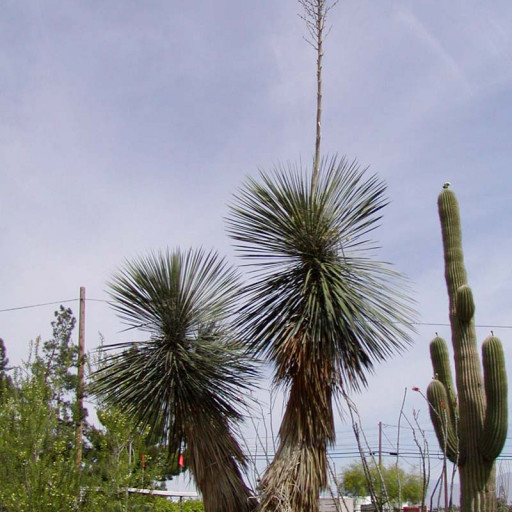
Plant Overview
Rising from the arid landscapes of the American Southwest like a guardian of the desert, the Yucca elata, or "Soaptree Yucca," is a symbol of resilience. Known for its towering flower stalks and shimmering, palm-like appearance, it was historically vital to indigenous cultures who used its roots to create a natural, sudsy soap for bathing and ceremonies. Whether silhouetted against a desert sunset or standing tall in a xeriscape garden, this plant brings a dramatic, architectural flair to any sun-drenched space.
🔍 How to Identify
- 🌿 The Foliage: Long, narrow, sword-like leaves that are flexible and green, often featuring distinctive white, curly fibers along the margins that look like loose threads.
- 🪵 The Trunk: Unlike many smaller yucca species, the Soaptree develops a distinct, cylindrical trunk that can reach 15 feet or more, often covered in a "skirt" of dried, downward-pointing old leaves.
- 🔔 The Blooms: During late spring, it sends up a massive woody stalk—sometimes doubling the height of the plant—topped with a dense, majestic cluster of creamy-white, bell-shaped flowers.
🏡 In Your Garden
- 🏜️ The Taproot Challenge: This plant develops an incredibly deep and sturdy taproot early in life to find water deep underground. Because of this, it is notoriously difficult to move once established; choose its permanent home carefully to avoid the risk of transplant shock.
- ☀️ Desert Logic: It thrives in poor, sandy, or alkaline soils and requires almost no supplemental water once settled. It is a perfect choice for fire-resistant landscaping and acts as a beacon for nocturnal pollinators, as its pale flowers seem to "glow" under the moonlight.
⚠️ Safety & Toxicity
- 🤺 Physical Hazard: The most immediate danger is the sharp, pointed tips of the leaves. They are stiff enough to puncture skin or cause eye injuries, so it is best kept away from narrow walkways or active play areas for children.
- 🐾 Pet Safety: The plant contains saponins. While these were used by humans for soap, they are toxic to cats and dogs if ingested, typically leading to drooling, vomiting, or digestive upset.
✨ Fun Fact
🦋 An Exclusive Romance: The Soaptree Yucca has a "monogamous" evolutionary relationship with the tiny Yucca Moth (Tegeticula). The moth is the plant's only pollinator, and in return, the moth lays its eggs in the flower so its larvae can eat a small portion of the developing seeds. Neither the moth nor the yucca can survive without the other!

Detailed Care Instructions
| Lighting | Full Sun |
To grow Yucca Elata plant, you can follow these steps:
- Choose a suitable location: Yucca Elata thrives in full sun to partial shade. It prefers fertile, well-draining soil. Ensure that the location has good drainage and is protected from strong winds.
- Prepare the soil: Yucca Elata prefers slightly acidic to neutral soil. Amend the soil with organic matter such as compost to improve its fertility and drainage. Avoid heavy clay or waterlogged soils.
- Planting: Dig a hole twice as wide and deep as the root ball of the plant. Place the Yucca Elata in the hole, ensuring that the crown is level with the soil surface. Backfill the hole with soil, pressing it firmly around the roots to eliminate any air pockets. Water thoroughly after planting.
- Watering: Yucca Elata is drought-tolerant once established. Water deeply but infrequently, allowing the soil to dry out slightly between each watering. Overwatering can lead to root rot, so it is important to avoid excess moisture.
- Mulching: Apply a layer of organic mulch, such as wood chips or bark, around the base of the plant. This helps conserve soil moisture, suppresses weed growth, and regulates the soil temperature. Avoid piling mulch against the stem to prevent rotting.
- Fertilizing: Yucca Elata does not require heavy fertilization. However, a slow-release balanced fertilizer can be applied in spring to promote healthy growth. Follow the manufacturer's instructions for application rates.
- Pruning: Remove any dead or damaged leaves or stems as needed. Pruning is generally not necessary for Yucca Elata unless to remove spent flower stalks or to shape the plant for aesthetic purposes.
- Protection: Yucca Elata is generally resistant to pests and diseases. However, you may want to protect it from extreme cold temperatures during winter. Covering the plant with burlap or a frost cloth can help prevent damage.
Remember, it may take some time for Yucca Elata to establish and start growing vigorously. Patience and consistent care will eventually lead to a healthy and thriving plant.

Place in a bright room that is sun drenched almost all day. Or directly in a south-facing window.

To properly water this type of plant, it is important to first consider the soil and the weather conditions. the soil should be allowed to dry slightly between watering to avoid over-watering and root rot. The plant requires moderate watering, about once a week. During hot and dry weather conditions the plant may need watering more frequently. When watering, it is important to water the soil directly and not the leaves or trunk as this can cause damage or disease. Additionally, it is best to avoid getting water on any blooms or flowers as they are delicate and can be easily damaged.
To fertilize this plant, use a balanced, slow-release fertilizer with equal amounts of nitrogen, phosphorus, and potassium. Apply the fertilizer in early spring and again in early autumn. Dilute the fertilizer to half strength and water the plant thoroughly after application. Avoid over-fertilizing, as excess nutrients can damage the roots and foliage. Instead, fertilize lightly but frequently to encourage healthy growth.
The soil that is recommended for Yucca Elata plant is well-drained, sandy or loamy soil with a neutral to slightly acidic pH level. It should not hold excessive moisture or be too heavy as the plant does not tolerate sitting in water for extended periods. A mix of sandy or loamy soil, coarse sand, and perlite or vermiculite is ideal. The soil should not contain high amounts of nitrogen as it can lead to excessive growth and weakens the plant's structure. Adding compost or well-rotted manure can improve the soil texture and provide some nutrients to the plant. Overall, a well-drained, porous soil mix is essential for the healthy growth of Yucca Elata plant.
To propagate this plant, you will need to first obtain a stem cutting from a mature plant. Choose a stem that is healthy, plump, and at least 4-6 inches long. Using a sharp, sterile knife or garden shears, cut the stem cleanly at a 45-degree angle, making sure to include at least one node.
Next, allow the cutting to dry out for a day or two. This will help prevent rot from developing when the cutting is planted. Once the cutting is dry, dip the cut end in rooting hormone to encourage root growth.
Prepare a pot with well-draining soil, such as a mix of sand and perlite. Make sure the pot has drainage holes to prevent water from pooling at the bottom. Insert the cutting into the soil, burying it about halfway down.
Water the cutting sparingly, making sure the soil stays moist but not waterlogged. Keep the pot in a warm, bright location but out of direct sunlight. Within a few weeks, the cutting should start to form roots and new growth. Once the new plant has become established, it can be repotted into a larger container or planted outside in a sunny, well-draining location.








