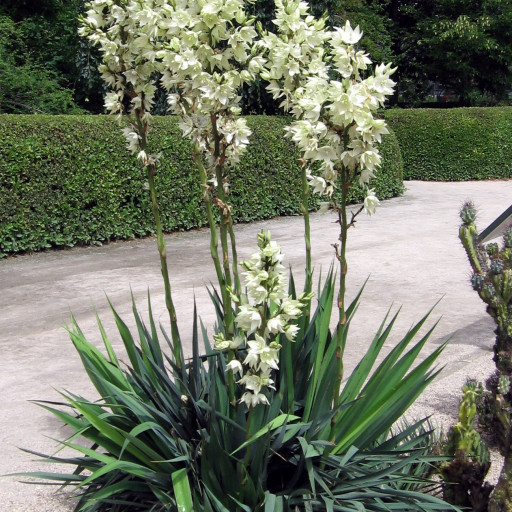
Plant Overview
Often called "Adam's Needle" or the "Weak-leaf Yucca," this architectural beauty is a staple of xeriscapes and desert-inspired gardens across North America. Unlike its more rigid cousins, this Yucca has a relaxed, "flaccid" appearance, with sword-like leaves that gracefully bend toward the earth. For centuries, its tough, stringy fibers were harvested by indigenous people to weave everything from sturdy sandals to fishing nets.
🔍 How to Identify
- 🗡️ The Foliage: Long, lance-shaped evergreen leaves that end in a sharp point. Unlike the stiff Yucca filamentosa, these leaves typically arch or droop downward near the middle.
- 🧵 Curly Filaments: The leaf margins are decorated with distinctive, curly white threads that look like frayed fabric blowing in the wind.
- 🔔 Summer Blooms: In mid-summer, a massive woody stalk (reaching up to 5-8 feet) rises from the center, laden with dozens of creamy-white, nodding bell flowers.
🏡 In Your Garden
- 🏜️ Drainage is King: This plant thrives on neglect but will quickly succumb to root rot if left in soggy, heavy soil. It is the perfect candidate for sandy slopes or rocky "hellstrips" where other plants struggle.
- ⚓ Deep Roots: It develops a massive, deep taproot. This makes it incredibly drought-resistant once established, but it also means it hates being transplanted. Choose its "forever home" carefully!
- 🛡️ Urban Warrior: It is highly resistant to salt spray and urban pollution, making it a "bulletproof" choice for coastal gardens or busy roadside plantings.
⚠️ Safety & Toxicity
- 🐾 Pet Warning: The plant contains saponins, which are toxic to dogs, cats, and horses. If ingested, it can cause drooling, vomiting, and coordination issues.
- 📌 Physical Hazard: The tips of the leaves are literally needle-sharp. Avoid planting it near narrow walkways or play areas where children or pets might accidentally run into the sharp spikes.
✨ Fun Fact
🦋 An Exclusive Romance: The Yucca Flaccida has a "soulmate" relationship with the Yucca Moth. This is an obligate mutualism; the plant cannot produce seeds without the moth, and the moth’s larvae can only survive by eating a small portion of the developing seeds. It is one of nature’s most specialized biological partnerships!

Detailed Care Instructions
Growing Yucca flaccida, also known as the weak-leaf yucca or Adam's needle, can be done by following these steps:
- Choose the right location: Yucca flaccida prefers full sun but can tolerate partial shade. Select a spot in your garden with well-draining soil. It is important to ensure that the soil does not become waterlogged to avoid root rot.
- Planting: Yucca flaccida can be planted from either seeds or small root cuttings. If using seeds, sow them in pots or directly in the ground during spring. If using root cuttings, ensure that they are around 4 to 6 inches long and plant them at the same depth they were in the original plant. Space multiple plants at least 2 to 3 feet apart.
- Watering: Yucca flaccida is a drought-tolerant plant. Water it regularly during the first few weeks after planting to help establish its root system. Once established, reduce watering frequency, allowing the soil to dry out partially between waterings. Watering sparingly will help the plant develop stronger roots.
- Mulching: Apply a layer of organic mulch around the base of the plant to help retain moisture, regulate soil temperature, and suppress weed growth. Ensure the mulch does not touch the stem as it can promote rot.
- Fertilizing: Yucca plants generally do not require much fertilizer. However, you can apply a balanced, slow-release fertilizer in spring to provide nutrients. Follow the instructions on the fertilizer packaging for the correct application amount and frequency.
- Pruning: Remove any dead or damaged leaves as needed. Yucca flaccida does not require heavy pruning, but you can remove the spent flowering stalks after they have finished blooming.
- Propagation: Yucca flaccida can be propagated by separating the offshoots, also known as pups, from the base of the mature plant. Ensure each pup has some roots attached and replant them in a new location.
- Winter care: Yucca flaccida is generally hardy and can tolerate temperatures down to around -20°F (-29°C). However, if you live in a colder climate, applying a layer of mulch around the base of the plant can provide some protection during winter.
Remember to always research specific care requirements for your specific yucca species, as different yuccas may have slightly different needs.

Place in a bright room that is sun drenched almost all day. Or directly in a south-facing window.

To water this plant, it is important to first thoroughly check the soil moisture level. Stick your finger into the soil about an inch deep and if it feels dry, it's time for watering.
When watering, use room temperature water and ensure the soil is moistened evenly. Be careful not to overwater, as this can cause root rot. Allow the top inch of the soil to dry out before watering again.
It's also important to provide good drainage and avoid leaving the plant in standing water, as this can also lead to root rot. Additionally, ensure the plant is located in an area with good air circulation to prevent moisture buildup and fungus growth.
The best time to fertilize the Yucca Flaccida plant is during its growing season, which is in the spring and summer months. Use a slow-release fertilizer and apply it to the base of the plant, being careful not to get any on the leaves. Water the plant thoroughly after fertilizing to ensure the nutrients are absorbed into the soil. Avoid fertilizing during the plant's dormant season, which is in the fall and winter months.
For optimal growth of the Yucca Flaccida plant, it is recommended to use a soil mixture that is well-draining with moderate fertility. The soil should be composed of a blend of organic materials, such as compost or peat moss, along with mineral components, such as sand or gravel. This will provide good aeration and drainage while also retaining enough moisture for the plant's needs. The pH level of the soil should be neutral to slightly alkaline, ideally between 6.0 and 7.5. It is important to avoid heavy soils that retain too much water, as this can lead to root rot and other issues. Additionally, the soil should not be too rich in nutrients, as this can cause the plant to grow too quickly and become weak or spindly. Overall, a well-balanced soil mix that provides good drainage and moderate fertility is the best choice for the Yucca Flaccida plant.
To propagate this particular plant, you will need to identify healthy and mature leaves that are at least 4 inches long. Look for leaves that are green in color and have no signs of damage or disease.
Next, using a sharp and clean knife or blade, cut the selected leaves from the base of the plant. Be sure to take care when cutting to avoid damaging the parent plant or harming yourself.
After cutting the leaves, remove any excess soil from the roots, being careful not to damage them. Then, place the leaves in a well-draining potting mix, ensuring that the base of the leaves is buried about 1 inch deep.
Keep the soil moist but not waterlogged, and place the pot in a warm and bright location with indirect sunlight. Within a few weeks, you should see new growth emerge from the base of the leaves.
Once the new plant has established roots, you can transplant it to a larger pot or outdoors into a well-draining soil in full or partial sun. With proper care and maintenance, your propagated Yucca Flaccida plant will thrive and grow into a beautiful specimen for your home or garden.
Common pests of the adam's-needle include Scale insect, mealybugs. Make a habit of checking your adam's-needle frequently for pests so that any infestations can be caught and managed early.








