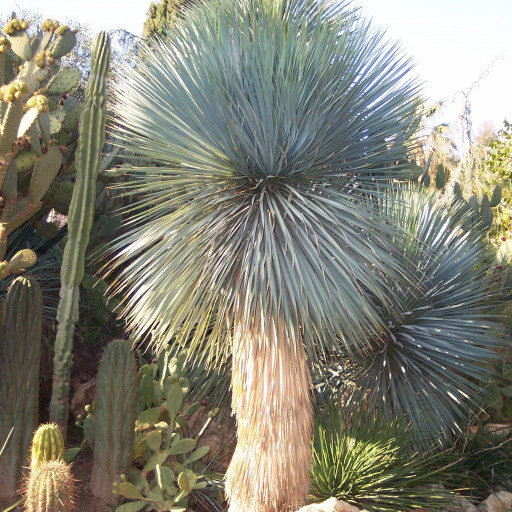
Plant Overview
Known affectionately as the "Beaked Yucca" or "Big Bend Yucca," this architectural masterpiece looks like something plucked straight from a futuristic desert landscape or a Dr. Seuss book. Native to the rocky slopes of Texas and Northern Mexico, it is prized for its shimmering, blue-silver "pom-pom" of leaves perched atop a rugged, shaggy trunk. It brings a high-end "desert chic" vibe to any space and is legendary for its ability to withstand both blistering heat and freezing winters.
🔍 How to Identify
- ❄️ The Foliage: A perfectly symmetrical, dense sphere composed of hundreds of narrow, flexible, needle-like leaves with a distinct powdery blue or silver-gray tint.
- 🧥 The Trunk: Mature specimens develop a stout, upright trunk often covered in a soft, tan "skirt" of old, dried leaves that provides natural insulation.
- 🔔 The Bloom: In late spring, a sturdy flower stalk rises high above the foliage, displaying large, spectacular clusters of waxy, creamy-white bell-shaped flowers.
🏡 In Your Garden
- 🏜️ Drainage is King: The Beaked Yucca is incredibly tough, but it cannot tolerate "wet feet." It thrives in gritty, rocky, or sandy soil where water moves through rapidly; sitting in damp soil will quickly lead to root rot.
- 🐢 Slow & Steady: This is a slow-growing species, often adding only a few inches of height per year. Because it takes a long time to develop its iconic trunk, mature specimens are often considered "investment plants" for the landscape.
- ☀️ Sun Seeker: To maintain that striking metallic-blue color and tight spherical shape, it needs full, unfiltered sunlight. In too much shade, the crown may become sparse and the leaves will turn a dull green.
⚠️ Safety & Toxicity
- 🌵 Physical Hazard: The most immediate danger is the leaf tips, which are quite sharp. It is best planted away from narrow walkways or areas where children and pets run to avoid accidental "pokes."
- 🐾 Pet Safety: Like many Yuccas, the leaves contain saponins. While not usually life-threatening, if chewed by dogs or cats, it can cause drooling, vomiting, or intestinal upset.
✨ Fun Fact
The Yucca rostrata is one of the hardiest trunk-forming yuccas in existence. While most desert plants hate the cold, this "silver star" can survive temperatures as low as -10°F (-23°C), making it a favorite for gardeners in chilly climates who want a tropical, desert look.

Detailed Care Instructions
| Humidity | Dry |
| Lighting | Full Sun |
| Difficulty | Easy |
| Hibernation | Cold Period |
| Temperature | 18°C - 23°C |
| Hardiness Zones | 5 - 10 |
To grow Yucca Rostrata, also known as Beaked Yucca, follow these steps:
- Choose a suitable location: Yucca Rostrata thrives in full sun, so select a spot with at least 6-8 hours of direct sunlight per day. It prefers well-draining soil, so amend heavy or clay soil with sand or gravel.
- Dig a hole: Prepare a hole that is slightly wider and deeper than the root ball of the plant. Gently tease the roots of the Yucca Rostrata before planting to encourage outward growth.
- Plant the yucca: Place the Yucca Rostrata in the hole, ensuring that the top of the root ball is level with or slightly above the soil surface. Backfill the hole with the amended soil, gently firming it around the roots.
- Watering: Yucca Rostrata is drought-tolerant once established, but it still requires regular watering during the first year to facilitate root establishment. Water deeply once a week initially and gradually reduce the frequency as the plant grows. Allow the soil to dry between waterings.
- Mulching: Apply a layer of organic mulch around the base of the yucca, leaving a gap around the stem to prevent rot. Mulch helps retain moisture and prevents weed growth.
- Pruning: Yucca Rostrata generally requires minimal pruning. However, you can remove the lower leaves as they dry out to maintain a more aesthetically pleasing appearance. Avoid cutting the entire crown of the plant as it may lead to irreversible damage.
- Fertilizing: Yucca Rostrata does not require frequent fertilizing. Apply a slow-release, balanced fertilizer in spring and avoid over-fertilizing, as it can negatively affect the plant's health.
- Protection: During winter, protect Yucca Rostrata from extreme frost by covering it with frost cloth or bringing it indoors if possible.
With proper care and maintenance, Yucca Rostrata can grow into a stunning specimen plant with its unique structural form and attractive blue-green foliage.

Place in a bright room that is sun drenched almost all day. Or directly in a south-facing window.

To water this type of plant, it is important to examine the soil moisture levels before watering. This can be done by sticking a finger or a moisture meter into the soil to determine if it is dry. If the soil is dry, water the plant deeply, making sure the water reaches the roots. It is best to water the plant on a regular basis, but be careful not to overwater as this can cause root rot. Alternatively, you can also mist the foliage of the plant to provide some moisture. When watering, it is best to avoid getting water on the leaves as this can lead to fungal or bacterial diseases. Finally, remember to allow the soil to dry out a bit between watering to avoid water accumulation in the soil.
To fertilize this plant, use a balanced fertilizer with an N-P-K ratio of 10-10-10 or 20-20-20. Mix the fertilizer according to the instructions on the package and apply it to the soil around the base of the plant. Make sure to water the plant thoroughly after fertilizing. Fertilize every 2-3 months during the growing season (spring and summer), but stop fertilizing during the winter months. Avoid over-fertilizing as it can lead to burnout and damage to the plant.
For optimal growth, Yucca Rostrata requires a well-draining soil mixture that is rich in nutrients. A suitable soil mixture for this plant should be composed of a blend of sand, perlite, and loam in a ratio of 1:1:1. This will ensure adequate drainage and prevent waterlogging of the roots. Additionally, a small amount of organic matter, such as compost or peat moss, can be added to the soil to increase water holding capacity and ensure sufficient nutrients for the plant. It is important to avoid using heavy garden soil or clay soils as they can cause drainage problems and lead to root rot.
To propagate this plant, first select a healthy mature plant with fully grown leaves. Using a disinfected sharp knife, remove a healthy young offshoot or pup from the base of the plant, ensuring it has roots attached.
Prepare a well-draining sandy soil mix, and plant the offshoot/pup in a pot. Place the pot in a bright, warm location, but not in direct sunlight. Water the newly planted pup sparingly, allowing the soil to dry out slightly between watering.
Within a few weeks, the plant should begin to establish roots and grow new foliage. Once the pup has grown large enough, it can be transplanted into a larger pot or outdoors in a suitable location.
Common pests of the beaked yucca include Scale insect, mealybugs. Make a habit of checking your beaked yucca frequently for pests so that any infestations can be caught and managed early.








