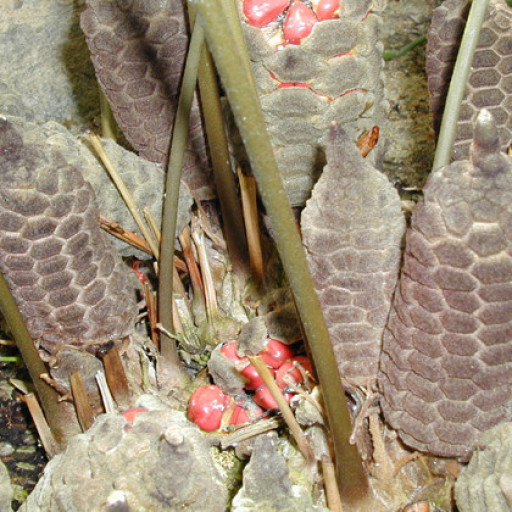
Plant Overview
Often called the "Coontie" or "Florida Arrowroot," the Zamia pumila is a rugged living fossil that has remained largely unchanged since the era of the dinosaurs. Though it looks like a cross between a fern and a palm, it is actually a cycad—a primitive seed plant. Native to the sandy woodlands of Florida and the Caribbean, it is legendary for its resilience and its historical role as a survival food for the Seminole people.
🔍 How to Identify
- 🌿 The Foliage: Stiff, leathery, evergreen fronds that grow in a rosette pattern. The leaflets are rounded at the tips and lack a central midrib, giving them a distinctively "neat" look.
- Stem The Trunk: Most of the plant's trunk stays underground (a "caudex"), which helps it survive fires and droughts. Above ground, it rarely grows taller than 3 feet.
- 🧶 The Cones: Instead of flowers, it produces woody cones. Male cones are slender and cylindrical, while female cones are thicker and covered in a velvety, reddish-brown fuzz.
🏡 In Your Garden
- 🏜️ Drought Specialist: Because of its massive underground starch-storing trunk, the Coontie is incredibly drought-tolerant once established. It is a "plant it and forget it" choice for sandy, well-draining soils.
- 🦋 The Butterfly Host: This is the only host plant for the rare Atala butterfly. By planting a Coontie, you are directly helping to save this beautiful, iridescent insect from extinction, as its larvae feed exclusively on the leaves.
⚠️ Safety & Toxicity
- 🚫 Status: TOXIC.
- 🐾 Details: All parts of the plant, especially the seeds found inside the female cones, contain cycasin. This is highly poisonous to dogs, cats, and humans. If ingested, it can cause severe liver failure and neurological issues. Always wear gloves when pruning if you have sensitive skin, and keep it away from curious pets.
✨ Fun Fact
The name "Coontie" is derived from the Seminole phrase conti hateka, meaning "white bread" or "white root." Native Americans learned to extract the starch from the toxic roots through a complex process of mashing and repeated washing to remove the poison—a technique later used to create Florida’s first starch industry.

Detailed Care Instructions
| Humidity | High |
| Lighting | Part Sun |
| Difficulty | Hard |
| Hibernation | Cold Period |
| Temperature | 15°C - 21°C |
| Hardiness Zones | 11 - 8 |
To grow a Zamia Pumila plant, also known as coontie, follow these steps:
- Choose the right location: Coontie thrives in partial shade to full sun. Select a spot in your garden or a container with well-draining soil.
- Soil preparation: Amend the soil with organic matter, such as compost, to enhance drainage and fertility. Coontie prefers slightly acidic to neutral soil, so adjust the pH if necessary.
- Planting: Plant zamia seeds or small coontie plants in the prepared soil, leaving enough space between them for future growth. If planting from seeds, sow them 1 inch deep and cover with soil.
- Watering: Initially, water the newly planted coontie plants thoroughly. Once established, water them consistently but avoid overwatering. Allow the top layer of soil to dry before watering again.
- Mulching: Apply a layer of organic mulch, such as wood chips or bark, around the base of the plants. This helps retain moisture and prevent weed growth.
- Fertilizing: Coontie plants do not require frequent fertilization. A slow-release fertilizer specific for cycads can be applied in spring. Follow the package instructions for proper dosage and application method.
- Pruning: Regularly remove any dead or damaged fronds to maintain the plant's health and appearance. Be cautious while handling coontie plants as they produce neurotoxic compounds that can cause skin irritation.
- Pests and diseases: Coontie plants are generally not prone to significant pest or disease issues. However, keep an eye out for scale insects, spider mites, or mealybugs. If detected, control them promptly with organic insecticides or by physically removing them.
- Propagation: To propagate coontie, collect the seeds from mature female plants and germinate them in a well-draining medium. This process may take a while, as Zamia Pumila has a slow growth rate.
- Winter care: In cold climates, protect your coontie plant from frost by covering it or moving it indoors during the winter months. Choose a location with a temperature above freezing and reduced watering during this dormant period.
By following these steps, you can successfully grow and maintain a Zamia Pumila plant (coontie) in your garden or as a container plant.

Place in a window with dappled sun or a spot in the middle of a room. Or directly in a window facing west or east.

To water this plant, you should first check the top inch of soil to see if it is dry. If it is, you can water the plant thoroughly until water runs out of the drainage holes. However, it is important not to let the plant sit in standing water, as this can lead to root rot. In general, this plant prefers to stay evenly moist but not waterlogged. It is also important to avoid getting water on the leaves, as this can cause spotting or fungal issues.
To fertilize this plant, use a balanced slow-release fertilizer in the spring, applying it at a rate of 1 tablespoon per square foot of soil. Water the plant thoroughly after fertilization. Avoid getting fertilizer on the foliage and ensure that the soil is moist before applying. Repeat the fertilization process every six months during the growing season.
The Zamia Pumila plant requires a specific type of well-draining soil to thrive. It is recommended to use soil that is formulated specifically for succulents or cacti. This soil is typically a blend of sand, perlite, and peat moss, which provides excellent drainage and prevents the soil from becoming waterlogged. The soil should be slightly acidic with a pH level between 5.5 to 6.5. Organic matter such as compost or leaf mold can be added to the soil to improve its texture and nutrient content. It is important to avoid using heavy clay soils or soils that retain too much moisture as this may cause root rot and damage to the plant.
Zamia Pumila can be propagated through the use of offsets or by collecting and planting its seeds.
To propagate through offsets, wait for the plant to produce small offsets or pups around the base of the mother plant. Carefully separate the pup from the mother plant using a clean and sharp knife or scissors. Make sure the pup has its own roots and plant it in a well-draining soil mix. Keep the newly potted pup in a brightly lit area with indirect light, keeping the soil consistently moist but not waterlogged.
To propagate from seeds, wait for the plant to produce cones or seed pods. When the cones change color and begin to open, collect the seeds. Clean and rinse the seeds with water and soak them in warm water for 24 hours prior to planting. Plant the seeds in a well-draining soil mix, about two inches deep. Keep the soil consistently moist, but not waterlogged, and keep the planting area in a brightly lit area with indirect light. Seeds can take up to six months or longer to germinate.
Common pests of the coontie include Scale insect, mealybugs, spider mites. Make a habit of checking your coontie frequently for pests so that any infestations can be caught and managed early.








