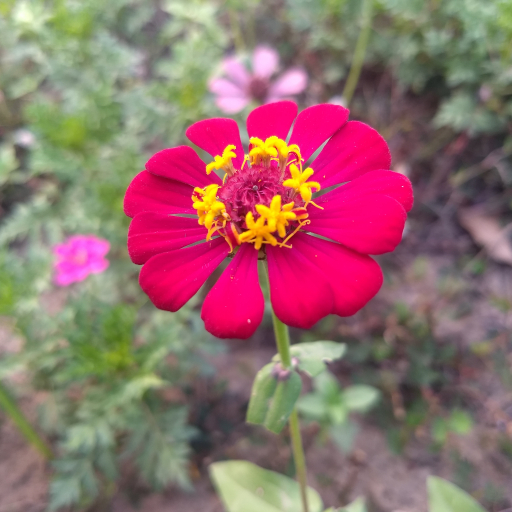
Plant Overview
The Zinnia, often called the "Workhorse of the Garden," is a burst of high-energy color native to the scrublands of Mexico. Known for their incredible stamina and ability to withstand scorching heat, these flowers have been a staple in cutting gardens for centuries. They are famously nicknamed the "Youth and Old Age" flower because new, vibrant blooms continue to emerge even as the older flowers stubbornly hold their petals and color.
🔍 How to Identify
- 🌸 Petal Variety: Zinnias come in three distinct flower forms: single-flowered (daisy-like), semi-double, and double-flowered (resembling pom-poms or dahlias).
- 🌿 Rough Texture: The stems and leaves are covered in fine, stiff hairs that feel slightly sandpaper-like to the touch.
- 🍃 Simple Foliage: The leaves are lance-shaped or oval and grow directly opposite one another along the stem, often clasping the stalk at the base.
🏡 In Your Garden
- 🦋 The Pollinator Magnet: Zinnias are one of the most effective plants for attracting Monarch butterflies and hummingbirds. Their "disk" centers are packed with nectar-rich mini-florets that act as a landing pad for insects.
- 🌬️ Airflow is Vital: While they are tough against heat, they are susceptible to powdery mildew in humid climates. To keep them healthy, always water at the soil level rather than the leaves and give them plenty of "elbow room" for air to circulate.
- ✂️ The "Cut-and-Come-Again" Rule: The more you harvest Zinnias for bouquets, the more they bloom. Pruning back the main stem encourages the plant to branch out and produce double the flowers.
⚠️ Safety & Toxicity
- ✅ Non-Toxic: Zinnias are generally considered safe and non-toxic for dogs, cats, and horses according to the ASPCA.
- 🧒 Child-Safe: They are an excellent "first plant" for children's gardens because they are easy to grow from large seeds and pose no systemic poisoning risk if accidentally nibbled.
✨ Fun Fact
In 2016, the Zinnia became a galactic pioneer! Astronaut Scott Kelly successfully grew and bloomed a bright orange Zinnia aboard the International Space Station, making it the first flower species to ever blossom in zero gravity.

Detailed Care Instructions
To grow Zinnia plants, follow these steps:
- Choose the right location: Zinnias prefer full sun, so choose a location that receives at least 6-8 hours of direct sunlight each day.
- Prepare the soil: Zinnias thrive in well-draining soil. Add organic matter, such as compost, to improve soil quality and drainage.
- Start seeds indoors: Start Zinnia seeds indoors 4-6 weeks before the last frost date in your area. Use seed-starting mix in small pots or trays. Sow the seeds shallowly, barely covering them with soil.
- Transplant outdoors: Once the danger of frost has passed and seedlings have at least two sets of true leaves, you can transplant them outdoors. Space the seedlings according to the recommended spacing for the variety you are growing.
- Direct sowing: Alternatively, you can directly sow Zinnia seeds outdoors when the soil has warmed up and frost is no longer a concern. Sow the seeds at the recommended spacing and depth on well-prepared soil.
- Watering: Keep the soil evenly moist but not soggy. Generally, water deeply once or twice a week, depending on rainfall and temperature.
- Mulching: Mulching around the base of the plants can help retain moisture, suppress weeds, and maintain even soil temperatures.
- Fertilizing: Zinnias are light feeders, so you may not need to fertilize if your soil is already rich in nutrients. If needed, use a balanced, slow-release fertilizer according to the package instructions.
- Pinching and deadheading: To encourage bushy growth and prolong blooming, pinch off the top growth when seedlings reach about 6 inches tall. Deadheading, or removing spent flowers, promotes continuous blooming.
- Pests and diseases: Zinnias are generally resistant to most pests and diseases. However, keep an eye out for aphids, spider mites, powdery mildew, and other common issues. Use organic pest control methods or consult a professional if necessary.
- Harvesting seeds: If you want to save seeds for future planting, allow some flowers to fully mature and dry on the plant. Collect the seeds and store them in a cool, dry place for next season.
By following these steps, you can successfully grow Zinnia plants and enjoy their colorful blooms throughout the growing season.

Place in a bright room that is sun drenched almost all day. Or directly in a south-facing window.

To water Zinnia plants, ensure that the soil is moist but not overly saturated. It is best to water deeply and infrequently, allowing the soil to dry out slightly between waterings. Water at the base of the plant rather than overhead to avoid wetting the leaves and promoting disease. When watering, do so in the early morning or late evening to avoid watering during the hottest part of the day. Adjust watering frequency based on the weather and soil conditions, increasing during hot and dry periods and decreasing during cooler and wetter periods.
To fertilize this plant, first, choose a fertilizer that is high in phosphorus, as this will support flower growth. Apply the fertilizer to the soil around the base of the plant, being careful not to let it touch the leaves or stems. Water the plant thoroughly after fertilizing to help the nutrients reach the roots. Repeat this process every few weeks throughout the growing season, or as recommended by the fertilizer instructions.
Zinnia plants prefer a well-draining soil that is rich in organic matter, and that has a pH level between 5.5 and 7.5. The soil should be loose and friable, with good air circulation, and should have good water-holding capacity. A soil that is too heavy or compacted can impede the growth of the Zinnia plant and cause it to wilt.
The ideal soil for Zinnia plants should be nutrient-rich, with a balance of nitrogen, phosphorus, and potassium, as well as trace minerals such as calcium, magnesium, and iron. Organic compost or aged manure can be added to the soil to improve its fertility and structure.
It is important to remember that the soil should also be free from contaminants and toxins, such as heavy metals or pesticides, as these can harm the Zinnia plant and affect its growth and flowering.
Zinnias can be propagated through stem cuttings. To do this, select a healthy stem from the plant and make a clean cut just below a node. Remove any leaves from the lower third of the stem. Dip the cut end of the stem in rooting hormone powder. Plant the cutting in a container filled with moist potting soil and cover with a plastic bag or clear plastic container to retain moisture. Place the container in a bright, but indirect light. Keep the soil moist but not waterlogged. After several weeks, the cutting should form roots and can be transplanted into a larger pot or garden bed.







