Plant Overview
Commonly known as the Christ’s Thorn Jujube or Sidr, this resilient evergreen tree is steeped in ancient history and religious lore. Believed by many to be the source of the biblical crown of thorns, it is a legendary survivor that thrives in arid landscapes where most other plants would perish. In the Middle East, it is revered not just for its shade, but for its medicinal properties and the prized honey produced from its flowers.
🔍 How to Identify
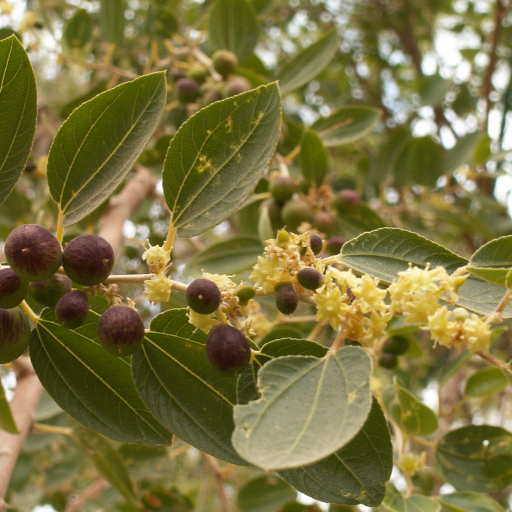
- 🍃 The Foliage: Look for small, oval-shaped leaves with a glossy sheen. A key identifying feature is the three prominent longitudinal veins that run from the base to the tip of each leaf.
- 🌼 The Blooms: It produces clusters of tiny, star-shaped flowers that are greenish-yellow. While subtle to the eye, they emit a distinct fragrance that acts as a magnet for honeybees.
- 🍎 The Fruit: The tree bears small, round drupes that transition from green to a wrinkled yellow or reddish-brown when ripe. They look like miniature apples and have a flavor profile somewhere between a tart apple and a sweet date.
- ⚔️ The Defense: True to its name, the branches are armed with sharp thorns that usually grow in pairs—one straight and one curved—making it an effective natural security fence.
🏡 In Your Garden
- ☀️ Desert Specialist: This plant is an "extremophile" regarding heat and light. It thrives in full sun and is incredibly drought-tolerant once established. It’s perfect for xeriscaping or Mediterranean-style gardens where water conservation is a priority.
- 🌳 The Anchor: Be very mindful of where you plant it! The Sidr develops a deep, aggressive taproot to find water far underground. This makes it nearly impossible to transplant once it reaches maturity and allows it to stabilize soil against erosion.
- 🐝 Pollinator Magnet: If you are a beekeeper or want to support local biodiversity, this is a top-tier choice. The nectar produces "Sidr Honey," which is globally renowned for its medicinal quality and rich taste.
⚠️ Safety & Toxicity
- ✅ Safe for Consumption: The fruits are entirely edible and high in Vitamin C. They are often eaten fresh, dried, or used to make traditional jams.
- 🩹 Physical Hazard: While not chemically toxic, the thorns are exceptionally sharp and can cause painful punctures. Keep this tree away from high-traffic walkways or areas where children play.
- 🐾 Pet Friendly: There is no known toxicity to cats or dogs, though the thorns pose the same physical risk to curious paws as they do to humans.
✨ Fun Fact
In many cultures, the Sidr tree is considered "blessed." In Yemen and Saudi Arabia, the honey produced from these trees is often referred to as the "Manuka of the Middle East" and is one of the most expensive and sought-after honeys in the world due to its rare antibacterial properties.

Detailed Care Instructions
To grow Ziziphus Spina-christi (also known as Christ's Thorn or Sidr), you can follow these steps:
- Climate and Soil Requirements: Ziziphus Spina-christi thrives in arid and semi-arid regions. It prefers well-drained soil with a pH level between 7 and 8. If the soil is heavy and clayey, consider mixing it with sand to improve drainage.
- Seed Germination: Soak the seeds in water for 24 hours to enhance germination. Alternatively, you can also scarify the seed coat slightly by rubbing it lightly with sandpaper or making a small nick with a knife. This helps water entering the seed more easily.
- Planting Location: Choose a sunny spot for planting. The plant requires full sunlight for optimal growth.
- Planting: Prepare a hole in the soil that is twice the size of the seed. Place the seed in the hole and cover it with soil, ensuring that it is not buried too deep. Leave some space for water to penetrate easily.
- Watering: Water the plant gently after planting. Avoid overwatering, as it can lead to root rot. Provide water regularly, allowing the soil to dry out slightly between waterings.
- Care and Pruning: Once the plant has established, it requires minimal care. Prune any dead or diseased branches to maintain a healthy plant.
- Mulching: Apply a layer of organic mulch around the base of the plant to help retain moisture, suppress weeds, and improve soil quality.
- Fertilization: While Ziziphus Spina-christi is generally adaptable to poor soils, you can use a balanced slow-release fertilizer during the growing season to promote healthy growth.
- Pests and Diseases: Monitor the plant for any signs of pests or diseases. In case of infestation, use appropriate organic pesticides or treatments to control them.
- Maturation and Harvesting: Ziziphus Spina-christi takes several years to reach maturity. Once mature, the plant produces small, reddish-brown fruit. Harvest the fruit when it turns dark red or brown and is slightly soft to the touch.
Remember, growing plants can vary depending on geographical location and climate conditions. It is advisable to consult local gardening experts or resources for specific guidance tailored to your region.
To ensure proper hydration for a plant belonging to the Ziziphus Spina-christi species, it is important to follow a few key steps.
Firstly, it is important to consider the environmental factors that may influence the plant's water needs. These factors include temperature, humidity, and sunlight exposure. A plant growing in a hotter, drier environment may require more frequent watering than one growing in a cooler, more humid climate.
Secondly, it is important to monitor the soil moisture levels around the plant. The soil should be moist but not waterlogged, as excess water can lead to root rot and other complications. One way to check soil moisture levels is to stick a finger a few inches into the soil, and water the plant if the soil feels dry.
Thirdly, it is important to water the plant slowly and evenly, ensuring that the water reaches the roots of the plant. One way to do this is to use a watering can or hose with a gentle stream of water. It is important to avoid getting water on the leaves of the plant, as this can encourage fungal growth and other plant diseases.
Finally, it is important to avoid over-watering the plant, as this can lead to root rot and other complications. It is better to underwater than overwater, as the plant can often recover from slight dehydration more easily than it can from over-saturation.
To fertilize this plant, use a balanced fertilizer with equal amounts of nitrogen, phosphorus, and potassium. Apply the fertilizer during the growing season, from early spring to late summer, every two weeks. Dilute the fertilizer to half strength to avoid burning the plant's roots. Water the plant thoroughly after fertilizing to help distribute the nutrients evenly. Avoid fertilizing during the dormant season, from late fall to early spring.
Ziziphus Spina-christi plant prefers well-draining soil that is rich in organic matter and slightly acidic in pH. It grows best in loamy soil that is deep, moist, and fertile, with adequate air circulation around the roots. The soil should not be too compacted or sandy, as this may hinder the plant's growth and development. Organic fertilizers such as compost, manure, or worm castings can be added to the soil to improve its structure and provide essential nutrients. It is also important to ensure that the soil is not waterlogged or too dry, as this can cause stress and damage to the plant. In areas with heavy clay soil, it may be necessary to amend the soil with sand or other materials to improve drainage and prevent waterlogging.
Ziziphus Spina-christi is a perennial plant species that can be propagated through several methods, including seed propagation, cutting propagation, and grafting. Here are some general steps for propagation:
Seed Propagation:
- Collect mature fruits from the Ziziphus Spina-christi plant.
- Clean the fruits and remove the seeds.
- Soak the seeds in warm water for 24 hours.
- Sow the seeds in a pot filled with well-draining soil.
- Keep the soil moist and in a warm, sunny spot.
- Wait for the seeds to germinate and grow into seedlings, which can take several months.
Cutting Propagation: - Take a cutting from a healthy Ziziphus Spina-christi plant.
- Dip the cutting in rooting hormone powder.
- Plant the cutting in a pot or planting medium filled with well-draining soil.
- Water the soil and cover the pot with a plastic bag to create humidity.
- Place the pot in a warm, sunny spot with indirect light.
- Check the soil regularly to make sure it stays moist.
- After several weeks, roots should start to grow from the cutting. Wait until the new plant reaches a good size before transplanting it to a larger pot.
Grafting: - Select a healthy rootstock from a related Ziziphus species.
- Cut a small branch from the Ziziphus Spina-christi plant and shape it into a wedge shape.
- Make a small cut in the rootstock and insert the wedge-shaped cutting.
- Secure the cutting with grafting tape or a similar binding material.
- Keep the grafted plant in a warm, sunny spot with indirect light.
- Water the plant regularly and monitor it for signs of growth and health.
Propagation by layering, air layering, and division may also be possible for Ziziphus Spina-christi, depending on the plant's age and condition. It's important to research the specific plant and its propagation requirements for the best results.








