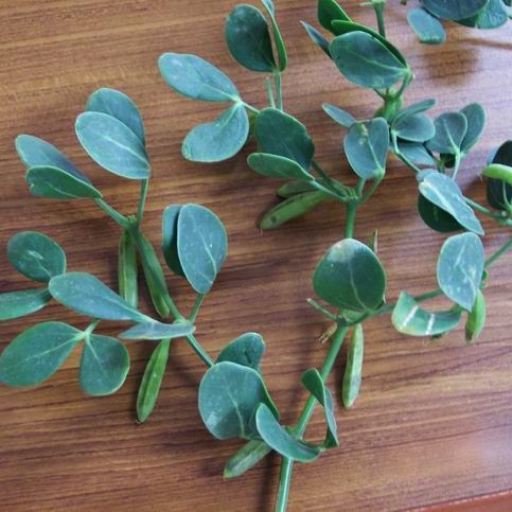
Plant Overview
Often called the Syrian Bean-caper, this resilient traveler hails from the dry landscapes of the Mediterranean and Central Asia. While its delicate, creamy flowers look soft and inviting, this plant is a rugged survivor, often found thriving in harsh, salty soils where other plants wither. In some regions, it is viewed as a persistent "weed" because once it digs its deep taproot into the earth, it rarely leaves without a fight.
🔍 How to Identify
- 🍃 The Leaf Pair: Unlike many plants, its leaves grow in distinct pairs of two fleshy, oval-shaped leaflets. This "twin-leaf" look is a hallmark of the species.
- 🌸 Copper-Centered Blooms: The flowers are small and cup-shaped, featuring five pale yellow or white petals. The real giveaway is the bundle of long, orange or copper-colored stamens that poke out from the center.
- 🫛 Cylindrical Fruit: After flowering, it produces long, ribbed green capsules that look a bit like miniature, upright beans, which is how it earned its "Bean-caper" nickname.
🏡 In Your Garden
- 🏜️ The Ultimate Minimalist: If you find this in your yard, it's likely because the soil is poor, dry, or disturbed. It thrives on neglect and can survive intense heat and drought thanks to its waxy, water-storing foliage.
- ⚓ Deep-Rooted Determination: It develops a massive, deep taproot early in life. If you are trying to remove it, you must dig deep; simply pulling the top off will result in the plant regenerating quickly from the root crown.
- 🧂 Salt Tolerance: It is a "halophyte," meaning it is one of the few plants that can tolerate high salinity, making it a common sight near coastal areas or roadsides where salt is used.
⚠️ Safety & Toxicity
- 🚫 Toxic to Livestock: It is generally considered unpalatable and potentially toxic to cattle and sheep due to certain alkaloids and saponins.
- 🐾 Pet & Child Safety: While not usually fatal in small amounts, it can cause digestive upset if leaves or seed pods are ingested. It is best kept away from curious pets and toddlers.
- 🧤 Skin Sensitivity: Some gardeners report mild skin irritation when handling the sap; wearing gloves during pruning or removal is a wise precaution.
✨ Fun Fact
In its native regions, the flower buds are sometimes pickled and used as a substitute for true capers (from the Capparis spinosa plant). However, unless you are an expert in traditional Mediterranean foraging, it's better to stick to the store-bought variety!

Detailed Care Instructions
To grow Zygophyllum fabago (Syrian bean-caper), follow these steps:
- Seed collection: Collect seeds from the plant when they are fully matured and dry. Look for seed pods that have turned brown and are starting to split.
- Soil preparation: Prepare a sandy, well-draining soil mix. Mix equal parts of garden soil, sand, and organic compost to create a good soil mixture for the plant.
- Sowing seeds: Sow the seeds directly into the prepared soil during spring. Make sure to space them at least a foot apart.
- Watering: Provide regular watering to keep the soil moist but not waterlogged. Once the plants are established, reduce the frequency of watering as they are drought-tolerant.
- Sunlight: Zygophyllum fabago requires full sunlight exposure. Choose a location where the plant will receive at least 6-8 hours of direct sunlight each day.
- Fertilizer: Apply a balanced, slow-release fertilizer during the growing season to promote healthy growth. Follow the instructions on the fertilizer packaging for application rates.
- Weed control: Regularly weed around the plants to prevent competition for nutrients and water. Remove any weeds or unwanted plants that may grow near to the Zygophyllum fabago.
- Pruning: Trim off any dead or damaged branches to maintain the plant's shape and vigor.
- Pests and diseases: Zygophyllum fabago is generally pest-resistant and disease-free. However, keep an eye out for common pests like aphids or spider mites, and take appropriate measures for control if necessary.
- Propagation: Zygophyllum fabago can also be propagated from stem cuttings or by division during the dormant season. Take cuttings of healthy stems and plant them in a well-draining soil mix. Keep the soil moist and place the cuttings in bright, indirect light until they root.
Remember that Zygophyllum fabago is a hardy plant that is adapted to arid and semi-arid conditions. It is relatively low-maintenance once established and can tolerate some neglect.

Place in a bright room that is sun drenched almost all day. Or directly in a south-facing window.

When watering this plant, it is important to ensure that the soil is moist but not overly saturated. This can be achieved by watering deeply once a week and allowing the soil to dry slightly between watering sessions. It is also important to avoid getting water on the leaves or foliage, as this can lead to fungal diseases. In addition, be mindful of the climate and temperature in which the plant is being grown, adjusting the watering schedule as needed to accommodate for changes in weather and humidity.
To properly fertilize this plant, use a balanced, slow-release fertilizer during the early spring before active growth begins. Apply the fertilizer evenly around the base of the plant, taking care not to overly concentrate it in one area. Follow the manufacturer's instructions carefully, and avoid using too much fertilizer, as it can result in burn and other damage to the plant. Water the plant deeply after fertilizing to ensure the nutrients are carried to the roots. Additionally, you can supplement with organic matter such as compost or manure, which can be spread around the plant's base to improve soil fertility.
The Zygophyllum Fabago plant prefers a well-draining soil that is rich in organic matter, with a pH range of 6.0 to 8.0. It grows best in sandy or gravelly soils and can tolerate drought conditions. The soil should be moist but not waterlogged, as the plant is susceptible to root rot. It is also essential to avoid any soil that is contaminated with salt, as this can be harmful to the plant. Additionally, the plant benefits from the addition of a slow-release fertilizer at planting and during the growing season.
To propagate this plant, you can collect mature seeds from the plant after blooming season. Soak the seeds in water for a day or two and then plant them in a well-draining soil mix. Keep the soil moist but not too wet as excess water can cause the seeds to rot. Place the pot or container in a warm, bright location but away from direct sunlight. Once the seedlings have grown to a size where they have developed their true leaves, they can be transplanted to individual pots or to the garden. Additionally, this plant can also be propagated by taking stem cuttings from the parent plant. Take a healthy and mature stem cutting and remove the bottom leaves. Dip the cutting in rooting hormone and plant it in a well-draining soil mix and keep it moist until roots have developed. The rooted cuttings can then be transplanted to individual pots or to the garden.








