Info
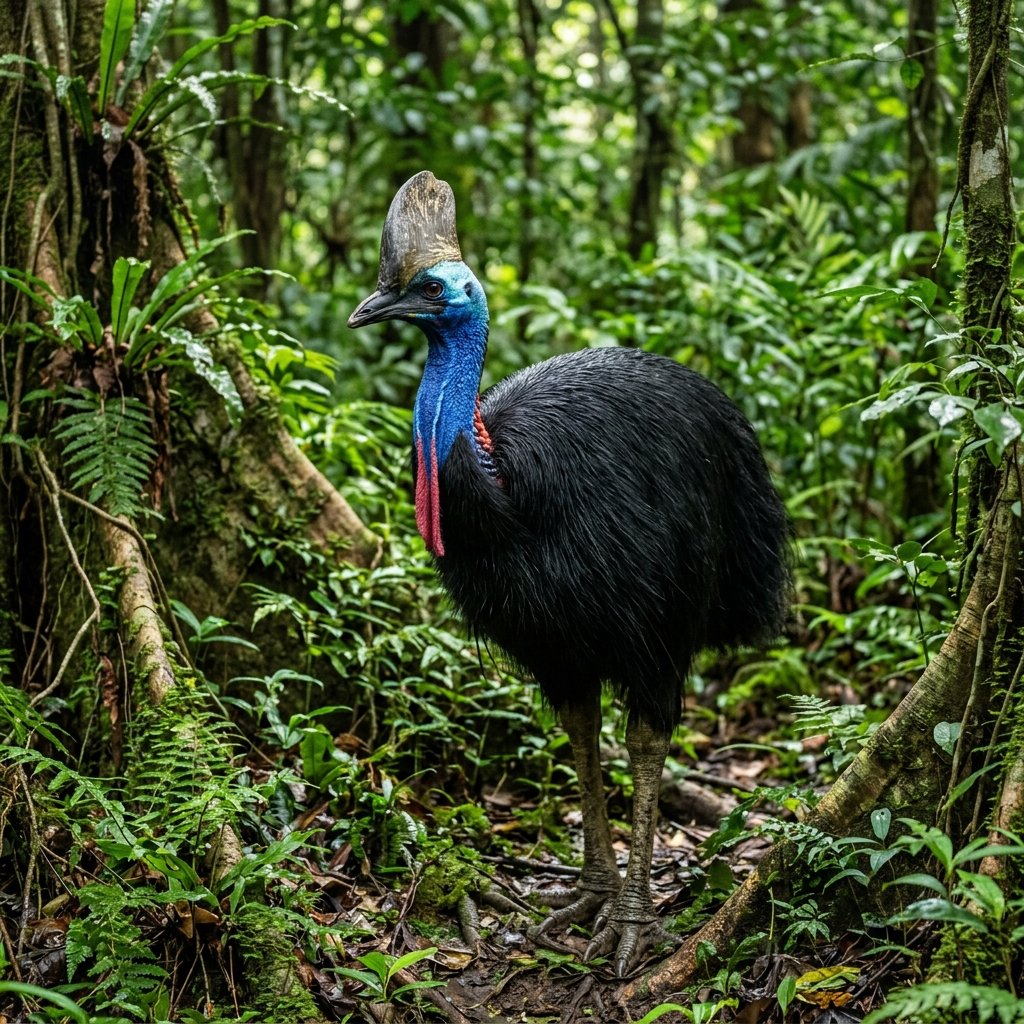
Often called a "living dinosaur," the Southern Cassowary is a magnificent, flightless giant that stalks the dense tropical rainforests of Northern Australia and New Guinea. Known for its striking sapphire-blue skin and the prehistoric "helmet" atop its head, this bird acts as a vital gardener of the forest, dispersing large seeds that no other creature can handle. Their low-frequency "boom" is so deep it can be felt in the human chest long before the bird is ever seen.
🔍 How to Identify
- 🪖 The Casque: A prominent, horn-like crest (helmet) on the head made of keratin. It is used for navigating through thick brush, indicating age, and potentially sensing low-frequency sounds.
- 🌈 Vivid Colors: A featherless, brilliant blue neck adorned with two long, fleshy red wattles that hang down from the throat.
- 🗡️ Dagger Toes: Massive, powerful feet featuring a 12-centimeter (5-inch) inner claw that is razor-sharp and used as a primary defensive weapon.
🪶 Behavior & Diet
- 🍎 Rainforest Gardener: They are primarily frugivores, consuming over 200 types of forest fruit. Because their digestive tract is gentle, they pass seeds whole, making them the most important seed dispersers in their ecosystem.
- 🤫 Solitary Giants: These birds are naturally shy and elusive, preferring the shadows of the deep jungle. Despite their bulk, they are incredible swimmers and can sprint up to 50 km/h (31 mph) through tangled vines and dense undergrowth.
🤝 Interaction & Safety
- 🚫 High Danger Level: The Southern Cassowary is widely considered the world's most dangerous bird. They are highly territorial and can be extremely aggressive if they feel cornered or if they are protecting their chicks.
- 🚷 Observe from Afar: Never approach, corner, or attempt to feed a Cassowary. Most attacks occur when birds become "habituated" (lose their fear of humans) because they expect food. If you encounter one in the wild, back away slowly and try to put a tree or large object between you and the bird.
✨ Fun Fact
Southern Cassowary dads are the ultimate stay-at-home parents! After the female lays a clutch of large, bright green eggs, she leaves to find another mate. The male stays behind to incubate the eggs for 50 days and raises the chicks entirely on his own for nearly a year.
More Details



