Info
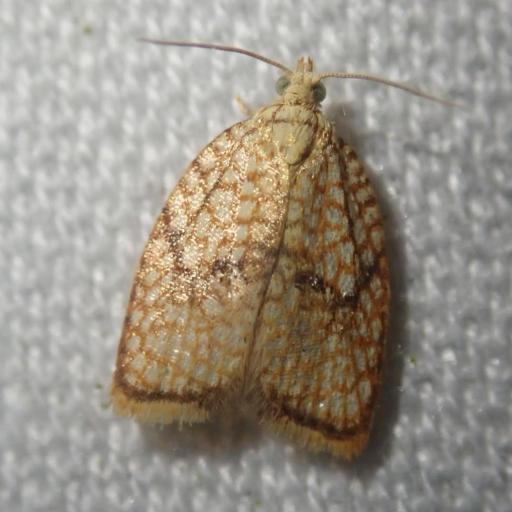
Often found resting on the undersides of maple leaves, the Maple Button Moth (Acleris forsskaleana) looks like a tiny piece of delicate, hand-woven lace. This moth is a specialist of the maple tree family and is named after Peter Forsskål, a brave 18th-century explorer. While it is technically a "pest" because its larvae munch on leaves, it is generally considered a harmless and beautiful guest in most gardens.
🔍 How to Identify
- 🕸️ The "Lace" Pattern: The most striking feature is the intricate, dark-brown reticulated (net-like) pattern covering its pale yellow or straw-colored wings.
- 🔔 Bell Shape: When at rest, the moth holds its wings in a flat, bell-like shape typical of the Tortricidae family, often appearing almost rectangular from above.
- 📏 Micro Size: This is a small moth, with a wingspan usually measuring between 12mm and 17mm—roughly the width of a adult's thumbnail.
🌲 Habitat & Ecology
- 🍁 Maple Specialist: You are most likely to spot this insect near Sycamore (Acer pseudoplatanus) or Field Maple (Acer campestre) trees. The larvae are "leaf-rollers," meaning they use silk to fold the edges of a maple leaf into a cozy, protective tube where they live and eat.
- 🌙 Night Moves: While they are nocturnal and attracted to garden lights, you can often "flush" them out of maple foliage during the day, where they fly a short distance before diving back into the green cover.
⚠️ Safety & Toxicity
- ✅ Harmless: The Maple Button Moth is completely safe for humans and pets. It does not bite, sting, or possess any irritant hairs.
- 🌿 Tree Health: While the caterpillars eat maple leaves, the damage is almost always cosmetic. They rarely occur in high enough numbers to threaten the health of a mature tree, so there is usually no need for chemical intervention.
✨ Fun Fact
This moth was named to honor Peter Forsskål, one of the "Apostles of Linnaeus." Forsskål was a visionary naturalist who died during a dangerous expedition to Yemen; his teacher, Carl Linnaeus, named several species after him to ensure his name would be remembered by future generations of nature lovers.
More Details








