Info
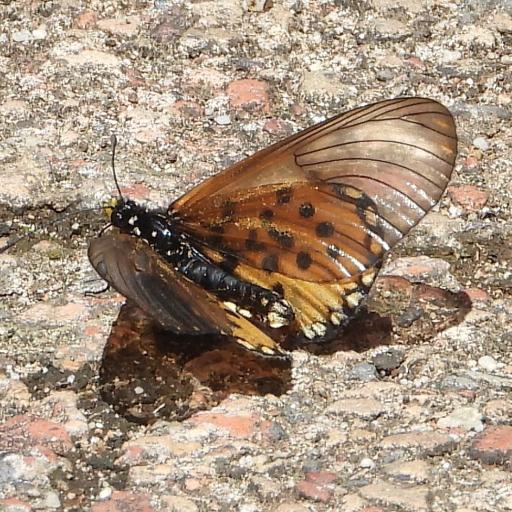
Often called the Garden Acraea, this butterfly is a slow-moving jewel common in Southern African landscapes. Unlike many butterflies that zip away at the slightest shadow, the Garden Acraea flies with a lazy, fluttering grace because it knows it is well-protected; its bright colors serve as a "do not eat" sign to every bird in the neighborhood.
🔍 How to Identify
- 🦋 Translucent Wings: A key giveaway is the forewings, which are smoky and partially transparent, while the hindwings are a solid, vibrant brick-red or orange.
- ⚫ Polka-Dot Pattern: Both the wings and the body are decorated with distinct black spots, a classic "aposematic" (warning) color pattern.
- 🐛 Spiky Larvae: The caterpillars are impossible to miss—they are bright yellow and black with rows of intimidating, branched black spines.
🌲 Habitat & Ecology
- 🌳 The Wild Peach Connection: This butterfly is almost entirely dependent on the Wild Peach tree (Kiggelaria africana). In many gardens, it is considered a "seasonal guest" that arrives in large numbers to lay eggs on these specific leaves.
- 🍽️ Social Eaters: The caterpillars are highly gregarious, meaning they live and feed in large groups. While they can temporarily strip a tree of its leaves, they rarely kill the plant, and the "damage" is simply a natural part of the local ecosystem.
⚠️ Safety & Toxicity
- 🧪 Toxic Defense: This insect is chemically protected. It sequesters cyanogenic glycosides (cyanide-like compounds) from its host plant, making it bitter and poisonous to birds and small mammals.
- 🧤 Skin Irritation: While the butterfly itself is safe to observe, the caterpillars' spines can cause mild skin irritation or an itchy rash if handled with bare hands. It is best to admire their "punk rock" look from a distance.
✨ Fun Fact
The Garden Acraea practiced "chemical warfare" long before humans. When a bird tries to grab one, the butterfly can "reflex bleed," exuding a foul-smelling, yellow liquid from its leg joints that tastes so bitter the predator will immediately release it!
More Details








