Info
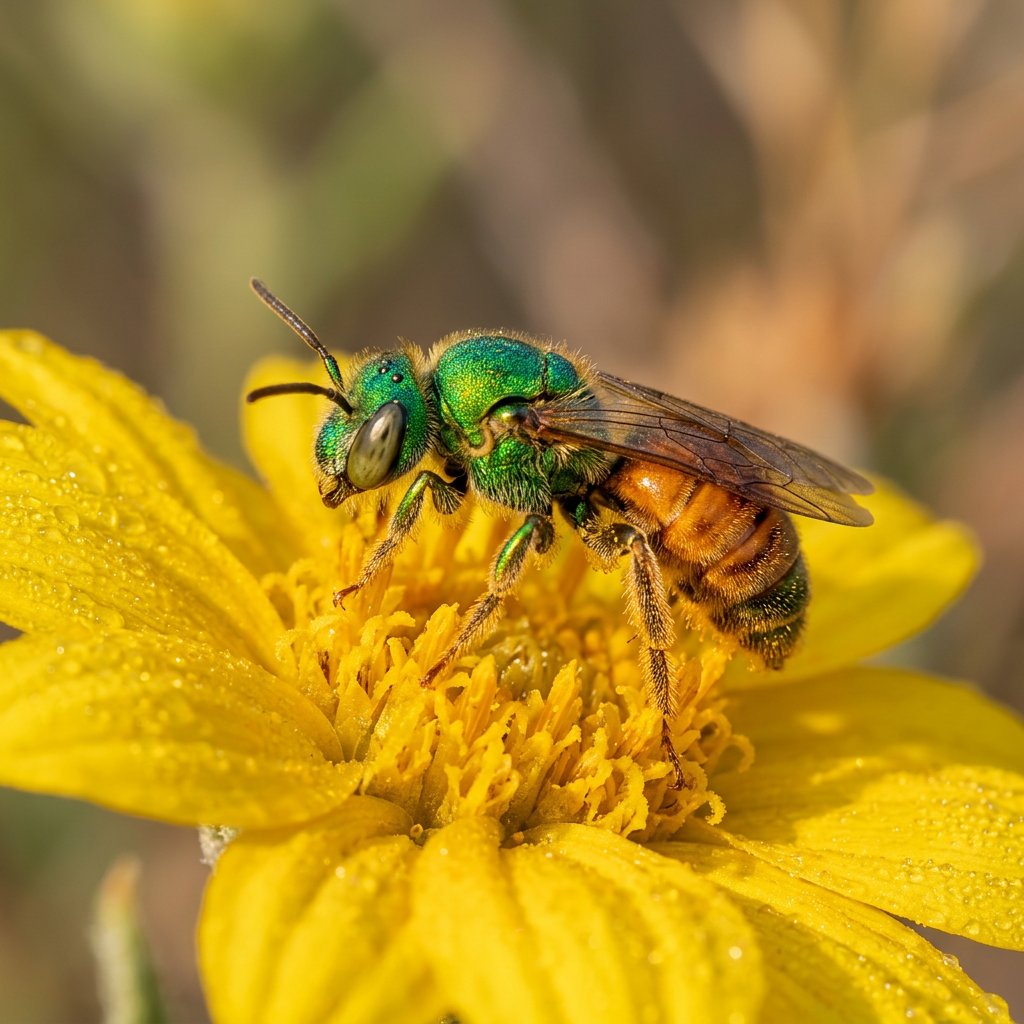
Known as the Honey-bellied Sweat Bee, this tiny insect is a living jewel of the desert and garden alike. While many of its relatives are famous for being entirely metallic green, this specific species stands out with its distinct two-toned "honey" colored tail. They are vital native pollinators that play a quiet but massive role in keeping wild landscapes blooming.
🔍 How to Identify
- 🟢 The "Emerald" Cape: The head and thorax (mid-section) are a brilliant, shimmering metallic green or blue-green that glints in the sunlight.
- 🍯 Honey Abdomen: Unlike the solid green of other sweat bees, the abdomen of Agapostemon melliventris is pale yellow or amber, often marked with thin, dark stripes.
- 🦟 Size and Shape: They are slender and compact, typically measuring about 7 to 12 millimeters—roughly the size of a fingernail.
🌲 Habitat & Ecology
- 🏜️ Arid Specialists: You’ll most often find them in the Western United States and Mexico, where they have adapted perfectly to dry, sun-drenched environments.
- 🏠 Subterranean Suites: These are ground-nesting bees. While they are technically "solitary," several females may share a single entrance tunnel in the soil to save energy, though they each maintain their own private nursery chambers.
- 🌸 Garden Allies: They are generalist pollinators, meaning they aren't picky eaters; they will visit everything from desert cacti and sunflowers to the herbs in your backyard.
⚠️ Safety & Toxicity
- 🐝 Passive Personality: These bees are exceptionally gentle and non-aggressive. They have no "nest-guarding" instinct like honeybees or yellowjackets.
- 🤏 Mild Sting: They can sting if squeezed or stepped on, but the sensation is very minor—often compared to a tiny, fleeting prick or a spark.
- 💧 Salt Seekers: They get the name "Sweat Bee" because they are attracted to the salts in human perspiration. If one lands on you, it’s just looking for a quick "sports drink" and isn't trying to cause harm.
✨ Fun Fact
While the females spend their days working hard in their underground tunnels, the males are the "socialites" of the species. On chilly nights, you can sometimes find groups of males huddling together on a single flower stem, sleeping in a cluster to stay warm until the sun comes up!
More Details








