Info
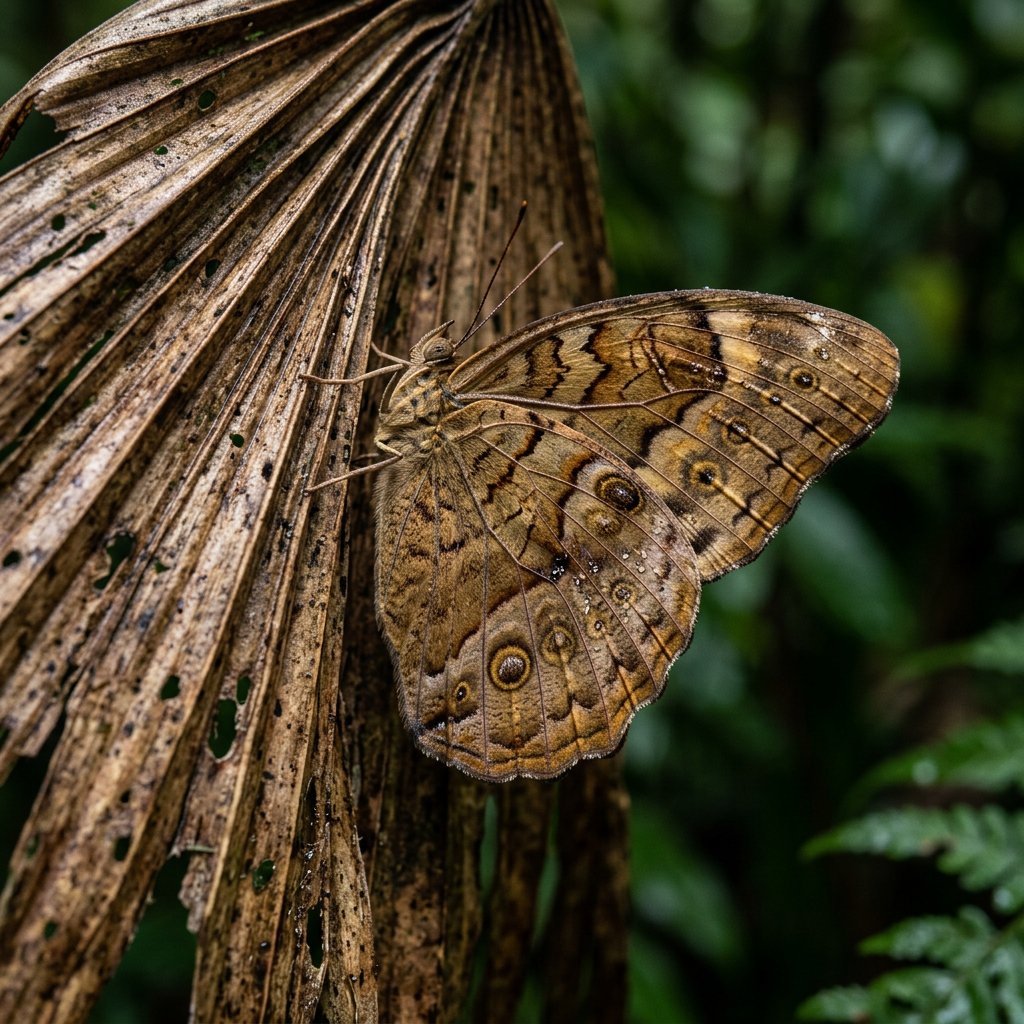
The Palmking (Amathusia phidippus) is a master of disguise and a true royal of the tropical undergrowth. Often mistaken for a withered leaf when resting, this large butterfly belongs to the "Satyr" family, known for their love of shade and fermented fruit. In Southeast Asian folklore, its sudden, silent appearance from the shadows of palm trees often gives it a mysterious, almost ghost-like reputation.
🔍 How to Identify
- 🍂 Wing Shape: When closed, the wings are shaped exactly like a dried, pointed leaf, complete with a "midrib" line running through the center to enhance the camouflage.
- 👁️ The Ocelli (Eyespots): The underside of the hindwings features two large, prominent "owl-like" eyespots. These are used to startle predators who might think they are staring at a much larger animal.
- 📏 Impressive Size: It is a relatively large butterfly, with a wingspan that can reach up to 12 centimeters, making its flight seem heavy and erratic compared to smaller species.
🌲 Habitat & Ecology
- 🌴 Palm Specialists: As its name suggests, this insect is deeply tied to palms. The caterpillars feed almost exclusively on coconut, oil palm, and banana leaves, making them a common sight in plantations and tropical gardens.
- 🌆 Twilight Dweller: Unlike many butterflies that love the midday sun, the Palmking is crepuscular. It is most active during the dim light of dawn and dusk, spending the hot hours of the day hiding perfectly still under large fronds.
- 🍌 Sweet Tooth: You won’t often find these on flowers. Instead, they prefer "dirty" energy sources like rotting fruit, sap flows from wounded trees, or even nutrient-rich damp earth.
⚠️ Safety & Toxicity
- 🛡️ Harmless Giant: Despite its large size and the "scary" eyes on its wings, the Palmking is completely harmless. It does not possess a stinger, and its mandibles are designed only for sipping liquids.
- 🐾 Pet & Child Friendly: They are non-toxic if accidentally touched. However, like all butterflies, their wings are fragile; the "dust" on their wings is actually tiny scales that help them fly, so it is best to observe them without handling.
✨ Fun Fact
The Palmking is a "telepathic" hider! If it senses a predator nearby, it doesn't just stay still—it aligns its body perfectly with the angle of the sun to minimize its shadow, making its "dead leaf" disguise nearly impossible to detect from above.
More Details








