Info
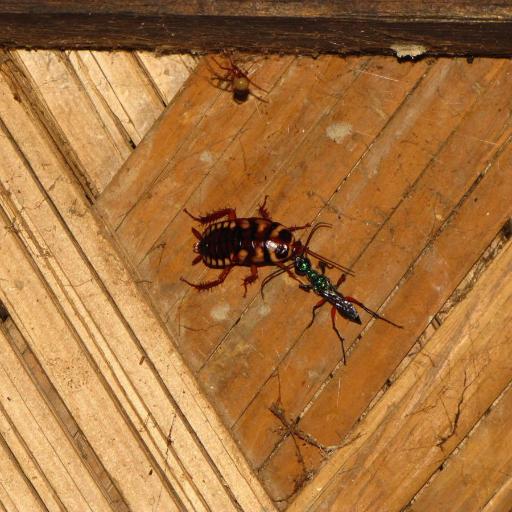
Often called the Emerald Cockroach Wasp or Jewel Wasp, this insect is a living gemstone of the arthropod world. Though you may have been searching for a plant, this creature is famous in the biological world for its stunning metallic armor and its "mind-control" abilities. It is a solitary hunter that plays a macabre but fascinating role in the tropical ecosystems of South Asia, Africa, and the Pacific Islands.
🔍 How to Identify
- ✨ Metallic Sheen: The entire body is a brilliant, iridescent blue-green that shifts color depending on how the light hits it.
- 🦵 Crimson Thighs: A key identifying feature is the bright reddish-orange color on the upper portions (femurs) of its second and third pairs of legs.
- 🐜 Slender Profile: It has a very thin, elongated waist and a flat, elegant head equipped with large, dark eyes and sensitive antennae.
🌲 Habitat & Ecology
- 🧪 The Surgeon’s Touch: This wasp is a parasitoid, meaning it uses a host to raise its young. It performs "brain surgery" on cockroaches, delivering a precise sting to the brain that removes the roach's "escape reflex" without killing it.
- 🏠 Tropical Hunter: You will typically find them in warm, humid environments where cockroaches are plentiful. They don't build large nests; instead, they use small crevices or holes in the ground as temporary nurseries for their larvae.
⚠️ Safety & Toxicity
- 🐝 Low Aggression: Unlike social wasps (like yellowjackets), the Jewel Wasp is solitary and has no colony to defend. It is generally shy and will fly away if approached.
- 🧤 The Sting: While it can sting a human if squeezed or handled roughly, the venom is designed for cockroach nervous systems, not mammals. For a human, the sting is minor—roughly equivalent to a small pinprick or a mild bee sting.
✨ Fun Fact
The Jewel Wasp doesn't actually carry its heavy prey to its burrow. After "zombifying" the cockroach, the wasp grabs the roach’s antennae and leads it to the hole like a dog on a leash, and the roach—having lost its will to resist—simply walks to its own doom!
More Details








