Info
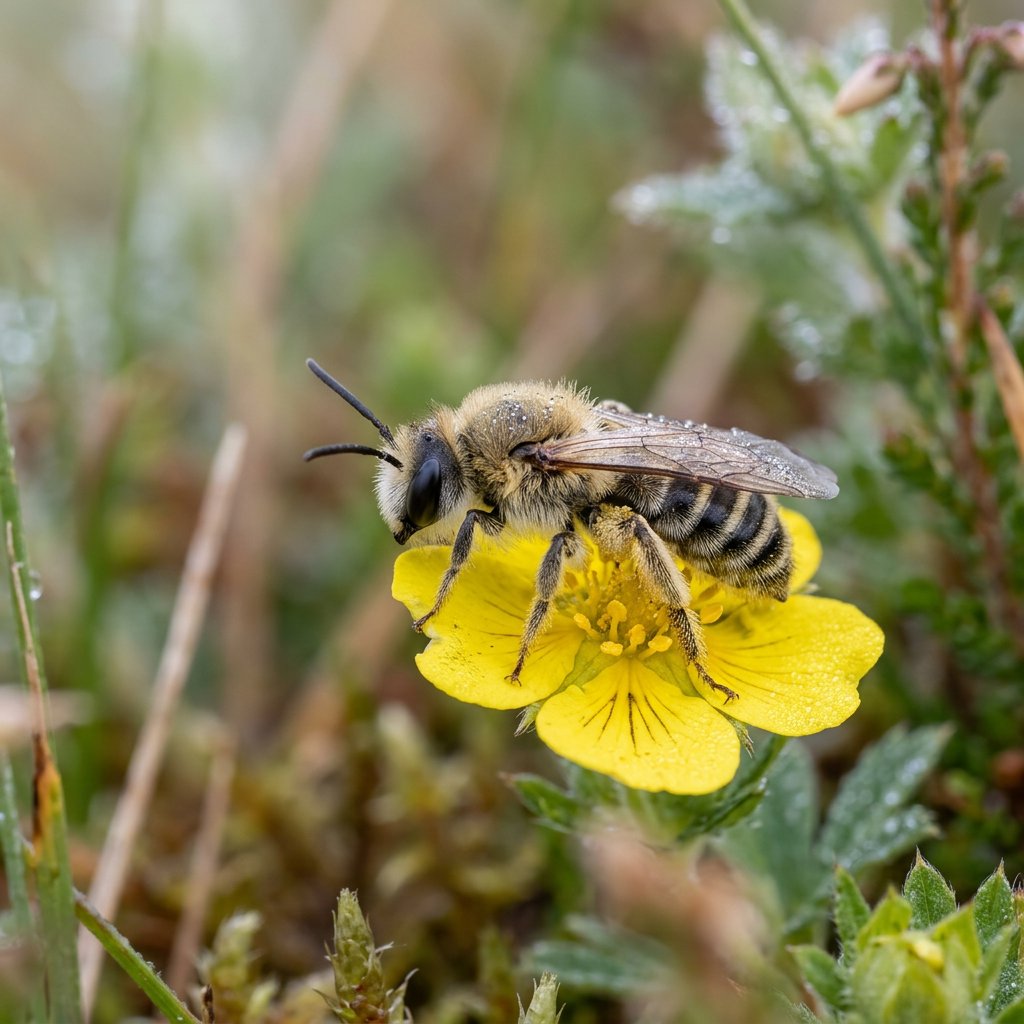
Meet the Tormentil Mining Bee, a tiny, hardworking specialist that plays a crucial role in heathland ecosystems. Often overlooked due to its small size, this bee is a "pollen specialist" with a very refined palate. You’ll rarely find it far from the bright yellow wildflowers it loves, making it a delightful find for any nature hiker or gardener in sandy regions.
🔍 How to Identify
- 🦵 The Pollen Baskets: The most distinctive feature of the female is the bright, orange-red hairs on her hind legs, used to carry pollen back to her burrow.
- 📏 Diminutive Stature: These are small bees, usually only 8–10mm long, with a sleek, dark black abdomen that can appear slightly shiny.
- 🐜 Low-Key Appearance: Unlike the fuzzy bumblebee, these mining bees have a slimmer, more "wasp-like" or "ant-like" silhouette, though they are covered in fine, dark hairs.
🌲 Habitat & Ecology
- 🌼 A Picky Eater: This bee is "oligolectic," meaning it is a specialist. It collects pollen almost exclusively from Tormentil (Potentilla erecta) and occasionally other members of the Rose family. If you find Tormentil, look closely—you might see this bee at work!
- 🏜️ Underground Living: As a mining bee, it nests in the ground. You might spot tiny "volcano-like" mounds of soil in sandy or acidic pathways, which are the entrances to their individual nurseries.
- 🤝 Solitary but Social: While they don't live in hives like honeybees, they are "gregarious," meaning many individuals may choose to build their separate burrows in the same sunny patch of dirt.
⚠️ Safety & Toxicity
- 🐝 Status: Extremely Safe: The Tormentil Mining Bee is a gentle, solitary creature. Because they don't have a queen or a massive honey store to defend, they have no reason to be aggressive toward humans or pets.
- 🤏 Weak Sting: While the females do possess a stinger, it is very small and used only in extreme self-defense (like being squeezed in a hand). For most people, the sting is barely noticeable compared to a honeybee or wasp.
✨ Fun Fact
The Tormentil Mining Bee is a master of timing! Its entire adult life cycle is synchronized perfectly with the blooming period of the Tormentil flower. If the flowers are late to bloom due to a cold spring, the bees stay tucked away in their underground burrows, waiting for the exact moment their favorite food source arrives.
More Details








