Info
Often called the Orange-striped Oakworm, this moth is a late-summer celebrity in the eastern United States. While their sudden appearance in large numbers can be startling—sometimes covering entire branches—they are fascinating native residents of our hardwood forests. They are best known for their dramatic "march" across the ground when they are ready to transform into moths.
🔍 How to Identify
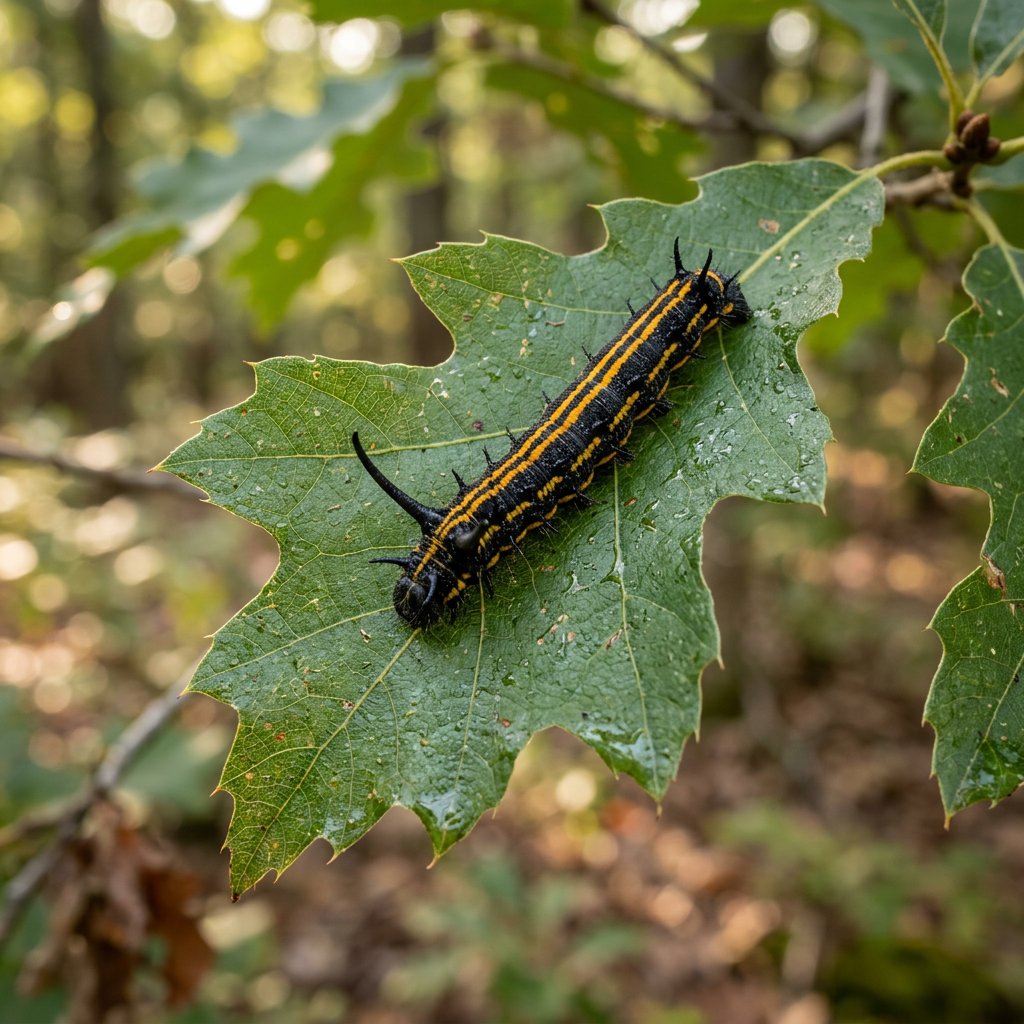
- 🐛 The Horns: The most striking feature is a pair of long, black, flexible filaments (horns) protruding from the segment just behind the head. They look prickly but are actually soft to the touch.
- 🎨 Striking Stripes: The caterpillar has a sleek, jet-black body decorated with eight bright orange or yellow longitudinal stripes running from head to tail.
- 🦋 The Adult Form: As a moth, it transforms into a warm, russet-orange creature with a distinct white dot on each forewing, perfectly camouflaged to look like a dried oak leaf.
🌲 Habitat & Ecology
- 🌳 Oak Specialists: As their name suggests, these insects are specialists. They feast almost exclusively on oak leaves, particularly Red, Pin, and White Oaks, often feeding in large, synchronized groups that can strip a branch in days.
- 🍂 The Underground Shift: Unlike many moths that spin cocoons in trees, these caterpillars crawl down to the forest floor in late summer. They burrow into the soil to pupate, staying underground all winter before emerging as moths the following June.
⚠️ Safety & Toxicity
- 🛡️ Harmless to Humans: Despite their "scary" black horns and prickly-looking spines, they are entirely harmless to humans and pets. They do not sting, bite, or possess the irritating stinging hairs found on some other caterpillars.
- 🍃 Tree Impact: While a heavy infestation can cause "defoliation" (loss of leaves), healthy, mature oaks usually recover without any long-term damage. You can usually just let them be, as they are an important food source for local birds.
✨ Fun Fact
In years when their population peaks, the sound of "frass" (caterpillar droppings) falling from the canopy onto the dry leaves below is so loud and rhythmic that it actually sounds like a gentle rain shower!
More Details








