Info
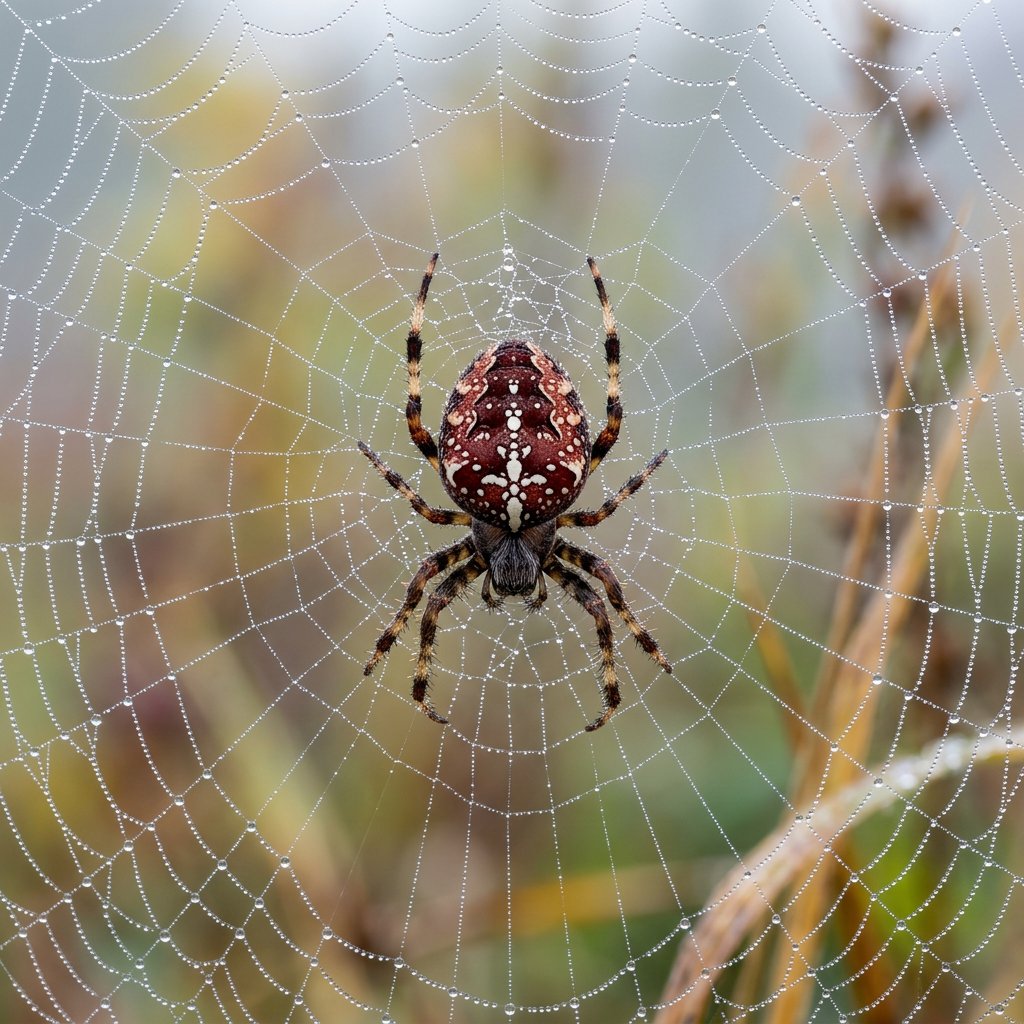
Known as the Cross Orb-weaver or European Garden Spider, this master architect is a staple of late-summer and autumn gardens. Often found hanging head-down in the center of an intricate, wheel-shaped web, it is a brilliant pest controller that has lived alongside humans for centuries. Its name, "Diadematus," refers to the regal, crown-like white markings on its back that resemble a crucifix.
🔍 How to Identify
- ✝️ The Signature Cross: The most identifying feature is a series of white or pale-yellow spots on the upper side of the abdomen that form a distinct cross shape.
- 🧶 Geometric Webs: They create large, vertical, wheel-like (orb) webs. If you see a perfectly symmetrical web between two bushes, it’s likely their handiwork.
- 🦵 Banded Legs: Their legs are covered in sensitive bristles and feature dark, alternating bands of color, which help them feel the slightest vibration of a trapped insect.
🌲 Habitat & Ecology
- 🦟 The Garden Guardian: These spiders are voracious eaters of flies, mosquitoes, and gnats. They play a vital role in keeping backyard pest populations in check without the need for chemicals.
- 🏗️ Nightly Recycling: To keep their "traps" sticky and strong, they often eat their old web every night to recycle the silk proteins before spinning a brand-new one in the morning.
- 🍂 Lifecycle: You are most likely to spot large females in the autumn when they are full of eggs. They hide their egg sacs in crevices or under bark to overwinter before the spiderlings emerge in spring.
⚠️ Safety & Toxicity
- 🛡️ Non-Aggressive: The Cross Orb-weaver is a shy creature. If disturbed, it will usually "vibrate" its web to look blurry or drop to the ground to hide rather than attack.
- 🩹 Minor Risk: While they are venomous (all spiders are!), their venom is designed for small insects. A bite is extremely rare and usually occurs only if the spider is squeezed. For humans and pets, the effect is typically milder than a bee sting, resulting in slight redness or itching.
✨ Fun Fact
In 1973, two Cross Orb-weavers named Arabella and Anita were sent into orbit on the Skylab 3 space station. Scientists wanted to see if they could spin webs in zero gravity; after a few clumsy attempts, both spiders successfully adapted and spun perfect geometric webs in space!
More Details








